Monday, September 17, 2012
The upgrades we’ve been performing on our kitchen, though not entirely cosmetic, have focused primarily on the various changes we can make to bring the area more inline with the rest of our home. Through building additional counter and storage space, and upgrading our counters to butcher block, we had taken a previously tired space and breathed in new life, but it still seemed something was missing.
The visual interest that a tile backsplash can bring to a kitchen was sorely lacking and incredibly obvious. This was only made more apparent once we finished our butcher block counters. Though we knew it would take a fairly significant level of effort to complete, we also knew that it was something we’d absolutely need to do.
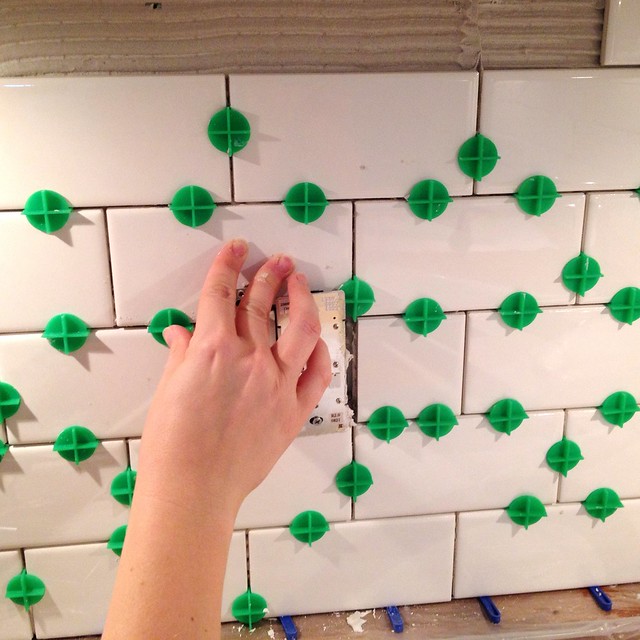
After significant debate, we finally landed on installing a 3” x 6” subway tile in a running bond style. This decision removed a huge weight from our shoulders as it meant a tile install that would be far more straightforward and involve fewer cuts than the more complex herringbone pattern we were also considering. With that decision and our completion of the Hardibacker install, Wendy and I were ready to move forward and begin tiling.
Before we begin our recap of this portion of the project, we can both tell you that television is a lying fool! If you watch HGTV, DIY Network, or any show where the homeowner works to "spruce up their place" and it includes fun and easy tiling...it's a load of crap. Tiling is a skill that's pretty easy to learn, but it's still something we find really stressful. The whole process is time consuming, you are constantly racing against the clock, you're typically having to make small and intricate cuts, what you do is almost immovable without significant effort just a few minutes after you put the tile in place, and when you're done at the end of the day, your hands are cracked, dry, and beaten. With that being said, it's totally DIY-able. We're just saying that you shouldn't be fooled by the television shows into thinking it's this quick, pain free, and easy process -- you need to know what to expect heading into it.
We kicked off the job with a little bit of prep work including tile saw set up, gathering supplies (sponges, buckets, 1/4" and 1/8” v-notch trowels, and taping knives), covering the counters with plastic to protect them from the thinset and water, and establishing a guide line to begin tiling from on the far right side of our counters.
Our plan was to work from right to left around the entire tileable area in a counter clockwise manner. This would allow us to start with the easy area and establish a good edge, and then finish in the harder area behind the stove and fridge.
If the first steps of any good tile job is the prep, the second is typically the mixing of the thinset. Though I’m by no means even close to a professional tile setter, I still have my brand preferences of thinset and grout based on previous experience. Personally, I like VersaBond for thinset, and Mapei’s Keracolor for grout (we’ll talk more about that when we get to the grouting phase). The thinset is a lightly modified thinset that stays workable for an adequate amount of time, but cures fully even in difficult curing applications. You can typically find the VersaBond at The Home Depot, and Keracolor grout at Lowes (which is a bit of a pain because they aren’t at both places).
Wendy and I have tiled a couple different areas of our house, and we’ve learned pretty much all we know using the excellent references and professionals that are willing to give free advice on the John Bridge tile community and forums. If you’re ever planning to undertake a DIY tiling job, or a bathroom job that includes tile or stone, be sure to check out these forums. They are invaluable with how much they are willing help out the novice DIYer with grand goals. We liked what we saw so much that we bought John Bridge’s book, Tile Your World. It’s an excellent reference for the aspiring beginner to advanced tile setter.
Okay, back to the thinset. There’s a bit of a trick to mixing up the thinset to be most effective, and it has to do with consistency. While the package tells us how much water to add to a full bag of thinset, we knew we’d only be mixing up smaller amounts (because we really aren’t fast enough to work with full bags, nor did the space require it). When this occurs, the best thing to do is break out the calculator and unit converter to determine how many cups of water we need per pound of mix, then get a small food scale to let us know just how many pounds of thinset we are mixing.
 Continue Reading Full Post

