I don't think Week of Alex II could possibly be considered complete without the inclusion of a particularly manly/geeky how to post, don't you agree? Well, I've surely got one for you.
When we talk to friends and neighbors about our house, or even to people we've just met that are blog readers, one of the most frequent topics of conversation revolves around our whole house audio. Whether they're interested in having it in their home, or are just curious how it works, for many (myself included), the idea of room filling music at your fingertips anywhere in your house is an absolutely awesome concept. While there are many different options out there that involve the placement of speakers and other devices in obvious places within the room where you want music, most people are far more drawn to the idea of built in speakers and controls that blend and disappear in the room.
I'll tell you one thing for sure, it doesn't matter how much we like music, if the device that delivered the music looked like a giant piece of furniture, there's no way Wendy would go for it (but I might, just sayin'). As cool as it may look, our house isn't Mad Men.
I'd say the thing I hear most often during conversations is "I'd love integrated music, but I just don't know where to start when running wires or installing a speaker. Is it hard?"
My response to this question is typically, "Well, in general, it's not hard at all, but in your house, it could be."
The key here is the distinction between running wires and installing a speaker. Running wires can be very easy or very hard, depending on where you're running them. If you're doing it on the top floor and have access to the back of the ceiling via the attic and you have the necessary electrical in the attic, it can be very easy. If you're trying to run them in a ceiling that has no access from above and is fully insulated, possibly with spray foam, it can be ridiculously hard. Bottom line, it's a case by case basis and you often won't know your case until you start poking holes in the walls or ceiling.
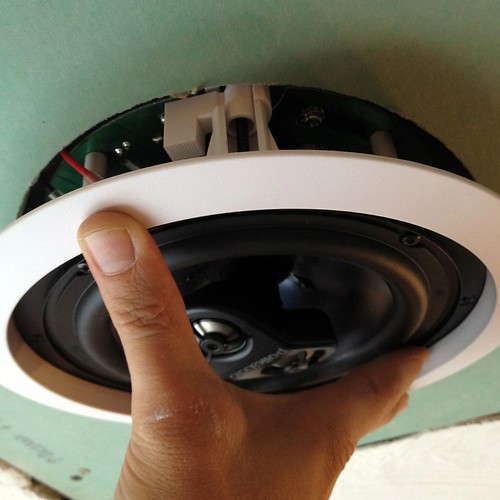
All of this being the said, installing a speaker when the wires have been run to the necessary location, purely child's play. No, really, if you've already gotten your wires where they need to be, you've got yourself a DIY task anyone can handle.
Over the weekend I found myself jumping forward several steps (and maybe getting ahead of myself) so that I could feel like I was actually accomplishing something. I decided I wanted to patch a rather large hole I had created months ago with the intention of installing a speaker. The hole is just in front of our bathroom window and was once the location of an HVAC vent. We're moving the HVAC location and are placing a speaker in its place.
Since I was installing this in a plaster ceiling and in a place that already had a large hole, I had to be a little more destructive than you typically need to be. A speaker install needs a perfectly round hole and the wall material can't be much more than 3/4 inch thick to accommodate the mounting brackets. Because of these restrictions, the fact that old plaster and lath is nearly impossible to make a round hole in without the edges cracking and crumbling, and the tendency for plaster thickness to be variable (up to and over 1 inch), I had no option other than to make a larger hole that I could patch with drywall.
This speaker is getting installed in a location where I've had extensive access while installing all of the attic insulation, so I took advantage of this access by running the wires necessary for this speaker prior to completing the insulation.
 Continue Reading Full Post

