I don't know about you, but it's been one heck of a week. Long hours, hectic days, and all things that point to the reward of a good cocktail come Friday night. So this got me thinking -- what refreshment would I like in my hand as I toast to a tough week behind me, as well as would make a refreshing beverage for the upcoming July 4th holiday? The clear winner: Lemonade Coolers.
In my family, it's a running joke that people steal other family members' recipes, and pass them off as their own under a new name. We busted my Aunt Judy for her "Aunt Judy's Chess Noels" (which are actually chess cookies), and I'm going to out myself for the Lemonade Cooler. This delectable drink is known by my Aunt Margie's family on Christmas day as "Whiskey Sours." But, I just don't feel that the name does the drink justice, nor does it allude to the thirst quenching summer inspired main ingredient of lemonade.
So how do you make this fine adult beverage? Simple! Just follow these steps, demonstrated in the photos below by my Aunt Margie.
Lemonade Coolers
Ingredients:
- 12 oz can of frozen lemonade (regular or pink, depending on personal preference)
- 6 oz Seagram's 7 Whiskey
- Ice
- Diet or regular 7 UP
Directions:
 Continue Reading Full Post
As working parents, Alex and I face the concern that I'm sure most pet parents face on a daily basis. We hope that our furry and four legged babies are at home being calm, well behaved, and relaxed. At the same time, we fear they are getting into trouble, eating or drinking off limits items, or generally misbehaving. Overall, Lulu and Mel are great kids, but as parents, we naturally worry.
Mel is going on 11 years old and has been well behaved his whole life. Aside from the occasional chewed plant, furball, or knocked over table item, Mel has been as easy of a cat as you can imagine.
 Continue Reading Full Post
Like many older homes, one of the key period pieces in our home is the transom windows that still exist over most of the house's doorways. Strictly a utilitarian feature of historic architecture, transom windows were used to both allow additional light into or out of a room, and to allow easier passage of heat or cool air to flow between rooms. Though offering utility in their implementation, their classic looks are a signature element of our home that we've painstakingly cared for and restored.
Throughout the renovation of our entry hallway and vestibule, we've been working to bring the charm and historic accuracy back to our entryway, including a full restoration of the transom above the interior front door. We're lucky enough to have the original and unbroken wavy glass in this transom window, a feature that is often hit or miss throughout older homes. When the sunlight comes in through this window, the light is slightly distorted by the uneven glass and looks quite nice on the walls or floor. However, this transom was not an operable transom window, meaning it did not open to allow the passage of air.
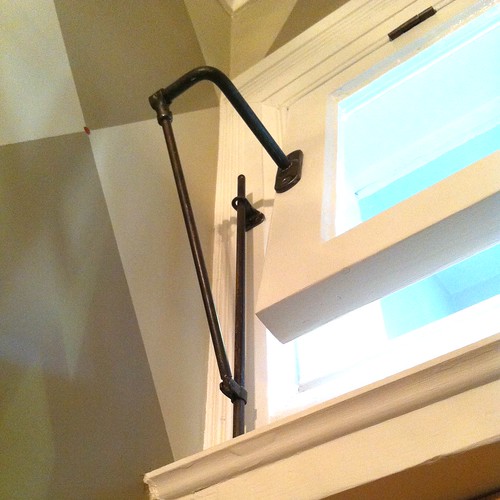
Typically, transom windows were configured in a way that would allow a person to open them when they wanted to let heat flow between rooms, or to allow the creation of a draft to cool the home. The mechanisms to allow opening of transoms were fairly vast in their construction and styles. There were bottom hinged transoms with latches and chains that had a long pole to pull the latch open, side hinged transoms that opened like doors, and top hinged transoms with fixed lifts that could be hand operated.
However, the transom above our front door was a "fixed" transom, and did not open in any way. Below is a photo of our window from early on in our renovation process, with all of its bumpy paint intact.
 Continue Reading Full Post
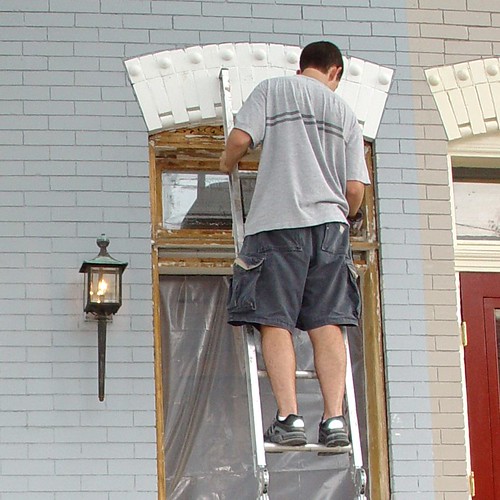
Our seemingly endless efforts to strip the paint in our home have led to years of trial and error experiences until we found the tools that really work well for our purposes. Today's Toolbox Tuesday will cover the tools we use that are must haves when stripping layers of old paint.
Yesterday we covered our fortunate salvage yard find of several paint covered doors. We were lucky to find just what we needed. (That rarely happens in a single stop.) However, our find was only the first step in a long restoration process. The doors were covered in flaking and thick layers of paint, and before we would be able to hang and paint the doors, we would need to strip them.
We're actually old pros at paint stripping at this point. We've been stripping paint off of various items in our house since day one -- baseboards, molding, doors, hinges -- just about anything that had thick layers of paint that hid the details or impaired function has been on our lengthy paint removal list. We have our favorite methods and chemicals for paint removal, but the things that actually make the biggest difference in our paint stripping are the tools we use to do it.
 Continue Reading Full Post
One of the things that we have the privilege of enjoying by owning an old home is the adventure of searching through salvage yards for items that "work" with the age and style of our home. When many people visit salvage yards, they are looking for something cool and old that they can use as a re-purposed decorative piece for their home to become a focal point of a room or provide some unique visual interest. Perhaps an old window sash that can be hung on the wall, an old door that can become a headboard, or door hardware that can turn into something like a towel hook or coat rack.
When Alex and I go to salvage yards, we're often looking for old windows, doors, or hardware that match the style of our house. We have a specific age, construction, or look we're trying to establish. We want most of our salvage yard finds to blend in with our house and look like they've been there since the house was built, and sometimes we'll spend years searching for an item before persistence meets luck, and we find it.
A significant feature of our vestibule/curb appeal overhaul involves the need to reconfigure the entryway doors. When the vestibule was "renovated" in the 1980s, the main entry door was moved to the outside entry of the house, and double doors were placed where the original front door resided. This change caused several problems with our entryway:
 Continue Reading Full Post

