<?xml version="1.0" encoding="utf-8"?>
<feed xmlns="http://www.w3.org/2005/Atom" xmlns:media="http://search.yahoo.com/mrss/">
  <title>Old Town Home Category: 'Tile'</title>
  <updated>2014-09-12T12:51:00.000-04:00</updated>
  <id>http://www.oldtownhome.com/tile/index.atom</id>
  <link rel="alternate" href="http://www.oldtownhome.com/tile/index.atom" />
  <author>
    <name>Alex and Wendy</name>
    <uri>http://www.oldtownhome.com/</uri>
    <email>wendy@oldtownhome.com</email>
  </author>
  <entry>
    <guid>5d562c4e-35f3-4d33-985a-4660c14ca2ba</guid>
    <id>https://www.oldtownhome.com/2014/9/12/The-Subway-Tiling-Train-is-Chugging-Along/</id>
    <title>The Subway Tiling Train is Chugging Along</title>
    <summary type="html"><![CDATA[<p>We have been tiling machines of late. </p><p>Well, when I say "machines" what I'm really saying is that we're tiling machines that are old and slow, but apparently still work sometimes and eventually get the job done. </p><p>I guess if we're trying to draw a comparison, we're less like...</p><p>
</p><div class="MediaContainer PhotoContainer"><a href="https://farm4.staticflickr.com/3874/15030152340_d92576cea1_z.jpg" rel="PhotoPopup" popupheight="300" popupwidth="630"><img alt="" src="https://farm4.staticflickr.com/3874/15030152340_d92576cea1.jpg" width="500" height="238" style="border-width: 0px; border-style: solid;"></a></div><p>...and more like...</p><p>
</p> <a href="https://www.oldtownhome.com/2014/9/12/The-Subway-Tiling-Train-is-Chugging-Along/">more</a>]]></summary>
    <published>2014-09-12T12:51:00.000-04:00</published>
    <updated>2014-09-12T12:51:00.000-04:00</updated>
    <link rel="alternate" href="https://www.oldtownhome.com/2014/9/12/The-Subway-Tiling-Train-is-Chugging-Along/" />
    <author>
      <name>Alex</name>
    </author>
    <content type="html"><![CDATA[<p>We have been tiling machines of late. </p>
<p>Well, when I say "machines" what I'm really saying is that we're tiling machines that are old and slow, but apparently still work sometimes and eventually get the job done. </p>
<p>I guess if we're trying to draw a comparison, we're less like...</p>
<p>
</p>
<div class="MediaContainer PhotoContainer"><a href="https://farm4.staticflickr.com/3874/15030152340_d92576cea1_z.jpg" rel="PhotoPopup" popupheight="300" popupwidth="630"><img alt="" src="https://farm4.staticflickr.com/3874/15030152340_d92576cea1.jpg" width="500" height="238" style="border-width: 0px; border-style: solid;" /></a></div>
<p>...and more like...</p>
<p>
</p>
<div class="MediaContainer PhotoContainer"><a href="https://farm4.staticflickr.com/3909/15216844245_4334b9bd61_z.jpg" rel="PhotoPopup" popupheight="514" popupwidth="640"><img alt="" src="https://farm4.staticflickr.com/3909/15216844245_4334b9bd61.jpg" width="500" height="402" style="border-width: 0px; border-style: solid;" /></a></div>
<p>...in the whole "machine" department. I guess it fits better with the age of our house.</p>
<p>Fair enough? Hey, we're still machines, you can't take that away from us. </p>
<p>
</p>
<div class="MediaContainer PhotoContainer"><a href="https://farm6.staticflickr.com/5587/15120037311_286355ea9e_z.jpg" rel="PhotoPopup" popupheight="480" popupwidth="640"><img alt="" src="https://farm6.staticflickr.com/5587/15120037311_286355ea9e.jpg" width="500" height="375" style="border-width: 0px; border-style: solid;" /></a></div>
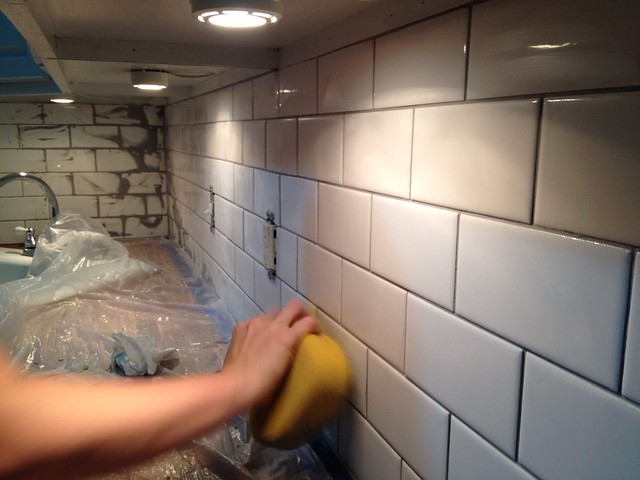
<p>What I'm trying to say is that we've been slowly tackling the tiling of our shower walls over the last week and a half, getting about a quarter to half a wall done at a time. There are so many corners and cuts we have to make that it's just sort of a slow go of it. Nonetheless, it still feels great, and I keep going into the room to stare at the bits that are done (usually closing one eye and blocking the parts that are not done with my left hand).</p>
<p>For our project we're placing the tile on the wall using setting type thinset with a 1/16" grout joint. Now this is a major debate for some people, but trust me, friends don't let friends use anything other than the powder mix bags of thinset. I've said it before, and I'll say it again.</p>
<p>I don't care how many will swear by the use of the pre-mixed bucket types of thinset when sticking their tiles on the wall, but we're not doing that. Pre-mixed thinset never fully cures and can re-activate when it comes in contact with water. Since stone and grout are porous, you'd only use pre-mixed stuff in a shower if you really don't mind your tiles possibly falling off the wall and grout cracking. And if you don't mind that...well...wtf is your problem? Am I Right?</p>
<p>
</p>
<div class="MediaContainer PhotoContainer"><a href="https://farm4.staticflickr.com/3897/14937001237_5ac6062cf8_z.jpg" rel="PhotoPopup" popupheight="480" popupwidth="640"><img alt="" src="https://farm4.staticflickr.com/3897/14937001237_5ac6062cf8.jpg" width="500" height="375" style="border-width: 0px; border-style: solid;" /></a></div>
<p>But I digress.</p>
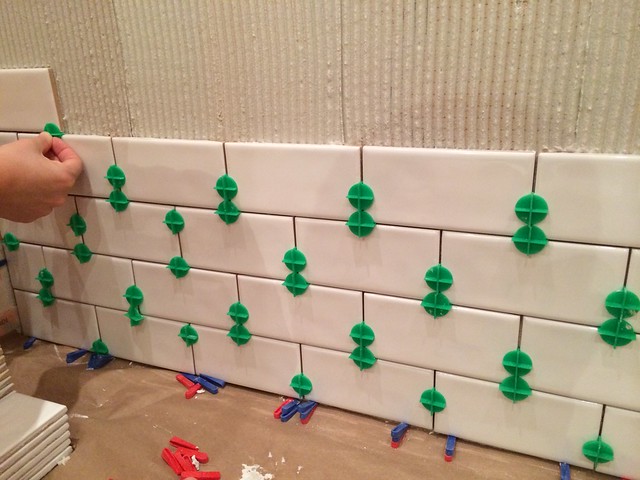
<p>Since our tiles don't have those awesome lugs that let us butt each one against the other, we're using the hated green spacers again. You know the ones. We swore to <a href="http://www.oldtownhome.com/2012/9/17/Swearing-and-Tiling-Tiling-and-Swearing/">never ever use these spacers again after our kitchen work</a>. It seems like for every one spacer you successfully place, five fall out. It's one of those DIY challenges that tests your ability to stay sane, married, and out of jail for unspeakable acts of rage against tile spacers. Not to mention when the spacer itself is screwed up and wasn't cut right.</p>
<p>
</p>
<div class="MediaContainer PhotoContainer"><a href="https://farm4.staticflickr.com/3839/15122782122_154ac69a18_z.jpg" rel="PhotoPopup" popupheight="480" popupwidth="640"><img alt="" src="https://farm4.staticflickr.com/3839/15122782122_154ac69a18.jpg" width="500" height="375" style="border-width: 0px; border-style: solid;" /></a></div>
<p>The issue with these little green bastards is that their leg isn't long enough and the tile can't really bite onto them, which allows them to jump from their location at will. Yes, the tile spacers hate themselves and what they stand for so much that they all try to commit suicide. These spacers have many issues, to say the least.</p>
<p>
</p>
<div class="MediaContainer PhotoContainer"><a href="https://farm6.staticflickr.com/5551/14880626067_60079d65b4_z.jpg" rel="PhotoPopup" popupheight="480" popupwidth="640"><img alt="" src="https://farm6.staticflickr.com/5551/14880626067_60079d65b4.jpg" width="500" height="375" style="border-width: 0px; border-style: solid;" /></a></div>
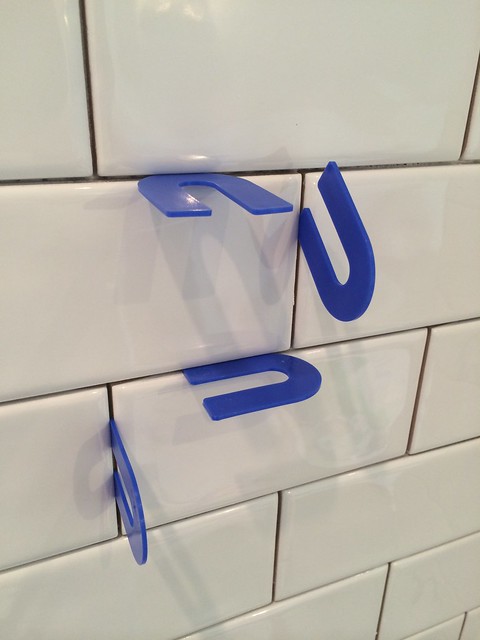
<p>I actually found a much better 1/16" spacer option that's sure to work a million times better. They are large horseshoe shaped 1/16" plastic pieces that can far more easily be secured against the tile base. However, we received them after we started tiling, and we had already started with the green idiots. As it turns out, the spacing is juuuuuuust a little different with these horseshoes, so we had to stick with the one we hate. The devil you know...right?</p>
<p>
</p>
<div class="MediaContainer PhotoContainer"><a href="https://farm4.staticflickr.com/3893/15030447807_afd41c3d5c_z.jpg" rel="PhotoPopup" popupheight="640" popupwidth="480"><img alt="" src="https://farm4.staticflickr.com/3893/15030447807_afd41c3d5c.jpg" width="375" height="500" style="border-width: 0px; border-style: solid;" /></a></div>
<p>It pained me to use the old green ones. I sort of can't wait for our next tile job so we can use these new ones and then just talk bad about the green jerks behind their backs. </p>
<p>Okay, back to tiling and away from ranting about spacers again. The layout we're using in our subway tile is a standard running bond pattern. Remember, we're looking for basic and classic in our bathroom. </p>
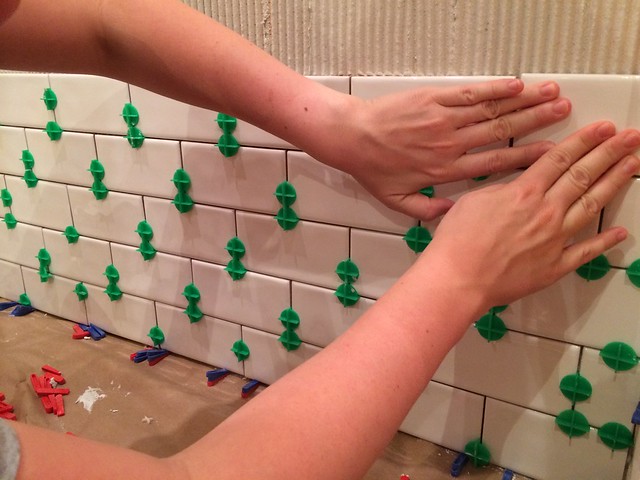
<p>With this pattern, as we put each tile on the wall we smoosh it into the thinset real good, then immediately support either side of the base with a spacer.</p>
<p>
</p>
<div class="MediaContainer PhotoContainer"><a href="https://farm4.staticflickr.com/3912/14880593648_3b970525cd_z.jpg" rel="PhotoPopup" popupheight="480" popupwidth="640"><img alt="" src="https://farm4.staticflickr.com/3912/14880593648_3b970525cd.jpg" width="500" height="375" style="border-width: 0px; border-style: solid;" /></a></div>
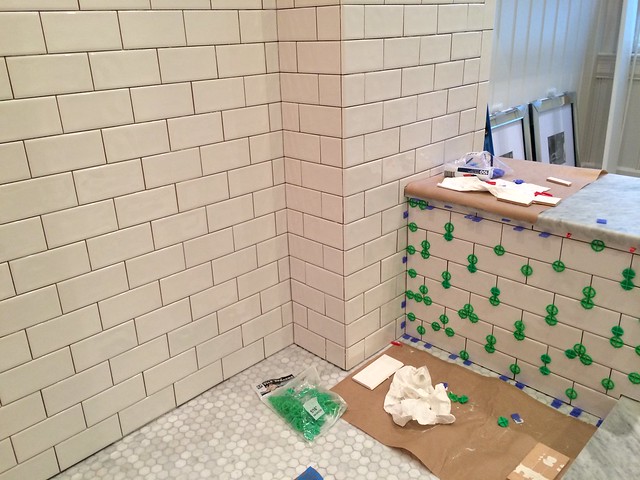
<p>Then we place the next tile in the same manner, pop a spacer into the gap between the two tiles, then one of the spacers from the first tile to support the base of both tiles. As long as the tile size is relatively consistent, this approach gives you a consistent line and saves on the number of spacers you use. </p>
<p>One major benefit of tiling in our home, my butt and legs are really starting to get in great shape!</p>
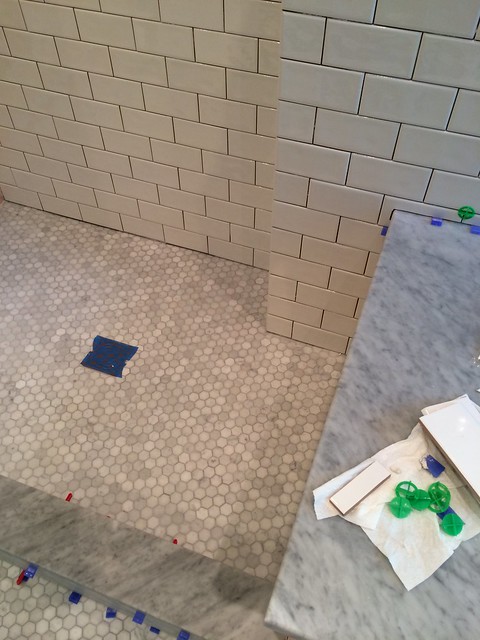
<p>Yes, I'll save you the trip to the header to double check who is writing this post, this is Alex. Are you wondering why my butt and legs are in good shape, or why I'm even talking about it? I thought you might be. You see, as I said, we have a whole lot of cuts in this project. We're trimming the corners, trimming the base slightly in some areas, trimming at the ceiling, and making crazy cuts all over the place where necessary. Like this one around the bench.</p>
<p>
</p>
<div class="MediaContainer PhotoContainer"><a href="https://farm4.staticflickr.com/3889/15114623096_d5a29bd171_z.jpg" rel="PhotoPopup" popupheight="480" popupwidth="640"><img alt="" src="https://farm4.staticflickr.com/3889/15114623096_d5a29bd171.jpg" width="500" height="375" style="border-width: 0px; border-style: solid;" /></a></div>
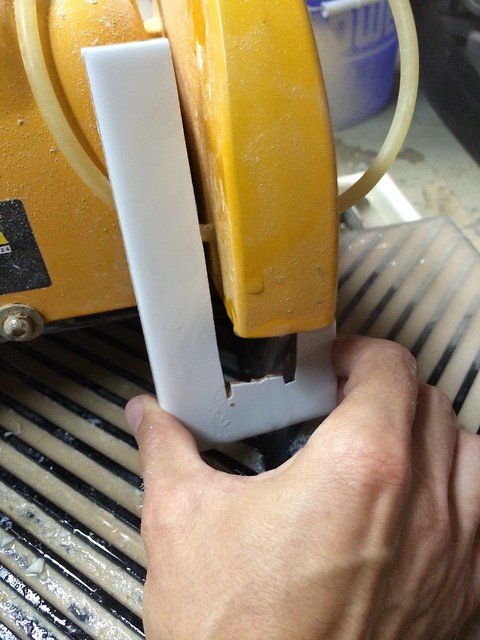
<p>The thing is, our tile saw is a messy water spraying proposition. It shoots water and tile dust backwards, forwards, and sideways. So its use is relegated to the basement only. That means each cut I have to make requires me to mark the tile or toe that need cuts, then walk down two flights of stairs where I can then crouch on the basement floor like a Neanderthal tile setter to cut my tile. </p>
<p>
</p>
<div class="MediaContainer PhotoContainer"><a href="https://farm4.staticflickr.com/3902/14951016898_8ff1f6d2f7_z.jpg" rel="PhotoPopup" popupheight="640" popupwidth="480"><img alt="" src="https://farm4.staticflickr.com/3902/14951016898_8ff1f6d2f7.jpg" width="375" height="500" style="border-width: 0px; border-style: solid;" /></a></div>
<p>Then I walk back up the two flights of stairs and deliver the cut tiles to my beautiful tiling wife, who may then set them on the wall while I make my next trip down to the dungeon. </p>
<p>
</p>
<div class="MediaContainer PhotoContainer"><a href="https://farm4.staticflickr.com/3879/15141827142_e2a1333018_z.jpg" rel="PhotoPopup" popupheight="480" popupwidth="640"><img alt="" src="https://farm4.staticflickr.com/3879/15141827142_e2a1333018.jpg" width="500" height="375" style="border-width: 0px; border-style: solid;" /></a></div>
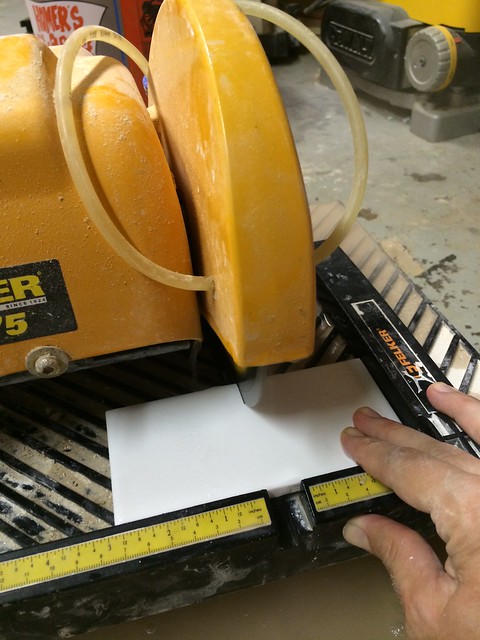
<p>Sometimes, when I really get lucky, I don't cut the tile to the right length, and I have to go back down a second...or even a third time to cut the thing. This is what I do in the name of getting the tile as close to perfect as we can. </p>
<p>
</p>
<div class="MediaContainer PhotoContainer"><a href="https://farm4.staticflickr.com/3897/14985860928_eef9d227ce_z.jpg" rel="PhotoPopup" popupheight="640" popupwidth="480"><img alt="" src="https://farm4.staticflickr.com/3897/14985860928_eef9d227ce.jpg" width="375" height="500" style="border-width: 0px; border-style: solid;" /></a></div>
<p>At the end of a weekend day of tiling, I sat in a heap on the couch and wondered why my legs were so tired. Then I realized my ridiculous setup had forced me to turn my house into a Victorian era stair master. </p>
<p>All the while, this is the view we have into the bedroom.</p>
<p>
</p>
<div class="MediaContainer PhotoContainer"><a href="https://farm4.staticflickr.com/3861/14985773830_79ba16fcf8_z.jpg" rel="PhotoPopup" popupheight="640" popupwidth="480"><img alt="" src="https://farm4.staticflickr.com/3861/14985773830_79ba16fcf8.jpg" width="375" height="500" style="border-width: 0px; border-style: solid;" /></a></div>
<p>Anyhow, back to the tile. </p>
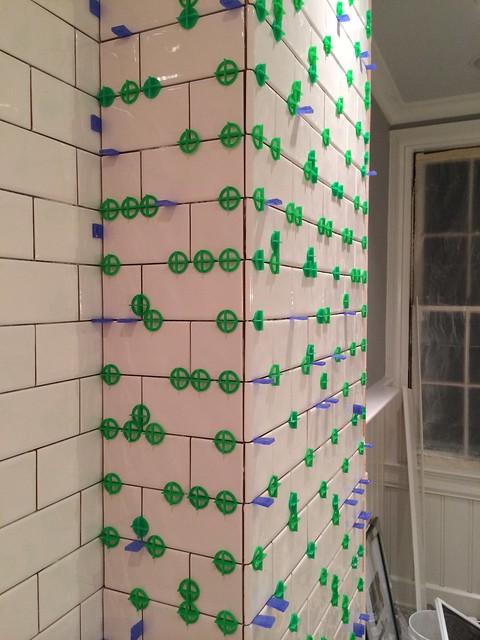
<p>We've opted to finish the transition areas of our tile with a vertical bullnose border of sorts. This is a pretty typical look and saves on the cost associated with standard bullnose. But the tile assumes a 1/8" spacing, rather than 1/16", so the long bullnose had to all be trimmed by 1/16" on each one. But the one inside corner of the shower will get bullnose on the short side of the tile so that the whole thing looks a little more cohesive.&nbsp;</p>
<p>
</p>
<div class="MediaContainer PhotoContainer"><a href="https://farm4.staticflickr.com/3894/14940961688_dc4a70b629_z.jpg" rel="PhotoPopup" popupheight="640" popupwidth="480"><img alt="" src="https://farm4.staticflickr.com/3894/14940961688_dc4a70b629.jpg" width="375" height="500" style="border-width: 0px; border-style: solid;" /></a></div>
<p>The main thing about these little bullnose tiles is that we have to back butter them to ensure good coverage all of the way to the corner.</p>
<p>
</p>
<div class="MediaContainer PhotoContainer"><a href="https://farm6.staticflickr.com/5572/14936220547_8b8630c23b_z.jpg" rel="PhotoPopup" popupheight="640" popupwidth="480"><img alt="" src="https://farm6.staticflickr.com/5572/14936220547_8b8630c23b.jpg" width="375" height="500" style="border-width: 0px; border-style: solid;" /></a></div>
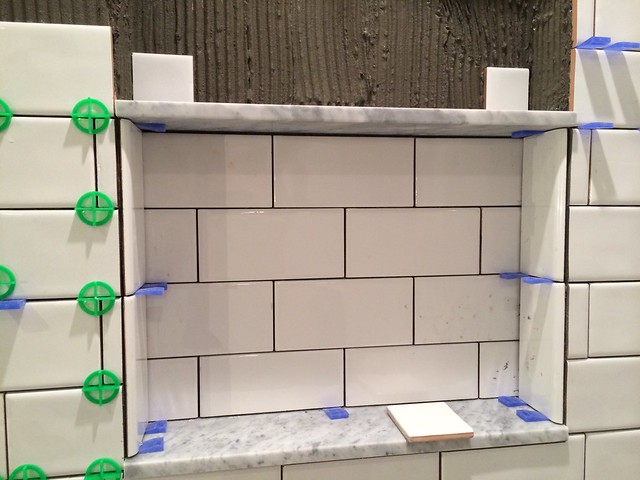
<p>The other interesting part of the shower is the niche. Seriously, what's a modern day shower without some sort of a niche. We decided to use pieces of marble for the shelves while continuing the tile pattern through the niche's background. Also, most people put a bullnose border of sorts on the exterior of the niche, but we don't prefer this look. Instead, we've put the bullnose border on the interior of the niche, using the bullnose and a good notch on the tile to actually support the second shelf on three sides.</p>
<p>
</p>
<div class="MediaContainer PhotoContainer"><a href="https://farm4.staticflickr.com/3911/15183742346_8e59e9e13e_z.jpg" rel="PhotoPopup" popupheight="480" popupwidth="640"><img alt="" src="https://farm4.staticflickr.com/3911/15183742346_8e59e9e13e.jpg" width="500" height="375" style="border-width: 0px; border-style: solid;" /></a></div>
<p>There are a few areas I'm not entirely happy with on the niche and I need to figure out if it will look better once grouted, or if I should take out the offending tiles and redo them. We shall see.</p>
<p>Let's check on the peanut gallery and see what they think of the project.</p>
<p>
</p>
<div class="MediaContainer PhotoContainer"><a href="https://farm4.staticflickr.com/3902/14940495389_8284472ef4_z.jpg" rel="PhotoPopup" popupheight="640" popupwidth="480"><img alt="" src="https://farm4.staticflickr.com/3902/14940495389_8284472ef4.jpg" width="375" height="500" style="border-width: 0px; border-style: solid;" /></a></div>
<p>Yep, still about the same response we usually get.</p>
<p>I am very proud of one thing in particular. When you order tile you typically add 15% for "cuts and breakage." That calculation is based on installers who don't typically plan out how to most effectively use the tile, and are also a bit more rough and cause more breaks. However, we've only broken 1 piece, and we have been extremely conservative in our tile cuts. This means that we were able to return two full boxes of tile, a total of 22 square feet of extra. Our tile cut area looked like this the whole time.</p>
<p>
</p>
<div class="MediaContainer PhotoContainer"><a href="https://farm4.staticflickr.com/3908/14937958569_9bf9a72441_z.jpg" rel="PhotoPopup" popupheight="640" popupwidth="480"><img alt="" src="https://farm4.staticflickr.com/3908/14937958569_9bf9a72441.jpg" width="375" height="500" style="border-width: 0px; border-style: solid;" /></a></div>
<p>Little slivers all over the place and no raw edge left unused. This meant that we were able to get about $160 back for the return. So our total cost for tile came in at just under $1,000. Not too shabby if you ask me.</p>
<p>We've got a few more pieces to put in before we can move onto grouting, but Wendy and I are both getting really excited by our progress. We'll probably have a four to six week wait for shower glass before it's a real shower, but we can feel the bathroom momentum train running at a decent speed ahead. And we think it's sure looking good.</p>
<p>
</p>
<div class="MediaContainer PhotoContainer"><a href="https://farm4.staticflickr.com/3878/14951356908_18e4ee9c4f_z.jpg" rel="PhotoPopup" popupheight="640" popupwidth="480"><img alt="" src="https://farm4.staticflickr.com/3878/14951356908_18e4ee9c4f.jpg" width="375" height="500" style="border-width: 0px; border-style: solid;" /></a></div>
<p>What do you think? Does the tile look like it belongs in the shower? Are you as excited as we are about being done? Probably not, but you might be so sick of hearing us talk about it that you just want it to be all over and done with! I agree.</p><p><a href="https://www.oldtownhome.com/2014/9/12/The-Subway-Tiling-Train-is-Chugging-Along/">Read Full Post</a></p>]]></content>
    <category term="Header Image" />
    <category term="Master Bathroom" />
    <category term="Tile" />
    <PostImage>https://farm6.staticflickr.com/5561/15030756950_9f9a9449ce.jpg</PostImage>
    <media:thumbnail url="https://farm6.staticflickr.com/5561/15030756950_9f9a9449ce_t.jpg" />
    <ExtensionElements>
      <Item>PostImage</Item>
      <Item>media:thumbnail</Item>
    </ExtensionElements>
  </entry>
  <entry>
    <guid>3f153ae0-0fb4-442e-8e0c-eaab6e2f5700</guid>
    <id>https://www.oldtownhome.com/2014/8/29/Not-All-Subway-Tile-is-Created-Equal/</id>
    <title>Not All Subway Tile is Created Equal</title>
    <summary type="html"><![CDATA[<p>I think the search for finish materials is possibly one of the more difficult aspects of a bathroom renovation. </p><p>Yes, in spite of all of the other complex, planning, and pain in the butt items, I'm totally serious. When you look at even a "simple" overhaul, you're still changing just about every major surface in a bathroom, and all of those surfaces have to come from somewhere. </p><p>
</p><div class="MediaContainer PhotoContainer"><a href="https://farm4.staticflickr.com/3825/12097009766_bd676d071f_z.jpg" rel="PhotoPopup" popupheight="421" popupwidth="640"><img alt="" src="https://farm4.staticflickr.com/3825/12097009766_bd676d071f.jpg" width="500" height="329" style="border-width: 0px; border-style: solid;"></a></div><p>In our case, by the time we're done with the bathroom, we'll have had to source wainscoting, floor tile, shower tile, hardware, fixtures, wall panelling for the closet, a vanity, a tub (got that one done 10 years ago), shower glass, crown molding, trim details, and so many little odds and ends that it's hard to wrap my mind around the whole thing. (Wendy is now reminding me that list doesn't even include any of the accessories, curtain fabric, or the eternally important paint color.)</p><p>Overall, we've been pretty lucky. We've knocked out each selection step by step, in a sometimes last minute, but typically cost conscious manner that has ended up with pretty great results. The only thing we've had to grow to like was the bead size on the beadboard wainscoting. However, there are two major items still on our list that have been giving us some major heartburn, the shower tile and the vanity (and other misc) marble. </p><p>We've long been pondering our shower tile, but one thing has been certain all along, we want subway tile. The problem today is, subway is not always just plain old subway tile. Confusing enough? </p> <a href="https://www.oldtownhome.com/2014/8/29/Not-All-Subway-Tile-is-Created-Equal/">more</a>]]></summary>
    <published>2014-08-29T08:58:00.000-04:00</published>
    <updated>2014-08-29T08:58:00.000-04:00</updated>
    <link rel="alternate" href="https://www.oldtownhome.com/2014/8/29/Not-All-Subway-Tile-is-Created-Equal/" />
    <author>
      <name>Alex</name>
    </author>
    <content type="html"><![CDATA[<p>I think the search for finish materials is possibly one of the more difficult aspects of a bathroom renovation. </p>
<p>Yes, in spite of all of the other complex, planning, and pain in the butt items, I'm totally serious. When you look at even a "simple" overhaul, you're still changing just about every major surface in a bathroom, and all of those surfaces have to come from somewhere. </p>
<p>
</p>
<div class="MediaContainer PhotoContainer"><a href="https://farm4.staticflickr.com/3825/12097009766_bd676d071f_z.jpg" rel="PhotoPopup" popupheight="421" popupwidth="640"><img alt="" src="https://farm4.staticflickr.com/3825/12097009766_bd676d071f.jpg" width="500" height="329" style="border-width: 0px; border-style: solid;" /></a></div>
<p>In our case, by the time we're done with the bathroom, we'll have had to source wainscoting, floor tile, shower tile, hardware, fixtures, wall panelling for the closet, a vanity, a tub (got that one done 10 years ago), shower glass, crown molding, trim details, and so many little odds and ends that it's hard to wrap my mind around the whole thing. (Wendy is now reminding me that list doesn't even include any of the accessories, curtain fabric, or the eternally important paint color.)</p>
<p>Overall, we've been pretty lucky. We've knocked out each selection step by step, in a sometimes last minute, but typically cost conscious manner that has ended up with pretty great results. The only thing we've had to grow to like was the bead size on the beadboard wainscoting. However, there are two major items still on our list that have been giving us some major heartburn, the shower tile and the vanity (and other misc) marble. </p>
<p>We've long been pondering our shower tile, but one thing has been certain all along, we want subway tile. The problem today is, subway is not always just plain old subway tile. Confusing enough? </p>
<p>
</p>
<div class="MediaContainer PhotoContainer"><a href="https://farm6.staticflickr.com/5559/15071830622_d64514a53e_z.jpg" rel="PhotoPopup" popupheight="480" popupwidth="640"><img alt="" src="https://farm6.staticflickr.com/5559/15071830622_d64514a53e.jpg" width="500" height="375" style="border-width: 0px; border-style: solid;" /></a></div>
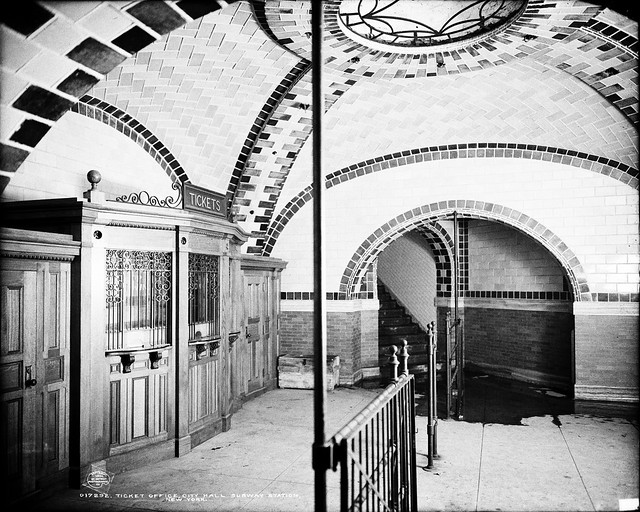
<p>You see, subway tile was popularized at the turn of the 20th century. It's sterile and no nonsense look adorned the walls of many floors and walls, from bathrooms to hospitals, and butchers to its namesake, subway stations. </p>
<p>The lines were simple, its glazing easy to keep clean, and the measurements were standard at 3" by 6" rectangles and 4" by 4" squares. Here's a classic Library of Congress photo of New York's City Hall subway ticket station showing the use of subway tile at the turn of the 20th century in all of it's subway glory. Amazing what you can do with two sizes of tile.</p>
<p>
</p>
<div class="MediaContainer PhotoContainer"><a href="https://farm4.staticflickr.com/3898/14885506159_4e898d481c_z.jpg" rel="PhotoPopup" popupheight="512" popupwidth="640"><img alt="" src="https://farm4.staticflickr.com/3898/14885506159_4e898d481c.jpg" width="500" height="400" style="border-width: 0px; border-style: solid;" /></a></div>
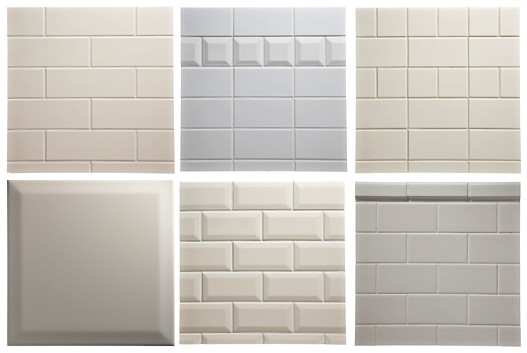
<p>Over the years colors were added to the mix, as were alternate shapes and sizes. Today, subway tile is a generic term for any simple and usually rectangular tile. You've got beveled subway, stone subway, glass subway, crackled, textured, dimpled, concave, convex, and on and on and on. What ever happened to the simple porcelain and sterile white subway tile we've all come to know and love?</p>
<p>
</p>
<div class="MediaContainer PhotoContainer"><a href="https://farm4.staticflickr.com/3875/14885398249_58f90bde06_z.jpg" rel="PhotoPopup" popupheight="353" popupwidth="527"><img alt="" src="https://farm4.staticflickr.com/3875/14885398249_58f90bde06.jpg" width="500" height="335" style="border-width: 0px; border-style: solid;" /></a></div>
<p>I mean, we installed "subway tile" in our guest bathroom shower, and it's 2" by 8". I loved it at install, and still love it today, but it feels like we've done something in our home we're not supposed to have done.</p>
<p>
</p>
<div class="MediaContainer PhotoContainer"><a href="https://farm3.staticflickr.com/2849/9041003291_f3c97c0dac_z.jpg" rel="PhotoPopup" popupheight="640" popupwidth="480"><img alt="" src="https://farm3.staticflickr.com/2849/9041003291_f3c97c0dac.jpg" width="375" height="500" style="border-width: 0px; border-style: solid;" /></a></div>
<p>The subway we installed in our kitchen fits our stereotype of subway tile. Porcelain, white, 3" by 6", but I'm picky, and I didn't want to use it in our bathroom. </p>
<p>
</p>
<div class="MediaContainer PhotoContainer"><a href="https://farm9.staticflickr.com/8179/7938903324_8ce27f679e_z.jpg" rel="PhotoPopup" popupheight="480" popupwidth="640"><img alt="" src="https://farm9.staticflickr.com/8179/7938903324_8ce27f679e.jpg" width="500" height="375" style="border-width: 0px; border-style: solid;" /></a></div>
<p>Why? Because I'm a bit of a snob. No really, I'm about to write one of the most ridiculously pretentious things ever. I don't like our kitchen tile because it's so obviously not <em>hand made</em>.</p>
<p>Ugh, I suck so bad. I feel like Ed Norton in Fight Club talking about his <em>"hand-blown green glass dishes with the tiny imperfections, all made by the hard-working indigenous aboriginal peoples of wherever..."</em></p>
<p>But it's true. Our house is 125 years old, and it's imperfect throughout. There isn't a right angle to be found, not a straight or truly flat surface in sight, and anything "original" would have been either hand made or created in a more crude time of machinery and mechanical fabrication.</p>
<p>Perfectly smooth and consistent machine made tiles just don't really look right in our home. But the rub of this whole debate, handmade tiles are much more expensive than machine made.</p>
<p>
</p>
<div class="MediaContainer PhotoContainer"><a href="https://farm6.staticflickr.com/5561/15072239525_f810c8debc_z.jpg" rel="PhotoPopup" popupheight="501" popupwidth="564"><img alt="" src="https://farm6.staticflickr.com/5561/15072239525_f810c8debc.jpg" width="500" height="444" style="border-width: 0px; border-style: solid;" /></a></div>
<p>After doing quite a bit of research the "accurate" tile for our subway bathroom walls would have been a square cut subway. The edges of these tile are not rounded like modern tile, but far more abrupt. Just look at a bathroom or kitchen that was put in before 1920 and you'll see the telltale signs of this old fashioned tile. </p>
<p>You can still buy this tile today from several places, such as <a href="http://subwaytile.com/" target="_blank">Subway Ceramics</a>, but it ain't cheap. You'll likely spend about $20 per square foot on this tile from the most inexpensive shops. Compare that to about $9 for our floor marble, and about $4 for the big box white subway. We're using about 95 square feet of tile in our bathroom, so this is not chump change. </p>
<p>So our search for a subway tile that was irregular enough to look hand made and appropriate for our bathroom without breaking the bank dragged on for quite some time. We looked online, in tile shops, in catalogs, and generally all over. It wasn't until we were both home in the middle of the week one day where we decided to drop into the <a href="http://www.architecturalceramics.com/" target="_blank">Architectural Ceramics</a> showroom on Union Street in Alexandria.</p>
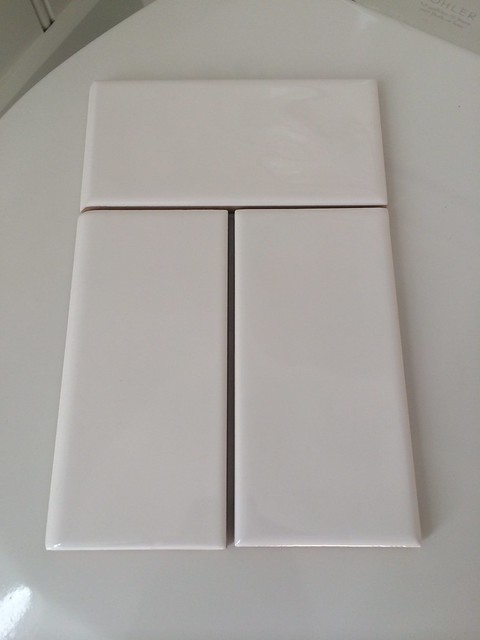
<p>We met with Ashley and told her what we are doing and what we were looking for. As soon as we described it her eyes lit up and she said, "I have just the tile for you." She walked over, grabbed a few sample pieces, and put them on the table for us.</p>
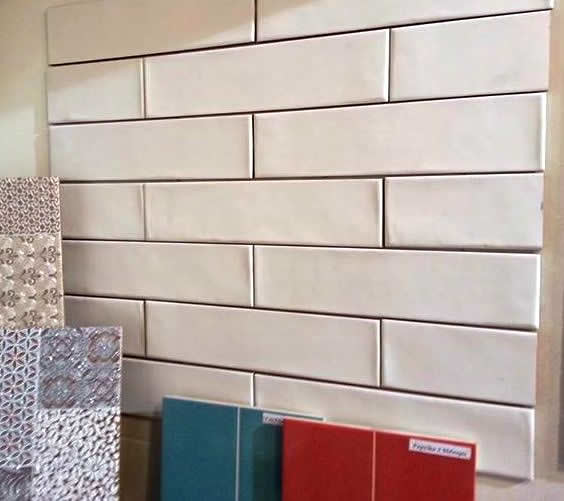
<p>Ashley described the tile as "machine made, but it looks hand made." She was absolutely right. The subtle imperfections a pretentious a-hole such as myself expects from a handmade tile were all over the place, and not in a predictable and repeatable pattern. The tile totally looked handmade.</p>
<p>Certain we'd be paying an arm and a leg of we went this route, we asked her for pricing. We were shocked to learn the field tile would be just over $6 per square foot. It felt too good to be true!</p>
<p>We sketched out the whole shower area where this tile is being installed and put the estimation of quantity into Ashley's capable hands. She suggested the necessary bullnose pieces for the transition areas, total square footage, and put our order in for us. What was complicated suddenly became simple. </p>
<p>
</p>
<div class="MediaContainer PhotoContainer"><a href="https://farm4.staticflickr.com/3854/14677331098_6f227f1fdc_z.jpg" rel="PhotoPopup" popupheight="480" popupwidth="640"><img alt="" src="https://farm4.staticflickr.com/3854/14677331098_6f227f1fdc.jpg" width="500" height="375" style="border-width: 0px; border-style: solid;" /></a></div>
<p>If you're calculating the amount of subway tile you need, there's a pretty simple rule of thumb for it. Take the total square footage of the space you're tiling times 1.15 (for a 15% addition to account for cuts and breakage), and you've got the square footage of the tile you'll need to purchase.</p>
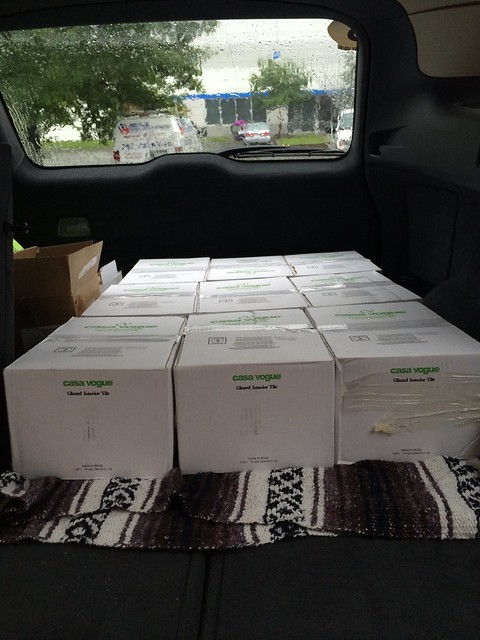
<p>Last week, on a very rainy day, we took a quick trip out to the Chantilly, Virginia showroom and warehouse for Architectural Ceramics and picked up our tile order. </p>
<p>
</p>
<div class="MediaContainer PhotoContainer"><a href="https://farm6.staticflickr.com/5553/14825226028_ea8ce9bd79_z.jpg" rel="PhotoPopup" popupheight="640" popupwidth="480"><img alt="" src="https://farm6.staticflickr.com/5553/14825226028_ea8ce9bd79.jpg" width="375" height="500" style="border-width: 0px; border-style: solid;" /></a></div>
<p>It was a quick and painless pickup and we used the trip as an opportunity to search for another material selection for our bathroom, the marble supplier that might ultimately make the top for our vanity. But that's another story for another time. </p>
<p>The tile we ordered is made up of the standard field tile, bullnose on the long side for the borders of the shower, and bullnose on the short side for an outside corner area inside of the shower.</p>
<p>
<div class="MediaContainer PhotoContainer"><a href="https://farm4.staticflickr.com/3913/14886057898_db91eeb185_z.jpg" rel="PhotoPopup" popupheight="640" popupwidth="480"><img alt="" src="https://farm4.staticflickr.com/3913/14886057898_db91eeb185.jpg" width="375" height="500" style="border-width: 0px; border-style: solid;" /></a></div>
</p>
<p>Now we have our tile in hand and all we have to do is put all of it up on the wall. Work and life have been crazy the last week, so it feels like we have little time for anything, but we're trying to plug away. Let's hope this weekend brings good DIY karma from the renovation gods and we can get this show on the road. Fingers crossed!</p><p><a href="https://www.oldtownhome.com/2014/8/29/Not-All-Subway-Tile-is-Created-Equal/">Read Full Post</a></p>]]></content>
    <category term="Header Image" />
    <category term="Master Bathroom" />
    <category term="Tile" />
    <PostImage>https://farm4.staticflickr.com/3860/14885706319_62626cd784.jpg</PostImage>
    <media:thumbnail url="https://farm4.staticflickr.com/3860/14885706319_62626cd784_t.jpg" />
    <ExtensionElements>
      <Item>PostImage</Item>
      <Item>media:thumbnail</Item>
    </ExtensionElements>
  </entry>
  <entry>
    <guid>c7801cce-925d-4138-a19e-15a0a03abdb7</guid>
    <id>https://www.oldtownhome.com/2014/8/1/The-Good-the-Bad-and-the-Ugly-of-Grouting/</id>
    <title>The Good, the Bad, and the Ugly of Grouting</title>
    <summary type="html"><![CDATA[<p>As with any major project, no matter how experienced you are, things don't necessarily go quite as planned.</p><p>Rather than just simply going with a big "Look at how awesome our floor looks, and it was so easy" blog post, I want to share our grouting process with you. And that include everything...The Good, the Bad, and the Ugly.</p><p>
</p><div class="MediaContainer VideoEmbed"><iframe width="560" height="349" src="https://www.youtube.com/embed/h1PfrmCGFnk?wmode=transparent&amp;hd=1&amp;start=6&amp;autoplay=0" frameborder="0" allowfullscreen="true"></iframe></div><p>Though our <a href="http://www.oldtownhome.com/2014/7/29/The-Three-Bears-Go-Back-In-Time-for-the-Right-Color-Grout/">grout color selection</a> was a major step in the overall progress of our bathroom, it was ultimately a small component of the much larger "give our bathroom an actual floor" task that has required quite a few steps to complete.</p><p>The main thing an actual selection of a color resulted in was our ability to move forward with the remainder of those many additional smaller tasks. And after our trials and tribulations with color selection, we approached our actual grouting with gusto. </p><p>We actually kicked off the whole process even before we selected a color by first sealing the tile that had been laid. </p> <a href="https://www.oldtownhome.com/2014/8/1/The-Good-the-Bad-and-the-Ugly-of-Grouting/">more</a>]]></summary>
    <published>2014-08-01T13:05:00.000-04:00</published>
    <updated>2014-08-01T13:05:00.000-04:00</updated>
    <link rel="alternate" href="https://www.oldtownhome.com/2014/8/1/The-Good-the-Bad-and-the-Ugly-of-Grouting/" />
    <author>
      <name>Alex</name>
    </author>
    <content type="html"><![CDATA[<p>As with any major project, no matter how experienced you are, things don't necessarily go quite as planned.</p>
<p>Rather than just simply going with a big "Look at how awesome our floor looks, and it was so easy" blog post, I want to share our grouting process with you. And that include everything...The Good, the Bad, and the Ugly.</p>
<p>
</p>
<div class="MediaContainer VideoEmbed"><iframe width="560" height="349" src="https://www.youtube.com/embed/h1PfrmCGFnk?wmode=transparent&amp;hd=1&amp;start=6&amp;autoplay=0" frameborder="0" allowfullscreen="true"></iframe></div>
<p>Though our <a href="http://www.oldtownhome.com/2014/7/29/The-Three-Bears-Go-Back-In-Time-for-the-Right-Color-Grout/">grout color selection</a> was a major step in the overall progress of our bathroom, it was ultimately a small component of the much larger "give our bathroom an actual floor" task that has required quite a few steps to complete.</p>
<h3>The Good</h3>
<p>The main thing an actual selection of a color resulted in was our ability to move forward with the remainder of those many additional smaller tasks. And after our trials and tribulations with color selection, we approached our actual grouting with gusto. </p>
<p>We actually kicked off the whole process even before we selected a color by first sealing the tile that had been laid. </p>
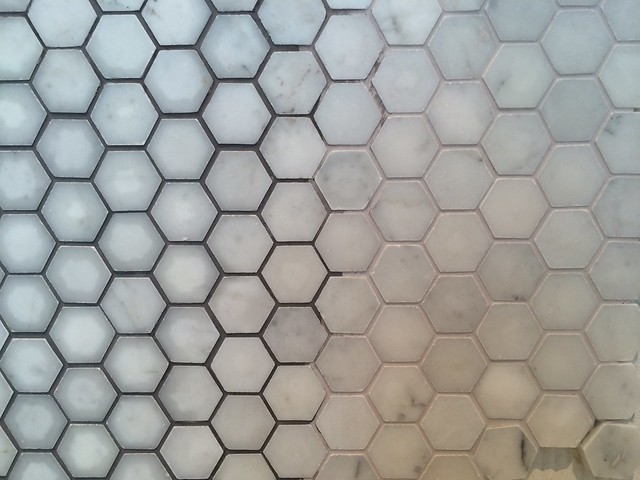
<p>I know it may sound weird, but stone is a porous stone that likes to absorb the things it touches...like water. You can actually see how the stone turned a slight color around the edges of each tile on the sample board where we used the dark grout.</p>
<p>
</p>
<div class="MediaContainer PhotoContainer"><a href="https://farm6.staticflickr.com/5584/14695071924_5e69d50bd2_z.jpg" rel="PhotoPopup" popupheight="480" popupwidth="640"><img alt="" src="https://farm6.staticflickr.com/5584/14695071924_5e69d50bd2.jpg" width="500" height="375" style="border-width: 0px; border-style: solid;" /></a></div>
<p>That dark halo on each tile is the stone actually sucking the water out of the grout as it dries. Given enough time, the stone typically turns back to its normal color, but this relatively subtle change in color is not a desirable outcome when the grout/stone comes into contact with water.</p>
<p>
</p>
<div class="MediaContainer PhotoContainer"><a href="https://farm4.staticflickr.com/3913/14652828636_b7c8c367f5_z.jpg" rel="PhotoPopup" popupheight="640" popupwidth="480"><img alt="" src="https://farm4.staticflickr.com/3913/14652828636_b7c8c367f5.jpg" width="375" height="500" style="border-width: 0px; border-style: solid;" /></a></div>
<p>To protect against this you should always apply a sealer product to stone tile before you grout. This isn't quite as necessary (or necessary at all) with porcelain tile, but it's a must for stone, especially porous stone. </p>
<p>
</p>
<div class="MediaContainer PhotoContainer"><a href="https://farm6.staticflickr.com/5565/14695749483_71ae941472_z.jpg" rel="PhotoPopup" popupheight="480" popupwidth="640"><img alt="" src="https://farm6.staticflickr.com/5565/14695749483_71ae941472.jpg" width="500" height="375" style="border-width: 0px; border-style: solid;" /></a></div>
<div class="ToolItem">
<iframe style="width: 120px; height: 240px;" marginwidth="0" marginheight="0" scrolling="no" frameborder="0" src="//ws-na.amazon-adsystem.com/widgets/q?ServiceVersion=20070822&amp;OneJS=1&amp;Operation=GetAdHtml&amp;MarketPlace=US&amp;source=ac&amp;ref=qf_sp_asin_til&amp;ad_type=product_link&amp;tracking_id=oltoho-20&amp;marketplace=amazon&amp;region=US&amp;placement=B00065W8G8&amp;asins=B00065W8G8&amp;linkId=VNQPY6QBAQMAJ24R&amp;show_border=false&amp;link_opens_in_new_window=true&amp;price_color=333333&amp;title_color=0066C0&amp;bg_color=FAFAF8">
</iframe>
</div>
<p>I like the StoneTech products from DuPont. Though they're a bit expensive, they have a great reputation among the stone pros and have worked really well for is over the years. Best of all, they have so much more than just sealer. Really, their list of products is so extensive, you'll just need to check them out. </p>
<p>Beyond StoneTech you can find sealers at various tile specialty stores, big box stores, and many different places online. The main thing is to find one that works well for your situation and needs.</p>
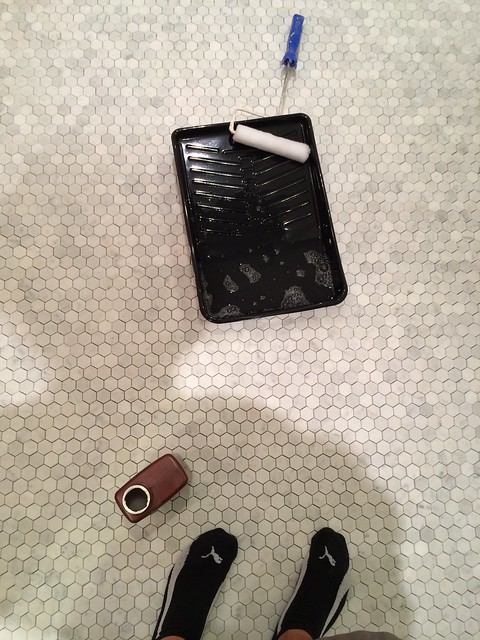
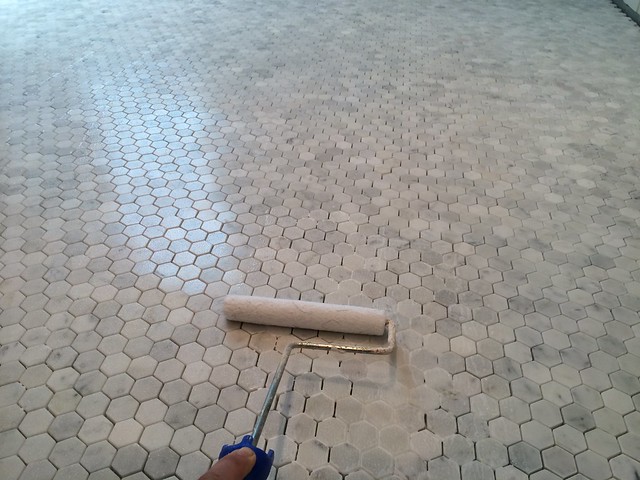
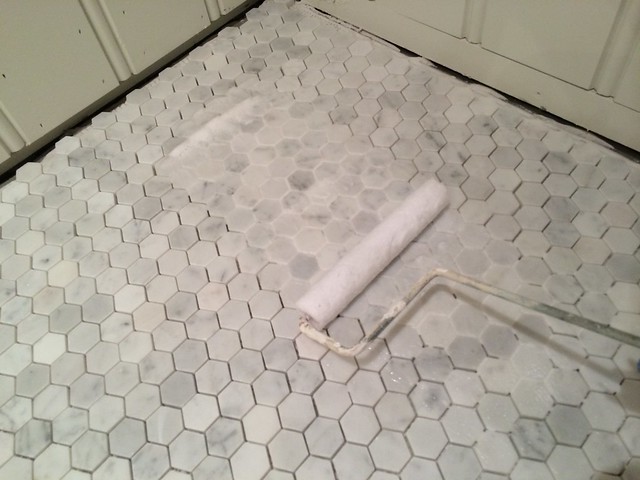
<p>To apply this sealer all you need is a small paint roller brush and tray. You shake up the sealer, pour it into the tray, then liberally roll it on getting as much good coverage as you can. </p>
<p>
</p>
<div class="MediaContainer PhotoContainer"><a href="https://farm4.staticflickr.com/3862/14687849711_61fe139f85_z.jpg" rel="PhotoPopup" popupheight="480" popupwidth="640"><img alt="" src="https://farm4.staticflickr.com/3862/14687849711_61fe139f85.jpg" width="500" height="375" style="border-width: 0px; border-style: solid;" /></a></div>
<p>It will suds up some, and a lot will fall between the tile, this is all good as it will help keep the edges of the tile from sucking the moisture out of the grout once it's in place. One thing to note, whatever the coverage estimates are on the bottle, cut it in half if you're sealing ungrouted marble hex (or any small format mosaic). So much of the sealer goes between the tile's gaps that it's impossible to really make it go a long way.</p>
<p>
</p>
<div class="MediaContainer PhotoContainer"><a href="https://farm3.staticflickr.com/2923/14652827996_6a21396f53_z.jpg" rel="PhotoPopup" popupheight="480" popupwidth="640"><img alt="" src="https://farm3.staticflickr.com/2923/14652827996_6a21396f53.jpg" width="500" height="375" style="border-width: 0px; border-style: solid;" /></a></div>
<p>With very porous stone, like marble, a second application is advisable to get full penetration. And after you allow it to cure for about 20-30 minutes, you can towel anything remaining off with a clean rag.</p>
<p>After allowing the sealer to cure for a full 24 hours, we could begin grouting. </p>
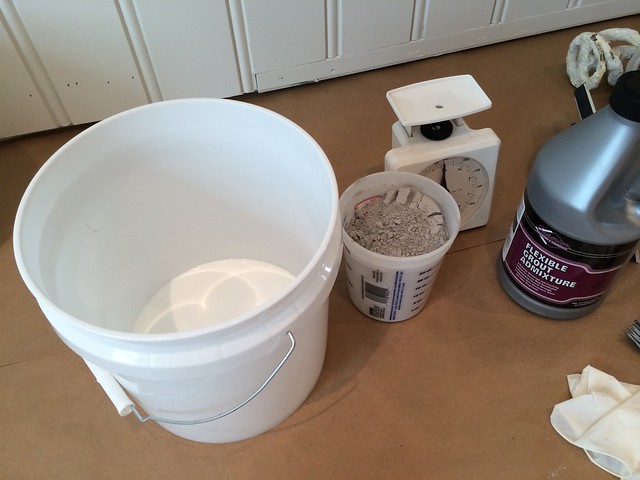
<p>We elected to stick with the latex admixture from The Tile Store even though we weren't using their grout. I've heard lots of good things about this mixture, including its help with grout color consistency, purity of material (vs what could be in city water), and its ability to cure more slowly and remain a bit "flexible" and crack resistant over time. Since you can use it with any cement based grout, we figured "why not?"</p>
<p>
</p>
<div class="MediaContainer PhotoContainer"><a href="https://farm4.staticflickr.com/3922/14707106472_c41d54a587_z.jpg" rel="PhotoPopup" popupheight="480" popupwidth="640"><img alt="" src="https://farm4.staticflickr.com/3922/14707106472_c41d54a587.jpg" width="500" height="375" style="border-width: 0px; border-style: solid;" /></a></div>
<p>The main thing about this admixture was they we needed to use 24 ounces per five pounds of grout. So once again, I broke out our scale to ensure absolutely precise measurements of each material. </p>
<p>The best way I've found to mix grout requires a pair of two gallon buckets, one small 32 ounce container, a food scale, a hammer drill with spiral mixing attachment, and an observant family member. </p>
<p>
</p>
<div class="MediaContainer PhotoContainer"><a href="https://farm4.staticflickr.com/3918/14707629555_823b42f91b_z.jpg" rel="PhotoPopup" popupheight="480" popupwidth="640"><img alt="" src="https://farm4.staticflickr.com/3918/14707629555_823b42f91b.jpg" width="500" height="375" style="border-width: 0px; border-style: solid;" /></a></div>
<p><em>A word to the wise. The buckets should be clean and new grout buckets. Not buckets you've used to wash or car or mix your thinset. Any extra stuff in the buckets can cause issues with your grout install.</em></p>
<p>What worked best for us was to measure out the correct amount of admix for the batch we're mixing in the small 32 ounce container and set it aside. I then measure out the five pounds of dry grout into one of the two gallon buckets.</p>
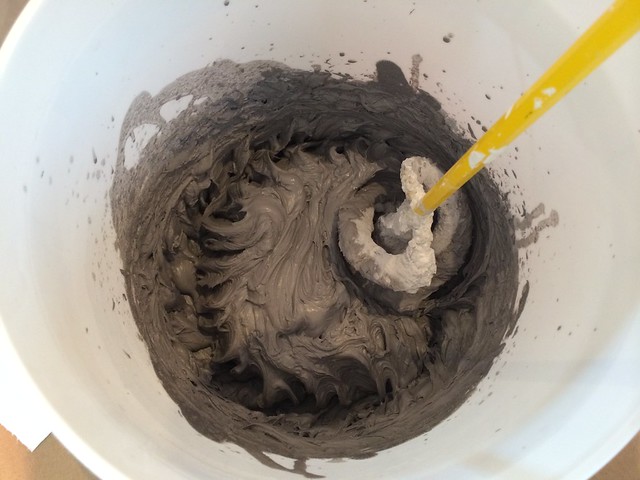
<p>Finally, I pour all of the admix liquid into the empty two gallon bucket and begin mixing in the dry grout a little at a time. </p>
<p>It starts out very watery, and in our case, quite dark gray. This is a great scenario where it's best to have two people working. One can continuously mix the grout while the other slowly pours the dry grout into the bucket mixture. This will ensure the grout is mixed thoroughly and without lumps. Once all grout is added to the mixture the consistency will resemble a good cookie dough...mmmmm, cookie dough.</p>
<p>
</p>
<div class="MediaContainer PhotoContainer"><a href="https://farm4.staticflickr.com/3861/14715933492_0f41d0553c_z.jpg" rel="PhotoPopup" popupheight="480" popupwidth="640"><img alt="" src="https://farm4.staticflickr.com/3861/14715933492_0f41d0553c.jpg" width="500" height="375" style="border-width: 0px; border-style: solid;" /></a></div>
<p>Once we've reached cookie dough state, it's all about smearing the grout all over the floor.</p>
<p>Wendy and I each took an area and worked towards each other. We started in the back corner of the room to get the hang of it again and figured out we could get through five pounds of mixed grout in about 20 minutes.</p>
<p>
</p>
<div class="MediaContainer PhotoContainer"><a href="https://farm6.staticflickr.com/5595/14727343573_08f88e1ccc_z.jpg" rel="PhotoPopup" popupheight="480" popupwidth="640"><img alt="" src="https://farm6.staticflickr.com/5595/14727343573_08f88e1ccc.jpg" width="500" height="375" style="border-width: 0px; border-style: solid;" /></a></div>
<p>After the grout was down on the floor and the excess scraped away, we'd go over it in multiple directions again to ensure we really worked it down into all of the gaps. </p>
<p>I know you've probably seen many grouting blog posts, and there's a good chance you've done grouting yourself, so I'll try to focus on the tips and tricks that make grouting work for us, rather than saying "and then you put the grout on the float..."</p>
<p>
</p>
<div class="MediaContainer PhotoContainer"><a href="https://farm4.staticflickr.com/3841/14520869968_6e30990d78_z.jpg" rel="PhotoPopup" popupheight="640" popupwidth="480"><img alt="" src="https://farm4.staticflickr.com/3841/14520869968_6e30990d78.jpg" width="375" height="500" style="border-width: 0px; border-style: solid;" /></a></div>
<p>The main thing I look for while grouting is how full the grout joints are. When you spread the grout over the tile and work it into the joints, and then scrape the excess away, you can see how full the joints are simply by looking for a bulge. You can see it pretty clearly in this photo.</p>
<p>
</p>
<div class="MediaContainer PhotoContainer"><a href="https://farm6.staticflickr.com/5554/14684631946_ae68583d11_z.jpg" rel="PhotoPopup" popupheight="480" popupwidth="640"><img alt="" src="https://farm6.staticflickr.com/5554/14684631946_ae68583d11.jpg" width="500" height="375" style="border-width: 0px; border-style: solid;" /></a></div>
<p>The grout is sort of sitting proud of the top of the tile, joints completely full. This shows me that we've done our job in making sure the joints are truly full and there shouldn't be any significant gaps or pits.</p>
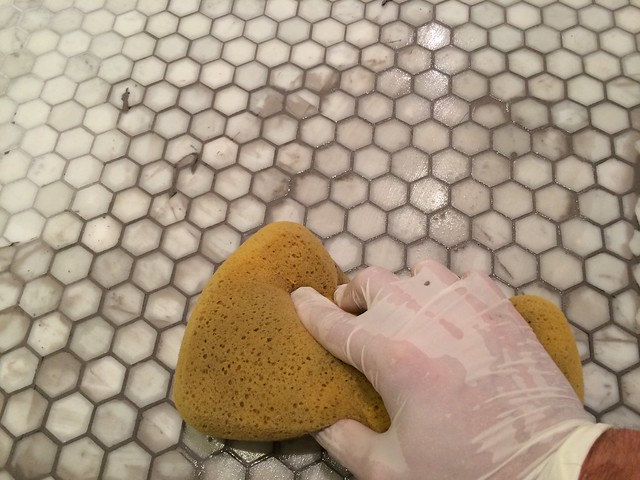
<p>Waiting about 10 to at most 20 minutes after the grout has been applied, it was time to remove the excess with those lovely and awesome orange-yellow grout sponges. </p>
<p>
</p>
<div class="MediaContainer PhotoContainer"><a href="https://farm6.staticflickr.com/5552/14742316915_891096eda7_z.jpg" rel="PhotoPopup" popupheight="480" popupwidth="640"><img alt="" src="https://farm6.staticflickr.com/5552/14742316915_891096eda7.jpg" width="500" height="375" style="border-width: 0px; border-style: solid;" /></a></div>
<p>As you can see in the photos, I like to grout while wearing latex gloves, and Wendy likes to grout wearing thicker and longer rubber gloves. Ultimately, this saves our hands a ton. Grout is very alkaline, and extended exposure to the mixed grout will significantly dry your hands to the point where they crack. Grouting can be hard on your hands, so do yourself a favor and pick a pair of gloves that you like.</p>
<p>I feel like the removal of the excess grout is a little bit more difficult with the latex admixture than with grout mixed with water, but a little elbow grease and persistence is all that's necessary. But in a few cases, where we had particularly stubborn grout, I was able to use one of the grout specific abrasive sponges.</p>
<p>
</p>
<div class="MediaContainer PhotoContainer"><a href="https://farm4.staticflickr.com/3885/14727606173_373343b30b_z.jpg" rel="PhotoPopup" popupheight="640" popupwidth="480"><img alt="" src="https://farm4.staticflickr.com/3885/14727606173_373343b30b.jpg" width="375" height="500" style="border-width: 0px; border-style: solid;" /></a></div>
<p>Finally, once all of the excess is removed, and before giving the grout time to fully cure, it's best to towel off the completed area with a clean and dry towel. I prefer to use one of the fine cotton towels that you typically use for car washes. This removes any excess or sitting water and helps prevent efflorescence on the surface of the grout due to too much water.</p>
<p><em>Okay, full disclosure, I didn't do that towel off thing on the first few batches of grout and I ended up with a fair amount of chalky white stuff on the surface of the cured grout, so I've been working on removing that for a while now. Ugh.</em></p>
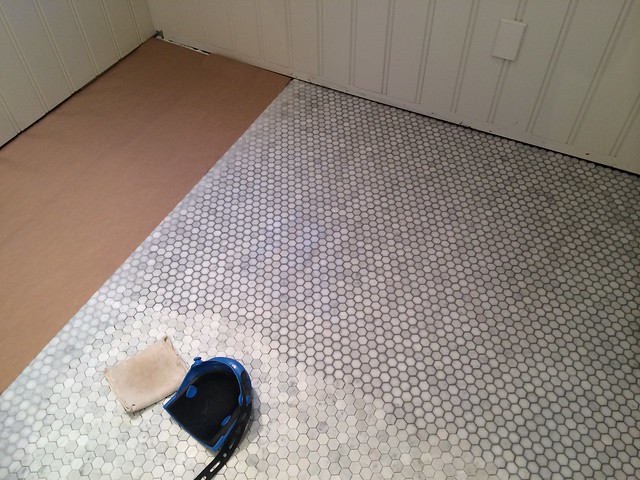
<p>One other tip, cover the newly grouted floor with some brown paper to keep the moisture in to allow the grout to cure a little more slowly. This helps everything dry more evenly and further reduces the risk for cracking. You can see where we've already completed the grout to the left and covered it, while continuing with the grout on the right area.</p>
<p>
</p>
<div class="MediaContainer PhotoContainer"><a href="https://farm3.staticflickr.com/2896/14529781209_b86656d9a3_z.jpg" rel="PhotoPopup" popupheight="480" popupwidth="640"><img alt="" src="https://farm3.staticflickr.com/2896/14529781209_b86656d9a3.jpg" width="500" height="375" style="border-width: 0px; border-style: solid;" /></a></div>
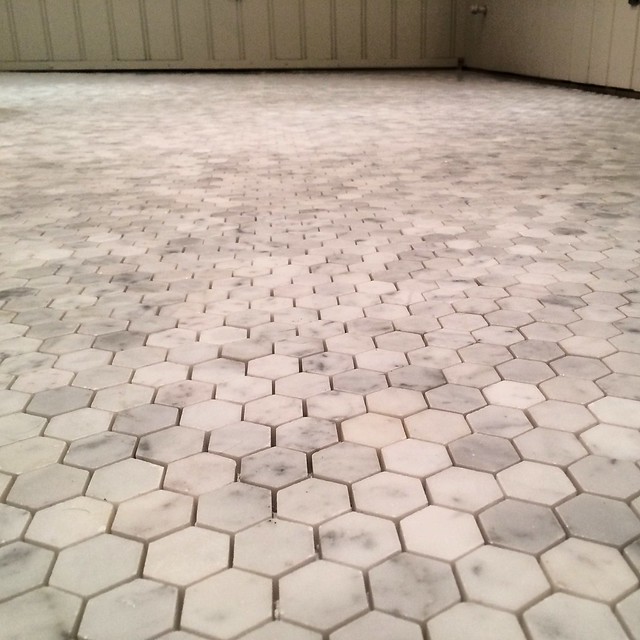
<p>After many changes of water, lots of sponges, dry hands, quite a few arguments, lots of cleaning, scrubbing, and sweating, nearly 40 pounds of mixed grout, and about 200 ounces of latex ad mixture, and we had ourselves a completely grouted floor...and boy did it feel great!</p>
<h3>The Bad</h3>
<p>However, and there's often a however, we did have a few somewhat significant problems, at least in my mountain out of a mole hill assessment.&nbsp;</p>
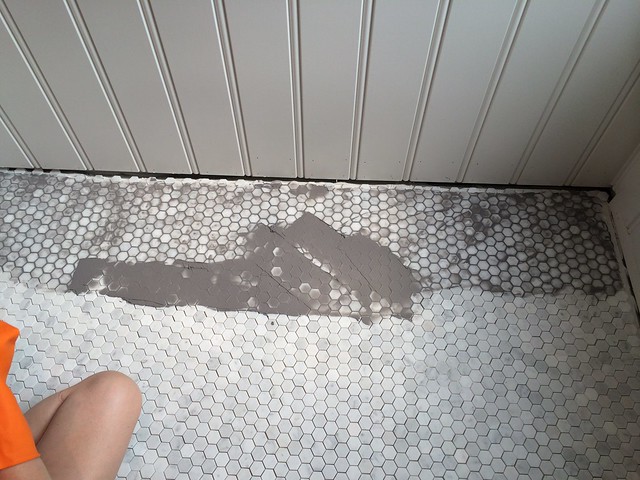
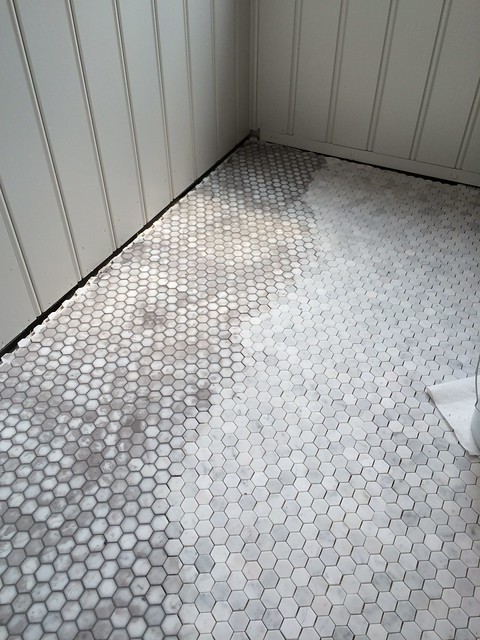
<p>Though the admixture promised more consistent grout color, and we were absolutely diligent in mixing the ratios of grout to admixture, we ended up with a fair amount of color variability. This occurred all over the floor, not just where the grout mix batches changed. I could see we were getting efflorescence as well, but the color differences were more than surface chalk, this was actual light to dark color changes, and we could see it at the edge of where we finished batches of grout and moved onto our next bag more clearly.</p>
<p>
</p>
<div class="MediaContainer PhotoContainer"><a href="https://farm4.staticflickr.com/3862/14742489805_55e213db30_z.jpg" rel="PhotoPopup" popupheight="480" popupwidth="640"><img alt="" src="https://farm4.staticflickr.com/3862/14742489805_55e213db30.jpg" width="500" height="375" style="border-width: 0px; border-style: solid;" /></a></div>
<p>The color changes are likely only significant enough for us to notice them under our compulsive gaze, but we noticed them nonetheless. Unfortunately, I think it's just part of the variability of cement grout. This is a case where epoxy grout would have been much better, but that comes with its own problems in a room this big (namely, impossible to remove haze).</p>
<p>To be truthful, I'm sort of beating myself up about it and worrying way too much. And when I take a break from worrying, I somehow get Wendy all whipped up about it and she starts worrying. I guess you could say we complement each other?</p>
<p>In retrospect I should have emptied all of the 40 pounds of grout into a single large bucket and mixed them all together to establish a consistent color across all boxes. But hindsight is 20/20, and maybe we'll use that trick on the next bathroom we renovate sometime in the 22nd century.</p>
<p>As I mentioned, the efflorescence was something that we'd actually need to take care of, rather than stare and obsess about. To tackle this, I pulled a trick that I learned from that good old tile setter I mentioned before named Pookie Pro. </p>
<p>Pookie told me to just "wait about three days then give that efflorescence a bath in vinegar." Yep, that's all there is too it. Vinegar is an acid, and you don't typically want to use an acid to clean your tile (or it will remove your sealer), but sometimes it's necessary. In this case we'd be doing another coat of two of sealer on the grout, so using vinegar to clean the issue won't be an issue at all.</p>
<p>I tested it out in the back corner of the closet tile before taking on the whole room and really thought the results looked great.</p>
<p>
</p>
<div class="MediaContainer PhotoContainer"><a href="https://farm4.staticflickr.com/3863/14694304006_326e243fe8_z.jpg" rel="PhotoPopup" popupheight="480" popupwidth="640"><img alt="" src="https://farm4.staticflickr.com/3863/14694304006_326e243fe8.jpg" width="500" height="375" style="border-width: 0px; border-style: solid;" /></a></div>
<p>The vinegar bath is simple. You just need a bottle of distilled white vinegar, a bucket of water, a large stiff synthetic bristled scrub brush, and a bunch of clean rags. Start by pouring the vinegar onto the tile about the size of a big pancake, and then just start scrubbing with the brush in alternating circles. You don't want to let it sit at all, or it could cause damage to porous stone. It also worked well for us because our finish is a honed finish, but if your tile is polished, you'll want to look at different options or it could damage the floor.</p>
<p>Once I started scrubbing, it was something that I really needed to work at. I'm talking full on sweat, pants falling down, plumbers crack hanging out level of effort. Your arms and shoulders should be sore the next day. But that's how you really get the efflorescence and any haze off the surface of the tile.</p>
<p>This process actually takes care of both the efflorescence on the grout as well as any grout haze that may be left on the surface of the tile. You can actually see just how significant the cleaning is in this photo.</p>
<p>
</p>
<div class="MediaContainer PhotoContainer"><a href="https://farm3.staticflickr.com/2900/14763363451_2f7db3ea4a_z.jpg" rel="PhotoPopup" popupheight="640" popupwidth="480"><img alt="" src="https://farm3.staticflickr.com/2900/14763363451_2f7db3ea4a.jpg" width="375" height="500" style="border-width: 0px; border-style: solid;" /></a></div>
<p>You can see a previously cleaned portion in the upper right, an in process section of dark/wet grout on the upper left, and an uncleaned, light, and hazy and not yet clean section of tile on the lower portion. This just shows how important this step can be, or at least was for us.</p>
<p>After scrubbing a large section of tile you'll have a large wet portion with little bubbles and gritty cloud vinegar over the tile. Grab one of your clean towels, soak it in the bucket of clean water, give it a 75% wring, then start wiping down all of the vinegar. </p>
<p>It's important to remove all of the vinegar before it sits more than a few minutes or you might end up with some etching from the acid, especially on a very porous surface. When you've wiped up all of the vinegar, go over all of it one more time with another wet rag.</p>
<p>Finally, after it's been thoroughly wiped and is soaking wet, wipe everything down with a dry towel to remove any significant standing water and allow the surface and grout to dry.</p>
<p>
</p>
<div class="MediaContainer PhotoContainer"><a href="https://farm4.staticflickr.com/3915/14563419637_9fd1115bd4_z.jpg" rel="PhotoPopup" popupheight="640" popupwidth="480"><img alt="" src="https://farm4.staticflickr.com/3915/14563419637_9fd1115bd4.jpg" width="375" height="500" style="border-width: 0px; border-style: solid;" /></a></div>
<p>In our case, when the unsealed grout gets wet it darkens considerably, which makes it easy to see when the grout dries since it returns to its more standard gray color. </p>
<p>After about a gallon of distilled white vinegar, and several hours of aggressive scrubbing later, we had ourselves a relatively clean floor free of haze and efflorescence. The only remaining step was to apply a final few coats of sealer on the fully cured grout and hope that it will even out some of the color differences a bit.</p>
<p>
</p>
<div class="MediaContainer PhotoContainer"><a href="https://farm4.staticflickr.com/3909/14798553114_6c4260b83c_z.jpg" rel="PhotoPopup" popupheight="640" popupwidth="480"><img alt="" src="https://farm4.staticflickr.com/3909/14798553114_6c4260b83c.jpg" width="375" height="500" style="border-width: 0px; border-style: solid;" /></a></div>
<p>Using the same method for applying the sealer as we had used the first time around, we checked "grout floor" off of our list of bathroom tasks remaining and allowed the sealer to cure.&nbsp;</p>
<p>I have to be honest here, we're not 100% happy with the finished results, but I think we're just too close and obsessing too much right now. There's definitely a color change from the closet to the rest of the room, and there's a darker line of grout toward the end of the room that we're worried will stand out, but we feel it's reached a point where we just need to move on and start the next steps. Once we have the room full of everything that will live in there, we both think it will all be okay.</p>
<h3>The Ugly</h3>
<p>"The Ugly" during grouting tends to show its head often and unexpectedly. It's sometimes hard to capture in photos, especially because you're usually pretty pissed off and have no interest in taking photos. But Wendy did a pretty great job of capturing just one of the many instances of the Ugly in this grouting process.</p>
<p>
</p>
<div class="MediaContainer PhotoContainer"><a href="https://farm4.staticflickr.com/3871/14736410743_2f874520e7_z.jpg" rel="PhotoPopup" popupheight="480" popupwidth="640"><img alt="" src="https://farm4.staticflickr.com/3871/14736410743_2f874520e7.jpg" width="500" height="375" style="border-width: 0px; border-style: solid;" /></a></div>
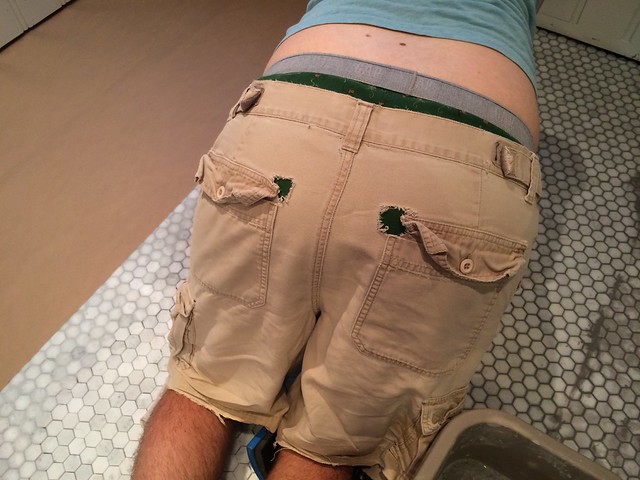
<p>Yes, that's right, that's an action shot of my ass in torn and tattered grouting shorts. Underwear showing, sweat soaked through so I look like I've had an accident of some sort. And it's all thanks to my lovely and adoring wife. Just consider yourself lucky that the band of my drawls were high enough to cover my crack. Not sure how that one happened.</p>
<p>You see, Wendy took this photo, along with several others, for me to find on my phone at a later date. I didn't know she had taken them, and when I found them I said "Why did you take a pic of my butt while grouting?" Her response..."because it was funny."&nbsp;</p>
<p>But the thing is, she hates these torn up shorts and says I'm not allowed to leave the house in them, and they should actually be in the trash. Well, joke's on her, as I've now made my round and sweaty derri&egrave;re a subject of the Internet in a game of blogger chicken. I have no shame, and this is about as ugly as it gets when it comes to grouting.</p>
<p>And there you have it, that's our adventure in grouting. Start to finish it took us a solid week and a half to finish the whole job. That spanned several days of actual grouting, three days cure before beginning the vinegar bath, a full 24 hours cure on the sealer, and two full time jobs that have been taking up way more than we'd like of late. But hey, what are you gonna do?</p>
<p>It's my hope that this post will ultimately help someone who is working on grouting their marble and they happen to run into some of the same difficulties we've encountered. But it's my sad realization that any of those unfortunate souls we might have helped will ultimately be turned away by my sweaty butt picture. And that concludes our grout adventure done in the style of one of the best spaghetti westerns of all time.</p>
<p style="text-align: center;">- THE END -</p><p><a href="https://www.oldtownhome.com/2014/8/1/The-Good-the-Bad-and-the-Ugly-of-Grouting/">Read Full Post</a></p>]]></content>
    <category term="Header Image" />
    <category term="Master Bathroom" />
    <category term="Tile" />
    <PostImage>https://farm4.staticflickr.com/3872/14616491688_342f7635a1.jpg</PostImage>
    <media:thumbnail url="https://farm4.staticflickr.com/3872/14616491688_342f7635a1_t.jpg" />
    <ExtensionElements>
      <Item>PostImage</Item>
      <Item>media:thumbnail</Item>
    </ExtensionElements>
  </entry>
  <entry>
    <guid>e481cd44-5c6d-4b11-a6d9-8dcc9976ca2d</guid>
    <id>https://www.oldtownhome.com/2014/7/29/The-Three-Bears-Go-Back-In-Time-for-the-Right-Color-Grout/</id>
    <title>The Three Bears Go Back In Time for the Right Color Grout</title>
    <summary type="html"><![CDATA[<p>Stop me if you've heard this story. <em>The Three Bears jump into a time machine and waste a whole weekend in search of the grout color that was juuuuuuusssssstttt right...</em></p><p>No? Not familiar with this little DIY fairy tale? Well then, let me fill you in.</p><p>The selection of a grout color for a large bathroom is easy...said no one...ever. That's why, once upon a time, three little bears named Wendy, Alex, and Lulu went out in search of the perfect grout color for a bathroom renovation that's taken longer than any of them would like to admit to the world.</p><p>Since these three bears were using one inch marble hex (actually, 1.25" marble hex) with 1/16" grout lines on their master bathroom floor, the color of the grout would ultimately play a major role in the overall look of the room, primarily because there's going to be a ton of it visible. </p><p>
</p><div class="MediaContainer PhotoContainer"><a href="https://farm4.staticflickr.com/3901/14651690516_85251aedfc_z.jpg" rel="PhotoPopup" popupheight="640" popupwidth="640"><img alt="" src="https://farm4.staticflickr.com/3901/14651690516_85251aedfc.jpg" width="500" height="500" style="border-width: 0px; border-style: solid;"></a></div><p>The bears knew that choosing the correct color could both highlight the tile while also distracting from any inconsistencies or layout issues. (Though I'm sure each and every one of those issues had been resolved through the bears' diligent search and correction techniques.)</p> <a href="https://www.oldtownhome.com/2014/7/29/The-Three-Bears-Go-Back-In-Time-for-the-Right-Color-Grout/">more</a>]]></summary>
    <published>2014-07-29T10:31:00.000-04:00</published>
    <updated>2014-07-29T10:31:00.000-04:00</updated>
    <link rel="alternate" href="https://www.oldtownhome.com/2014/7/29/The-Three-Bears-Go-Back-In-Time-for-the-Right-Color-Grout/" />
    <author>
      <name>Alex</name>
    </author>
    <content type="html"><![CDATA[<p>Stop me if you've heard this story. <em>The Three Bears jump into a time machine and waste a whole weekend in search of the grout color that was juuuuuuusssssstttt right...</em></p>
<p>No? Not familiar with this little DIY fairy tale? Well then, let me fill you in.</p>
<p>The selection of a grout color for a large bathroom is easy...said no one...ever. That's why, once upon a time, three little bears named Wendy, Alex, and Lulu went out in search of the perfect grout color for a bathroom renovation that's taken longer than any of them would like to admit to the world.</p>
<p>Since these three bears were using one inch marble hex (actually, 1.25" marble hex) with 1/16" grout lines on their master bathroom floor, the color of the grout would ultimately play a major role in the overall look of the room, primarily because there's going to be a ton of it visible. </p>
<p>
</p>
<div class="MediaContainer PhotoContainer"><a href="https://farm4.staticflickr.com/3901/14651690516_85251aedfc_z.jpg" rel="PhotoPopup" popupheight="640" popupwidth="640"><img alt="" src="https://farm4.staticflickr.com/3901/14651690516_85251aedfc.jpg" width="500" height="500" style="border-width: 0px; border-style: solid;" /></a></div>
<p>The bears knew that choosing the correct color could both highlight the tile while also distracting from any inconsistencies or layout issues. (Though I'm sure each and every one of those issues had been resolved through the bears' diligent search and correction techniques.)</p>
<p>While the bears may not have been tiling pros, they knew that with a white (or gray) stone tile, like marble, the rhyme to remember is "the whiter you can go with the grout, the less you'll see the problems in the layout."</p>
<p>However, this is in sharp contrast to the other rhyme of "historically accurate grout is gray." Okay, that's less of a rhyme and more of a fact. I guess preservationists aren't into rhyming. But the three bears knew, even without a rhyme, that a darker grout color is the only "correct" historical color. I think this goes all of the way back to the days of dinosaur tile setters. </p>
<p class="MediaContainer PhotoContainer"><a href="https://farm6.staticflickr.com/5568/14589878720_e1f589f8b7_z.jpg" rel="PhotoPopup" popupheight="480" popupwidth="640"><img alt="" src="https://farm6.staticflickr.com/5568/14589878720_e1f589f8b7.jpg" width="500" height="375" style="border-width: 0px; border-style: solid;" /></a></p>
<p class="MediaContainer PhotoContainer"><em>These two are obviously discussing a tile quote.</em></p>
<p>It may have been millions of years ago, but it's rather obvious that T-Rexes all had to hire out their tile jobs because their arms were too short to tile or grout. But back then, their triceratops and brontosaurus tile setters would use gray to dark gray grout exclusively, likely due to the fact that it all came from volcanic rock. Also, I don't think any of the big box stores carried the color varieties back then.</p>
<p>After grouting was complete, the dinosaur tile setters would show their customer the finished job and the T-Rex would usually eat the tile setter. It was a bad job to have. </p>
<p>But this isn't a story about dinosaurs' DIY shortcomings due to under evolved arms, this is a story about bears and grout, so let's get back to the point.</p>
<p>
</p>
<div class="MediaContainer PhotoContainer"><a href="https://farm4.staticflickr.com/3856/14589923520_d8072a937d_z.jpg" rel="PhotoPopup" popupheight="480" popupwidth="640"><img alt="" src="https://farm4.staticflickr.com/3856/14589923520_d8072a937d.jpg" width="500" height="375" style="border-width: 0px; border-style: solid;" /></a></div>
<p>Throughout history, from the dinosaurs to the Romans, to the Victorians, gray and dark gray grout was the only way to go (and the only way available). It's only in recent times with color additives and polymer blends that the three bears even have an option to use something other than gray.</p>
<p>The thing is, the three bears, and especially mama bear, had been planning on grouting their tile with a darker color. And as you may be able to guess, papa bear was all for an historically accurate approach with dark grout, as he likes historically accurate. They'd talked about it, day dreamed about it, and planned for it while they did their bear things around town. So when it came time to select the grout color they wanted, the bears jumped into the bear family truckster and headed out to the Tile Shop to do a little grout color selecting.</p>
<p>
</p>
<div class="MediaContainer PhotoContainer"><a href="https://farm4.staticflickr.com/3925/14609329791_a33a7ef226_z.jpg" rel="PhotoPopup" popupheight="480" popupwidth="640"><img alt="" src="https://farm4.staticflickr.com/3925/14609329791_a33a7ef226.jpg" width="500" height="375" style="border-width: 0px; border-style: solid;" /></a></div>
<p>What happened when they arrived? Well, apparently the two bears (baby bear was left home) chickened out. Their initial intent to select a dark grout somehow morphed into the selection of a grout color that was second lightest on the grout color chart. The guy who was helping the bears was pushing the lightest color, so they felt like they were being bear rebels simply because they went with the second lightest shade. While they thought they were being bear badasses, they were actually being bear wimps.</p>
<p>
</p>
<div class="MediaContainer PhotoContainer"><a href="https://farm4.staticflickr.com/3904/14425912050_2297b63211_z.jpg" rel="PhotoPopup" popupheight="640" popupwidth="480"><img alt="" src="https://farm4.staticflickr.com/3904/14425912050_2297b63211.jpg" width="375" height="500" style="border-width: 0px; border-style: solid;" /></a></div>
<p>With their not nearly as dark of grout in tow, they headed home ready to take on the whole bathroom. Luckily for these bears, this wasn't their first grout rodeo, and they realized just how much grouting they had ahead of them. They also realized that marble hex is not nearly as forgiving as 8" by 12" tiles when it comes to poor grout selection. If you need to remove a bad grout from hex you might as well just rip up the floor and start over. There's no "chip it out and re-grout" (another great tile setting rhyme there) when it comes to a small mosaic tile mat. But that's why these three bears had a plan.</p>
<p>Rather than jumping into the grouting pool before even checking the depth, the bears decided to make a sample board so they could test out the color. I encourage everyone who might ever read this tale to do exactly the same if you ever find yourself grouting even a small room. It's too easy not to do it.</p>
<p>
</p>
<div class="MediaContainer PhotoContainer"><a href="https://farm6.staticflickr.com/5591/14485561888_78ecd15796_z.jpg" rel="PhotoPopup" popupheight="480" popupwidth="640"><img alt="" src="https://farm6.staticflickr.com/5591/14485561888_78ecd15796.jpg" width="500" height="375" style="border-width: 0px; border-style: solid;" /></a></div>
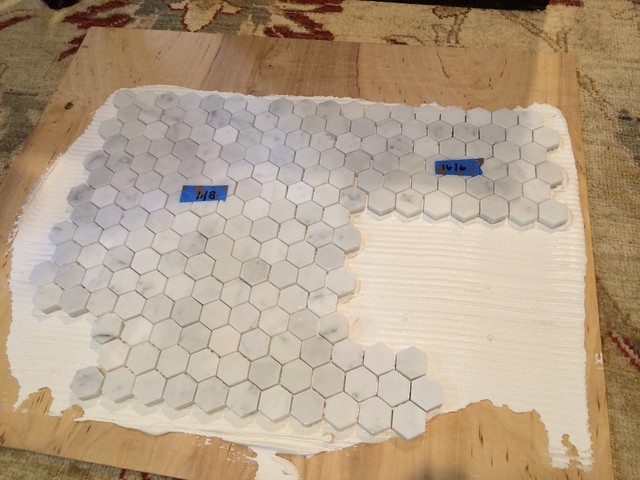
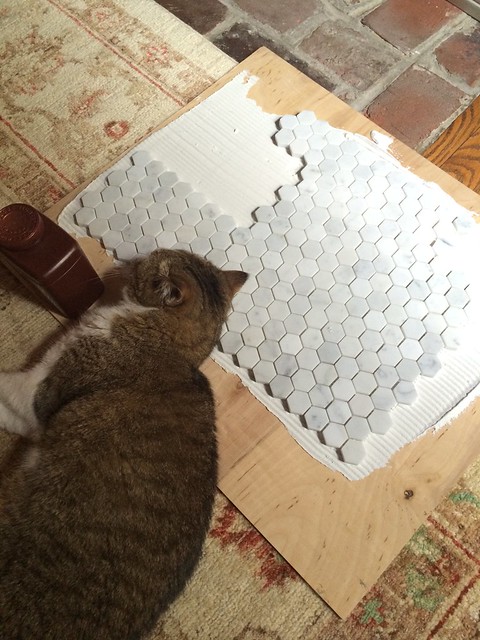
<p>Several days before the bears grout adventure began, papa bear grabbed a piece of scrap plywood from his disgusting, cumbersome, horrible, awful, and just plain terrible basement hoarder lair and mixed up a little bit of thinset. (Honestly, papa bear's basement is so bad that he can barely even move around down there, but he'd rather hibernate than deal with it.) Just like laying one of the sheets of tile on the bathroom floor, papa bear applied a few scrap sheets of tile to the plywood to act as an example of their bathroom's floor. He made sure to vary the sheets and their alignment slightly to simulate all of the variability in the room. Some spacing was too small, some spacing too large, some tiles were left high, others pushed low, and he even made sure there were a few tiles that represented the crooked population of off kilter hex. But some of the tiles...some of them were juuuuusssstttt right! Even Mel approved of the sample board, though he was in the midst of a full blown temper tantrum because he didn't make the cast as one of the three bears. We told him we thought his <a href="http://www.washingtonpost.com/realestate/a-do-it-yourself-long-term-renovation-works-for-an-alexandria-couple/2014/07/24/04d30b12-fca1-11e3-b1f4-8e77c632c07b_story.html" target="_blank">being featured on the cover of the real estate section in last Saturday's Washington Post</a> should make up for it, and we even promised him the starring role of Goldilocks. Mel, well, he was having none of it.&nbsp;</p>
<p>
</p>
<div class="MediaContainer PhotoContainer"><a href="https://farm3.staticflickr.com/2932/14496967677_10a61c2df2_z.jpg" rel="PhotoPopup" popupheight="640" popupwidth="480"><img alt="" src="https://farm3.staticflickr.com/2932/14496967677_10a61c2df2.jpg" width="375" height="500" style="border-width: 0px; border-style: solid;" /></a></div>
<p><strong>This sample board proved to be invaluable.</strong></p>
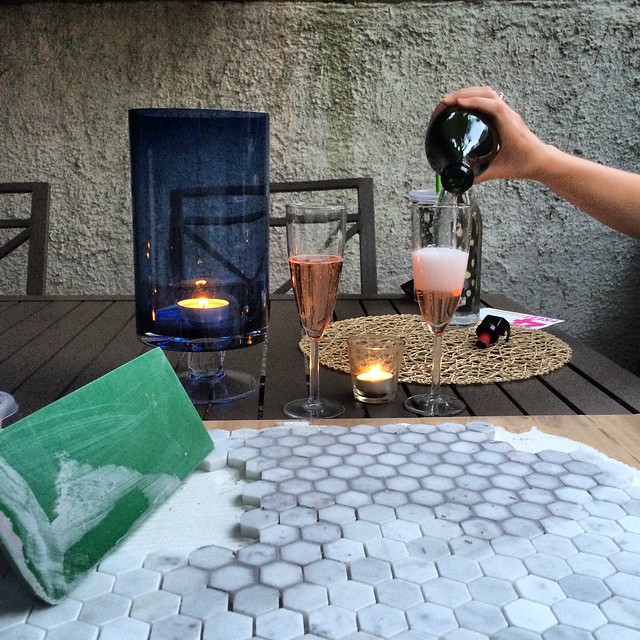
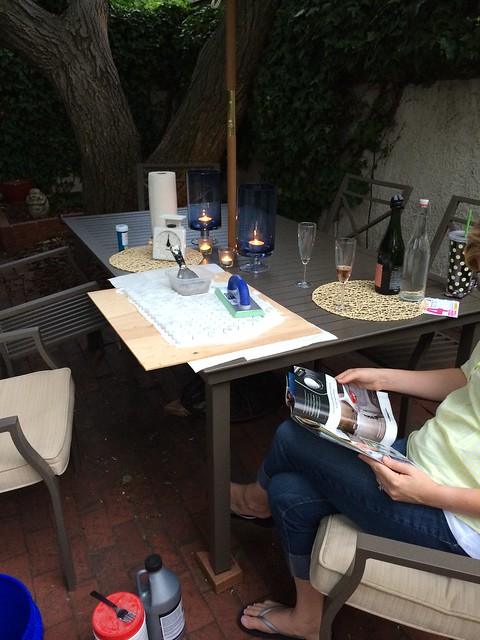
<p>On a Friday night, with absolutely perfect weather, the bears popped the cork on a little sparkling wine (bears like bubbles more than beets, remember that), enjoyed some cheese, nuts, and honey, and did a little grouting on the sample board. Excited to see the grout color come to life on the tile, these bears paid no attention to the fact they were using their Friday night and a bottle of sparkling wine to grout their sample tile rather than having a fun bear's night out.</p>
<p>
</p>
<div class="MediaContainer PhotoContainer"><a href="https://farm6.staticflickr.com/5577/14500861810_b3c63e3b33_z.jpg" rel="PhotoPopup" popupheight="640" popupwidth="640"><img alt="" src="https://farm6.staticflickr.com/5577/14500861810_b3c63e3b33.jpg" width="500" height="500" style="border-width: 0px; border-style: solid;" /></a></div>
<p>They allowed the grout to dry, the whole time thinking they'd be waking up first thing on Saturday and grouting the whole bathroom. After all, it looked like a slightly lighter version of the color the bears wanted when it was wet. But as the grout began to cure the frowny faces on the bears began to grow (except for baby bear, she was sort of oblivious). For what seemed like an adequate gray began to change to an almost white color over the stone.</p>
<p>
</p>
<div class="MediaContainer PhotoContainer"><a href="https://farm6.staticflickr.com/5596/14687625315_556b7b1b85_z.jpg" rel="PhotoPopup" popupheight="640" popupwidth="480"><img alt="" src="https://farm6.staticflickr.com/5596/14687625315_556b7b1b85.jpg" width="375" height="500" style="border-width: 0px; border-style: solid;" /></a></div>
<p>By the time the bears awoke on Saturday morning they were cranky and dejected. While they had hoped for a color that was juuuuusssttt right, they were left with a color that felt completely wrong.</p>
<p>Undeterred by their minor setback, the bears marched right into The Tile Shop once again with the hope they'd be able to muster the courage to get their darker grout. But that's the thing about the Tile Shop grout colors, there isn't a wide array of true gray grout, so the next darkest was called charcoal and was very dark.</p>
<p>This time, without hesitation, the bears asked for 30 pounds of the Charcoal grout and exchanged their purchase of Dove Gray. Though the exchange process took and exceedingly long time, due to checkout system errors and the need to try multiple credit cards, perhaps 20 minutes or more to check out, which resulted in a near meltdown from Mamma Bear that required a bit of a bear walkabout through the store to keep a level head, the new grout was ultimately acquired and the bears were on their way. </p>
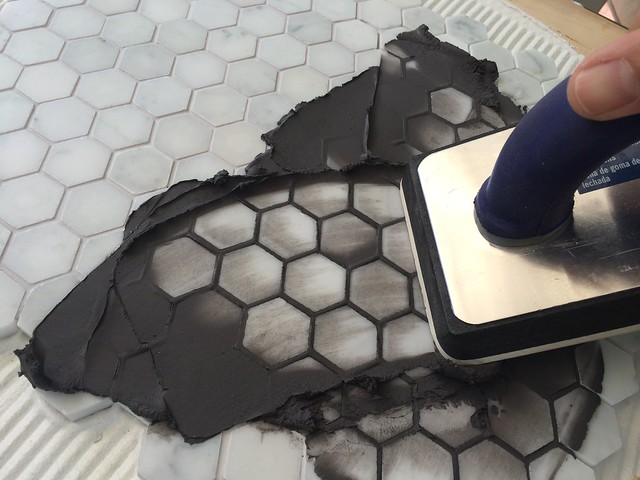
<p>Knowing the test board had saved their little bear hides the night before, they decided to have lunch outside and test out this new grout color on an ungrouted area of their test board. So once again, the bears gathered the necessary supplies and measured out the right amount of test grout to mix up. However, this time didn't involve alcohol of any sort since the bears needed to keep their heads about them. Day drinking doesn't typically lend itself to weekend grout productivity, though I'm relatively sure it was noon somewhere...</p>
<p>
</p>
<div class="MediaContainer PhotoContainer"><a href="https://farm4.staticflickr.com/3896/14509789357_2a8a9af744_z.jpg" rel="PhotoPopup" popupheight="480" popupwidth="640"><img alt="" src="https://farm4.staticflickr.com/3896/14509789357_2a8a9af744.jpg" width="500" height="375" style="border-width: 0px; border-style: solid;" /></a></div>
<p>As they applied the new charcoal grout to the board the bears both had the same though, "ruh-roh, that grout is actually quite dark. Is this right? Is this the color we want? Or is this just too dark?"</p>
<p>
</p>
<div class="MediaContainer PhotoContainer"><a href="https://farm6.staticflickr.com/5565/14507185048_5147ebdc54_z.jpg" rel="PhotoPopup" popupheight="480" popupwidth="640"><img alt="" src="https://farm6.staticflickr.com/5565/14507185048_5147ebdc54.jpg" width="500" height="375" style="border-width: 0px; border-style: solid;" /></a></div>
<p>The bears, being modern bears with smartphones and social media know-how, took to Instagram with a #nofilter post to solicit the advice of their Internet friends. And while the bears really hoped everyone would say "oh, bears, that dark is just splendid, you simply must grout your new floor using that dark gray, it would be a true shame to go light." (That's how the bear's Instagram friends usually talk.) The reality of the response was quite a bit different.</p>
<p>
</p>
<div class="MediaContainer PhotoContainer"><a href="https://farm6.staticflickr.com/5584/14695071924_5e69d50bd2_z.jpg" rel="PhotoPopup" popupheight="480" popupwidth="640"><img alt="" src="https://farm6.staticflickr.com/5584/14695071924_5e69d50bd2.jpg" width="500" height="375" style="border-width: 0px; border-style: solid;" /></a></div>
<p>Overwhelmingly the Internets thought the bears' light color grout was the way to go. Even people the bears thought for sure would prefer the dark wanted the light! And though the board had yet to cure, the bears knew in the their little bear hearts that this color was simply too dark.</p>
<p>Having now wasted half of the day they had hoped would have been spent grouting, the bears had established a grout color that was too light, and a grout color that was too dark. But they were still in search of a grout color that would be just right.</p>
<p>Frustrated but determined, the bears had to move on from The Tile Shop due to the limited colors and set out to search the orange box for the preferred color grout. If you're keeping score, this now meant the bears would be spending Saturday evening on their grout hunt. And while this may make for a "nice little Saturday" for some, it wasn't in the original plans for these bears.</p>
<p>The bears lumbered into the tile and grout aisle and located the many boxes of grout. The only problem, almost every single box was of the sanded variety. Since the bears are grouting tile that has a maximum of 1/16" grout lines, they needed un-sanded grout.</p>
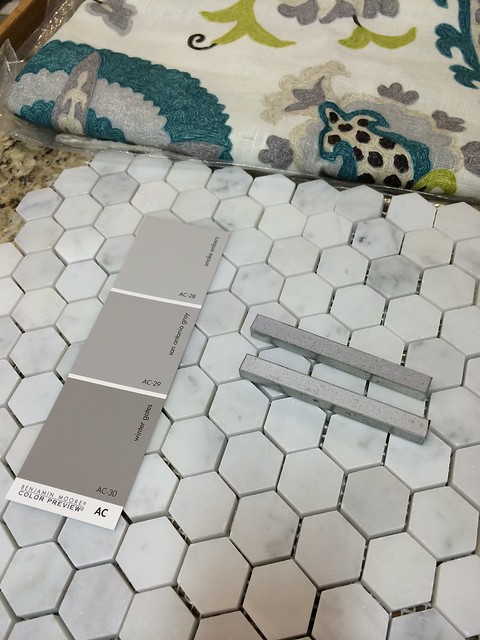
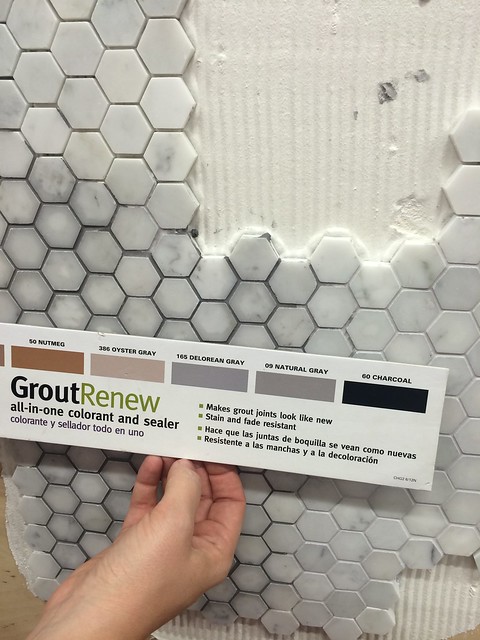
<p>While they searched the bears found a grout color chart and held it up to their sample board they'd brought with them to the store, like a couple of grouting bear crazies. </p>
<p>
</p>
<div class="MediaContainer PhotoContainer"><a href="https://farm3.staticflickr.com/2915/14511269128_df9ba22d58_z.jpg" rel="PhotoPopup" popupheight="640" popupwidth="480"><img alt="" src="https://farm3.staticflickr.com/2915/14511269128_df9ba22d58.jpg" width="375" height="500" style="border-width: 0px; border-style: solid;" /></a></div>
<p>In a way, the bears just wanted to jump into a time machine that would take them back to the beginning of this whole process so they could just choose the right grout from the start. And, in a way, they'd just found one...of sorts. </p>
<p>
</p>
<div class="MediaContainer PhotoContainer"><a href="https://farm4.staticflickr.com/3911/14776155362_20478640c9_z.jpg" rel="PhotoPopup" popupheight="316" popupwidth="640"><img alt="" src="https://farm4.staticflickr.com/3911/14776155362_20478640c9.jpg" width="500" height="247" style="border-width: 0px; border-style: solid;" /></a></div>
<p>"Delorean Gray" was the color, a happy medium between the too dark and too light and named for one of the most famous time machines ever created (and not named for the failed 1980's overpriced stainless steel sports car, obviously). But the question, would they have it in unsanded?</p>
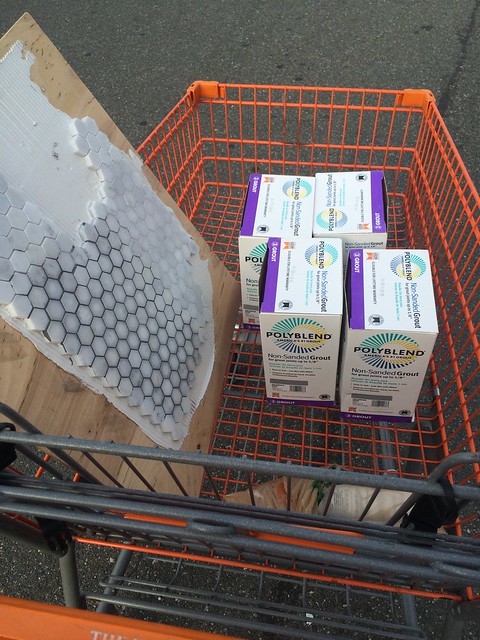
<p>Finally, the growing frustrated bears found the rather small collection of the unsanded variety of grout colors. They crossed their paws and started digging for the color they needed, fully expecting it to be a special order only item. But as luck would have it, the orange box actually had the unsanded Delorean gray in stock! Wow, what are the odds? (I'm guessing, quite low.)</p>
<p>
</p>
<div class="MediaContainer PhotoContainer"><a href="https://farm4.staticflickr.com/3901/14511294070_faffd6ed7f_z.jpg" rel="PhotoPopup" popupheight="640" popupwidth="480"><img alt="" src="https://farm4.staticflickr.com/3901/14511294070_faffd6ed7f.jpg" width="375" height="500" style="border-width: 0px; border-style: solid;" /></a></div>
<p>Returning home, the bears were both tired and excited by the prospects of actually moving ahead with their grouting work. Bears love grouting, and to this point, working only on sample boards was a lame second to the real thing. But the bears needed to measure out just a little more sample grout from the newly purchased boxes to run one more color test on their sample board.</p>
<p>
</p>
<div class="MediaContainer PhotoContainer"><a href="https://farm4.staticflickr.com/3899/14512826258_e8b8cdea70_z.jpg" rel="PhotoPopup" popupheight="640" popupwidth="480"><img alt="" src="https://farm4.staticflickr.com/3899/14512826258_e8b8cdea70.jpg" width="375" height="500" style="border-width: 0px; border-style: solid;" /></a></div>
<p>They'd already seen too dark, they'd already experienced too light, perhaps, just perhaps, this grout color would be juuuuuiissssstttt right!</p>
<p>
</p>
<div class="MediaContainer PhotoContainer"><a href="https://farm4.staticflickr.com/3886/14719060083_a79d868cf9_z.jpg" rel="PhotoPopup" popupheight="640" popupwidth="480"><img alt="" src="https://farm4.staticflickr.com/3886/14719060083_a79d868cf9.jpg" width="375" height="500" style="border-width: 0px; border-style: solid;" /></a></div>
<p>It may have started our quite dark, but the next morning, after an appropriate amount of dry time, the bears took a look at their sample board and found the color had dried to that soft medium gray they were searching for. Their "time machine" had worked, and the Delorean Gray (upper right) was the answer to their color questions.</p>
<p>
</p>
<div class="MediaContainer PhotoContainer"><a href="https://farm3.staticflickr.com/2918/14707437325_8dcc805886_z.jpg" rel="PhotoPopup" popupheight="480" popupwidth="640"><img alt="" src="https://farm3.staticflickr.com/2918/14707437325_8dcc805886.jpg" width="500" height="375" style="border-width: 0px; border-style: solid;" /></a></div>
<p>It was a process to say the least, and one that required perseverance and patience to select the appropriate color. The bears had a lot of work ahead of them before they can call the grouting complete, but one of the hardest parts of the process was now behind them.</p>
<p>Most importantly, the bears learned that a sample board is an invaluable piece of a proper grout selection, that return policies are a great thing, and they're fortunate that the various home improvement stores are all withing a relatively short drive in the bear family truckster.</p>
<p>And you're wondering where Goldilocks (but the male version) was throughout this whole ordeal, you need look no further than the nearest cushion.&nbsp;</p>
<p>
</p>
<div class="MediaContainer PhotoContainer"><a href="https://farm6.staticflickr.com/5571/14700709194_1e579ef851_z.jpg" rel="PhotoPopup" popupheight="640" popupwidth="480"><img alt="" src="https://farm6.staticflickr.com/5571/14700709194_1e579ef851.jpg" width="375" height="500" style="border-width: 0px; border-style: solid;" /></a></div>
<p>Apparently they are all pretty much just right.</p><p><a href="https://www.oldtownhome.com/2014/7/29/The-Three-Bears-Go-Back-In-Time-for-the-Right-Color-Grout/">Read Full Post</a></p>]]></content>
    <category term="Header Image" />
    <category term="Master Bathroom" />
    <category term="Tile" />
    <PostImage>https://farm3.staticflickr.com/2917/14753665806_3985d9ea2a.jpg</PostImage>
    <media:thumbnail url="https://farm3.staticflickr.com/2917/14753665806_3985d9ea2a_t.jpg" />
    <ExtensionElements>
      <Item>PostImage</Item>
      <Item>media:thumbnail</Item>
    </ExtensionElements>
  </entry>
  <entry>
    <guid>a9e7a932-d5ba-44bf-9e13-a53645eb7a9c</guid>
    <id>https://www.oldtownhome.com/2014/7/18/At-the-End-of-Our-Floor-Tiling-Ropes/</id>
    <title>At the End of Our Floor Tiling Ropes</title>
    <summary type="html"><![CDATA[<p>My mom loves to tell a story about how "detail oriented" I was as a small child. I think I was about six years old and was apparently creating some sort of improvised 3D construction paper house using a pen, scissors, and scotch tape. She fondly remembers that I wanted the house to be brick, so I grabbed some red construction paper for the walls and began free hand drawing every little line for the mortar. I guess I spent hours drawing each little line, and if I got something wrong, I'd start over on a new sheet of paper. Little did I know, this was an early example of the tone that would be set for so many projects throughout my life.</p><p>Like the construction paper house, the concept of tiling with a small mosaic pattern in a large room all begins so simply. The desire is obviously to have a beautiful room where the floor is covered by tens of thousands of tiny little pieces of naturally occurring stone that have been chipped off a much larger stone and sculpted by machines into tiny semi-consistent shapes. What could go wrong?</p><p>The answer is even simpler than the perceived goal.&nbsp;<strong><em>A lot can go wrong!&nbsp;</em></strong>Mosaic tile and being a perfectionist in no way go together like peas and carrots. This is a difficult lesson we've learned during each of our tiling processes, and one that has several stages of tiling grief before reaching tiling acceptance.</p><p>
</p><div class="MediaContainer PhotoContainer"><a href="https://farm4.staticflickr.com/3901/14651690516_85251aedfc_z.jpg" rel="PhotoPopup" popupheight="640" popupwidth="640"><img alt="" src="https://farm4.staticflickr.com/3901/14651690516_85251aedfc.jpg" width="500" height="500" style="border-width: 0px; border-style: solid;"></a></div><p>However, we seem to keep choosing mosaic tile of some sort time and again. Like we're some sort of DIY gluttons for punishment. Our first piece of evidence, the guest bathroom:</p><p>
</p> <a href="https://www.oldtownhome.com/2014/7/18/At-the-End-of-Our-Floor-Tiling-Ropes/">more</a>]]></summary>
    <published>2014-07-18T12:21:00.000-04:00</published>
    <updated>2014-07-18T12:21:00.000-04:00</updated>
    <link rel="alternate" href="https://www.oldtownhome.com/2014/7/18/At-the-End-of-Our-Floor-Tiling-Ropes/" />
    <author>
      <name>Alex</name>
    </author>
    <content type="html"><![CDATA[<p>My mom loves to tell a story about how "detail oriented" I was as a small child. I think I was about six years old and was apparently creating some sort of improvised 3D construction paper house using a pen, scissors, and scotch tape. She fondly remembers that I wanted the house to be brick, so I grabbed some red construction paper for the walls and began free hand drawing every little line for the mortar. I guess I spent hours drawing each little line, and if I got something wrong, I'd start over on a new sheet of paper. Little did I know, this was an early example of the tone that would be set for so many projects throughout my life.</p>
<p>Like the construction paper house, the concept of tiling with a small mosaic pattern in a large room all begins so simply. The desire is obviously to have a beautiful room where the floor is covered by tens of thousands of tiny little pieces of naturally occurring stone that have been chipped off a much larger stone and sculpted by machines into tiny semi-consistent shapes. What could go wrong?</p>
<p>The answer is even simpler than the perceived goal.&nbsp;<strong><em>A lot can go wrong!&nbsp;</em></strong>Mosaic tile and being a perfectionist in no way go together like peas and carrots. This is a difficult lesson we've learned during each of our tiling processes, and one that has several stages of tiling grief before reaching tiling acceptance.</p>
<p>
</p>
<div class="MediaContainer PhotoContainer"><a href="https://farm4.staticflickr.com/3901/14651690516_85251aedfc_z.jpg" rel="PhotoPopup" popupheight="640" popupwidth="640"><img alt="" src="https://farm4.staticflickr.com/3901/14651690516_85251aedfc.jpg" width="500" height="500" style="border-width: 0px; border-style: solid;" /></a></div>
<p>However, we seem to keep choosing mosaic tile of some sort time and again. Like we're some sort of DIY gluttons for punishment. Our first piece of evidence, the guest bathroom:</p>
<p>
</p>
<div class="MediaContainer PhotoContainer"><a href="https://farm8.staticflickr.com/7170/6534690155_a8c472fb58_z.jpg" rel="PhotoPopup" popupheight="640" popupwidth="427"><img alt="" src="https://farm8.staticflickr.com/7170/6534690155_a8c472fb58.jpg" width="333" height="500" style="border-width: 0px; border-style: solid;" /></a></div>
<p>We love the tile, yes, but getting that floor in place took every fiber of my being and I still see problems that no one else sees.</p>
<p>Evidence item number two...<a href="http://www.oldtownhome.com/2012/2/23/Vestibule-Project-Status-Complete/">our vestibule</a>. Teeny tiny as far as area, but a giant pain to lay since nearly even single sheet needed to be cut in some way.</p>
<p>
<div class="MediaContainer PhotoContainer"><a href="https://farm6.staticflickr.com/5080/5835863333_108daa275a_z.jpg" rel="PhotoPopup" popupheight="478" popupwidth="640"><img alt="" src="https://farm6.staticflickr.com/5080/5835863333_108daa275a.jpg" width="500" height="374" style="border-width: 0px; border-style: solid;" /></a></div>
</p>
<p>After our <a href="http://www.oldtownhome.com/2014/7/11/Tile-Laying-Tips-from-Baboon-Ear-and-Pookie-the-Thinset-Slinger/">last master bathroom update</a> we had reached the 95% mark on laying our tile. But that 95% was more about volume than actual completion of work. </p>
<p>
</p>
<div class="MediaContainer PhotoContainer"><a href="https://farm3.staticflickr.com/2898/14441812838_027152910f_z.jpg" rel="PhotoPopup" popupheight="640" popupwidth="640"><img alt="" src="https://farm3.staticflickr.com/2898/14441812838_027152910f.jpg" width="500" height="500" style="border-width: 0px; border-style: solid;" /></a></div>
<p>The idea in laying tile like this is to get the majority out of the way and save the hard stuff for last. </p>
<p>Come to think of it, tiling ends up being treated the same way a lot of people treat most things in life. Empty the bottom dishwasher rack first because the top is a pain. Wash the whites and towels first because folding the colors is a pain. Rip apart your whole house first...because putting it back together is a pain. You get my drift?</p>
<p>Anyhow, we had laid the majority of the field tile and left the more difficult areas that required measuring, lots of cuts, and a fair amount of patience for the last few steps. </p>
<p>Good plan! Until it came to doing all of the detail stuff. It's times like these where I wish we had a house elf of the Harry Potter variety that could assist with the tedious work.</p>
<p>
<div class="MediaContainer PhotoContainer"><a href="https://farm4.staticflickr.com/3909/14680695321_129f5e15ec.jpg" rel="PhotoPopup" popupheight="205" popupwidth="500"><img alt="" src="https://farm4.staticflickr.com/3909/14680695321_129f5e15ec.jpg" width="500" height="205" style="border-width: 0px; border-style: solid;" /></a></div>
</p>
<p>Our final steps in laying tile required cuts at the door threshold and inside the closet (the <a href="http://www.oldtownhome.com/2014/7/3/To-Paint-or-Not-To-Paint-the-Salvaged-Floor-Panelling-in-Our-Bathroom-Closet/">one with the awesome panelled walls</a>). We actually made pretty short work of it since the walls in the closet will ultimately have small shoe molding to mask any variability in the cut.</p>
<p>To be honest, I was dreading the door threshold. After we chose to lay the tile <a href="http://www.oldtownhome.com/2014/6/23/Whats-Your-Vote---On-the-Point-or-On-the-Flat/">"on point" instead of "on side,"</a> there was the nagging voice in my head that kept saying, "Now you're going to have to make lots of cuts like all of those people on your blog said you will." To make matters worse, the wall is ever so slightly out of square to the lines of the tile and the rest of the room, so the threshold isn't a true 90 degrees to the pattern of the room. But when it comes to mosaic tile, this turns out to be not that big of a deal.</p>
<p>I laid the tile in place and made pencil marks on the tile where it met the edge of the threshold. Using a straight edge I connected those lines and took the sheet down to the tile saw (which is in the basement, my legs got a workout on this project). I then slowly cut the sheet to give myself that slightly askew line the threshold needed. Any cuts that were too small to make on the sheet, like the tiny little triangle points, I made by cutting individual tiles. It wasn't terribly difficult, but it was a bit time consuming. But the end result? We have a nearly perfect threshold that should look pretty good once grouted.</p>
<p>
</p>
<div class="MediaContainer PhotoContainer"><a href="https://farm3.staticflickr.com/2916/14660428286_b63b296e22_z.jpg" rel="PhotoPopup" popupheight="480" popupwidth="640"><img alt="" src="https://farm3.staticflickr.com/2916/14660428286_b63b296e22.jpg" width="500" height="375" style="border-width: 0px; border-style: solid;" /></a></div>
<p>Now we just need the marble slab piece to fill in the transition.</p>
<p>One would think that laying this final critical element of mosaic marble tile would mark the completion of this major step in our bathroom journey. Perhaps we could now move onto sealing the stone and then grouting. However, if one would think that we logically move from one thing to the next, completing each task and then tidily moving onto the next step in the process with no significant steps backwards...well, I'd say one does not know us well.</p>
<p>No way, no how, could we leave well enough alone. After allowing our fully laid floor to cure for the prerequisite 24 hours, we began walking over the beautiful stone and discovering its glaring imperfections throughout. I know I may have said we are embracing the "consistent inconsistencies" of the stone, but this is so foreign to us that we were having a particularly difficult time letting some of the more egregious flaws fly.</p>
<p>For example, do you see the glaringly horrible space that's too large running along several of the tiles that clearly shows the demarkation line separating two sheets in the following photo?&nbsp;</p>
<p>
</p>
<div class="MediaContainer PhotoContainer"><a href="https://farm6.staticflickr.com/5529/14635945731_a0f3561b59_z.jpg" rel="PhotoPopup" popupheight="480" popupwidth="640"><img alt="" src="https://farm6.staticflickr.com/5529/14635945731_a0f3561b59.jpg" width="500" height="375" style="border-width: 0px; border-style: solid;" /></a></div>
<p>It may be a little harder to see in the photo, but when we saw it in person we couldn't stand it. Look at the line three tiles south of the detached sheet.</p>
<p>So what do you do in this situation? How do you resolve your tile laying mistakes, or even previously unseen issues in the tiles themselves, beyond the 24 hour dry time of the thinset?</p>
<p>Well, you start by defining the tiles that are particularly offensive throughout the whole room. In our case we were looking for tiles spaced too far apart, tiles way too close together (especially those touching), tiles too tall or too low, significantly crooked tiles, and collections of tiles that were off from the pattern in too consistent of a manner. And once you find them all, you mark all of the problem tiles with tape.</p>
<p>
</p>
<div class="MediaContainer PhotoContainer"><a href="https://farm4.staticflickr.com/3925/14465478989_dcc3e18d5f_z.jpg" rel="PhotoPopup" popupheight="480" popupwidth="640"><img alt="" src="https://farm4.staticflickr.com/3925/14465478989_dcc3e18d5f.jpg" width="500" height="375" style="border-width: 0px; border-style: solid;" /></a></div>
<p>This tape marking scheme makes it much easier to identify and move on, rather than attempting to fix every tile you need to adjust. Once you've gone over the whole room and have all of your biggest issues identified, it's time to get to work.</p>
<p>Since the thinset has already cured to some extent, you can't just pop tiles out without causing issues. This is especially true when the tiles are still adhered to the mats they were laid on. Chances are, if you pull up on one of the tiles in the mat, you'll end up ripping up far more than just the one or few problem tiles. In this case I grab my utility knife and begin tracing the perimeter of the tile to cut the mat and free the tile.</p>
<p>
</p>
<div class="MediaContainer PhotoContainer"><a href="https://farm6.staticflickr.com/5483/14634551616_c0f5109ff6_z.jpg" rel="PhotoPopup" popupheight="480" popupwidth="640"><img alt="" src="https://farm6.staticflickr.com/5483/14634551616_c0f5109ff6.jpg" width="500" height="375" style="border-width: 0px; border-style: solid;" /></a></div>
<p><strong>IMPORTANT!!! Don't ever do this if your tile is laid on a waterproofing membrane of any sort in a shower or other area that must remain waterproof. There's a pretty great chance you'll perforate your membrane and ruin your whole DIY life.</strong></p>
<p>We didn't need to worry about this on our floor as our membrane is just there for isolation purposes, not waterproofing. So an incidental puncture wouldn't be catastrophic.</p>
<p>Once the tile's sheet is scored, use a pry bar, putty knife, or some other small edge you can use as a lever. I use our pry bar and really jam my thumb in behind it. I find using my thumb in this way protects the surrounding tile from getting chipped edges.&nbsp;</p>
<p>
</p>
<div class="MediaContainer PhotoContainer"><a href="https://farm3.staticflickr.com/2909/14655993302_5003f067f4_z.jpg" rel="PhotoPopup" popupheight="640" popupwidth="480"><img alt="" src="https://farm3.staticflickr.com/2909/14655993302_5003f067f4.jpg" width="375" height="500" style="border-width: 0px; border-style: solid;" /></a></div>
<p>Applying gentle pressure to the stone you want to remove, you can usually pop it right out of its place. As a byproduct, you'll also get a pretty good sense of how well you did in getting the thinset coverage on the back of the tile. Then you just grab the loosened tile and pull it free.</p>
<p>
</p>
<div class="MediaContainer PhotoContainer"><a href="https://farm6.staticflickr.com/5523/14657514085_3e66a9eaf7_z.jpg" rel="PhotoPopup" popupheight="480" popupwidth="640"><img alt="" src="https://farm6.staticflickr.com/5523/14657514085_3e66a9eaf7.jpg" width="500" height="375" style="border-width: 0px; border-style: solid;" /></a></div>
<p>When the tile, or group of tiles, is free from it's location, set them aside. Since they have thinset all over them, it's usually easier to grab some tile from your leftovers to replace the removed tiles.</p>
<p>Before we can replace the removed tiles, we need to clean out the old thinset, otherwise we'll almost certainly end up with new tiles that correct the spacing or orientation issues of the problem tile, but it will be far too high and always look out of place. And we all know, this is what we'll stare at while we're in the room, always wondering why we didn't fix it properly.</p>
<p>
</p>
<div class="MediaContainer PhotoContainer"><a href="https://farm4.staticflickr.com/3850/14634550166_c494389a1a_z.jpg" rel="PhotoPopup" popupheight="480" popupwidth="640"><img alt="" src="https://farm4.staticflickr.com/3850/14634550166_c494389a1a.jpg" width="500" height="375" style="border-width: 0px; border-style: solid;" /></a></div>
<p>I like to scrape out the old thinset using some of our paint stripping pull scraper tools. The scraping heads are small enough to get into the small spaces, and the edges ensure I'm getting right down to the membrane fleece. <strong>Again, if you're doing this in a waterproofed space, make sure you're&nbsp;exercising&nbsp;tremendous caution to be sure you don't puncture the membrane.</strong></p>
<p>This method works on single tile spaces or much larger area, so it's great no matter the issue.</p>
<p><strong>
</strong></p>
<div class="MediaContainer PhotoContainer"><strong><a href="https://farm4.staticflickr.com/3915/14628102941_d4f54c732f_z.jpg" rel="PhotoPopup" popupheight="480" popupwidth="640"><img alt="" src="https://farm4.staticflickr.com/3915/14628102941_d4f54c732f.jpg" width="500" height="375" style="border-width: 0px; border-style: solid;" /></a></strong></div>
<strong>
</strong>
<p>After all is said and done with the scraper we had a clean space that was ready for our adjusted tiles.</p>
<p>
</p>
<div class="MediaContainer PhotoContainer"><a href="https://farm4.staticflickr.com/3910/14676286713_aea7095baa_z.jpg" rel="PhotoPopup" popupheight="480" popupwidth="640"><img alt="" src="https://farm4.staticflickr.com/3910/14676286713_aea7095baa.jpg" width="500" height="375" style="border-width: 0px; border-style: solid;" /></a></div>
<p>Like I said, big or small.</p>
<p>
</p>
<div class="MediaContainer PhotoContainer"><a href="https://farm4.staticflickr.com/3913/14628102111_1c3890b93f_z.jpg" rel="PhotoPopup" popupheight="480" popupwidth="640"><img alt="" src="https://farm4.staticflickr.com/3913/14628102111_1c3890b93f.jpg" width="500" height="375" style="border-width: 0px; border-style: solid;" /></a></div>
<p>Depending on the tiles removed we had to either select single tiles that would fit the space, or a collection of multiple tiles we could lay in as a mat. This process, due to the minor variances with each tile, required us to select the individual tiles and then lay them next to their intended location with a specific orientation. We couldn't just grab any tile and pop it in, it had to be a specific tile. You can see how I laid out the specific groups of tiles that would fill the space below the now vacant area. This is important whether it's one or 30 tiles.</p>
<p>
</p>
<div class="MediaContainer PhotoContainer"><a href="https://farm4.staticflickr.com/3865/14452834597_5899ab734d_z.jpg" rel="PhotoPopup" popupheight="480" popupwidth="640"><img alt="" src="https://farm4.staticflickr.com/3865/14452834597_5899ab734d.jpg" width="500" height="375" style="border-width: 0px; border-style: solid;" /></a></div>
<p>This is also where that "detail oriented" nature I learned I had as a kid really came into play. It's a trait that grossly expands the timeline of a project, making it border on the unbearable, but it produces some tremendously improved results.</p>
<p>Incidentally, when working on hexagon tile without knee pads, it also leaves quite an impression...of sorts.</p>
<p>
</p>
<div class="MediaContainer PhotoContainer"><a href="https://farm4.staticflickr.com/3901/14675896823_4e2ac5c4e8_z.jpg" rel="PhotoPopup" popupheight="640" popupwidth="480"><img alt="" src="https://farm4.staticflickr.com/3901/14675896823_4e2ac5c4e8.jpg" width="375" height="500" style="border-width: 0px; border-style: solid;" /></a></div>
<p>When we were happy with the selection of replacement tiles it was time to proceed with a little batch of thinset mixing. Since we're just laying a small number of tiles, we really didn't need much thinset at all. Maybe a cup or two at most.</p>
<p>After the the surface was clean of old thinset, and the tiles were specifically chosen for each area, putting the tile in place was actually the easiest part of the whole process. Using a technique aptly called "back buttering" it's simple. Just grab a bit of thinset and smear it on the back of the tile that's being placed.</p>
<p>With small or single tiles, it's best to overfill the back just a bit to ensure good coverage, usually with a peak right in the middle. When it's placed, this little peak smooshes out to the edges and allows the tile to sit at exactly the right height.</p>
<p>
</p>
<div class="MediaContainer PhotoContainer"><a href="https://farm4.staticflickr.com/3882/14664770885_096430b05c_z.jpg" rel="PhotoPopup" popupheight="480" popupwidth="640"><img alt="" src="https://farm4.staticflickr.com/3882/14664770885_096430b05c.jpg" width="500" height="375" style="border-width: 0px; border-style: solid;" /></a></div>
<p>With larger mats of tiles I still like to apply the thinset and then scrape it off with my V-notch trowel. This ensures that there isn't too much thinset when I place the tiles, otherwise I might end up with some of the thinset coming up between the pattern.</p>
<p>
</p>
<div class="MediaContainer PhotoContainer"><a href="https://farm4.staticflickr.com/3868/14461427748_e164f85c92_z.jpg" rel="PhotoPopup" popupheight="640" popupwidth="480"><img alt="" src="https://farm4.staticflickr.com/3868/14461427748_e164f85c92.jpg" width="375" height="500" style="border-width: 0px; border-style: solid;" /></a></div>
<p>After placing the tiles in their new home all that's left is a little adjustment here and there to get a good fit and even spacing...</p>
<p>
</p>
<div class="MediaContainer PhotoContainer"><a href="https://farm3.staticflickr.com/2926/14662445114_1f22255cec_z.jpg" rel="PhotoPopup" popupheight="480" popupwidth="640"><img alt="" src="https://farm3.staticflickr.com/2926/14662445114_1f22255cec.jpg" width="500" height="375" style="border-width: 0px; border-style: solid;" /></a></div>
<p>...then to step back and admire the newly set tile. We always use a tape outline to either show the results of our tile crime scene efforts, or to ensure we don't step on any of our wet tile areas for another 24 hours.</p>
<p>
</p>
<div class="MediaContainer PhotoContainer"><a href="https://farm6.staticflickr.com/5522/14462306199_968c028eb3_z.jpg" rel="PhotoPopup" popupheight="640" popupwidth="480"><img alt="" src="https://farm6.staticflickr.com/5522/14462306199_968c028eb3.jpg" width="375" height="500" style="border-width: 0px; border-style: solid;" /></a></div>
<p>As you can see, we ended up pulling up and putting back down quite a few areas where we weren't happy with the initial layout. In reality, this is just the first of what turned out to be two go-rounds with this pull up and put down process. In total, we ended up making these adjustments to about a dozen different places in the bathroom. We pulled up strips of tiles where the line was too apparent, sections where there had been problems in the sheets, and many different area where two tiles were touching.&nbsp;</p>
<p>And after all of those efforts, what happened?&nbsp;</p>
<p><strong>We. Keep. Finding. More. Problems.</strong></p>
<p>It's inevitable. No matter how many things you fix in a tile job like this, you're going to find more problems. At a certain point it becomes Pandora's box, and the more you fix the more you find. The cycle goes on endlessly and we could spend a solid week doing nothing but fixing problems only to find more.&nbsp;</p>
<p>So we decided that two rounds of fixes were enough for our room and we called our tile layout efforts complete. I'm sure after we finish grouting I'll find plenty of places that drive me crazy about the final floor, but I'll begrudgingly chalk it up to the character of an old house and using a stone mosaic floor.&nbsp;</p>
<p>We're anxiously looking forward to the next step in this flooring phase, but we're mulling over other decisions. More specifically, what color grout to use. It's a major debate, I assure you. We'll share the whole process we're going through for that next week. But I'll tell you one thing for sure, I'm both dreading and excited to start that step.</p>
<p>Do you have any experience laying mosaic tile on the floor and have any tips or tricks to share? Do you think we're going overboard with the corrections we're making? Or is it possible our exercise in futility will actually improve the floor enough that we won't just stare at all of the imperfections when, as our commenters all put it, we're sitting there on the toilet? Fingers crossed, we're on the positive side of that debate.</p><p><a href="https://www.oldtownhome.com/2014/7/18/At-the-End-of-Our-Floor-Tiling-Ropes/">Read Full Post</a></p>]]></content>
    <category term="Header Image" />
    <category term="Master Bathroom" />
    <category term="Tile" />
    <PostImage>https://farm3.staticflickr.com/2901/14684188012_ce86a6b073.jpg</PostImage>
    <media:thumbnail url="https://farm3.staticflickr.com/2901/14684188012_ce86a6b073_t.jpg" />
    <ExtensionElements>
      <Item>PostImage</Item>
      <Item>media:thumbnail</Item>
    </ExtensionElements>
  </entry>
</feed>