<?xml version="1.0" encoding="utf-8"?>
<feed xmlns="http://www.w3.org/2005/Atom" xmlns:media="http://search.yahoo.com/mrss/">
  <title>Old Town Home Category: 'Salvage'</title>
  <updated>2018-06-01T09:43:00.000-04:00</updated>
  <id>http://www.oldtownhome.com/salvage/index.atom</id>
  <link rel="alternate" href="http://www.oldtownhome.com/salvage/index.atom" />
  <author>
    <name>Alex and Wendy</name>
    <uri>http://www.oldtownhome.com/</uri>
    <email>wendy@oldtownhome.com</email>
  </author>
  <entry>
    <guid>fca5e21a-0889-4ef6-ad64-708f6a53a561</guid>
    <id>https://www.oldtownhome.com/2018/6/1/Window-Sash-Restoration-Part-5-Sourcing-and-Cutting-New-or-Salvaged-Wavy-Glass/</id>
    <title>Window Sash Restoration Part 5: Sourcing and Cutting New or Salvaged Wavy Glass</title>
    <summary type="html"><![CDATA[<p>Old windows are glorious things of beauty, and the wavy glass they possess are no small part of their classic winning looks.</p><p>If you've ever had a chance to see the undulations of light cast by a ray of sun through imperfect included glass, or enjoyed the subtle dance of fractured and warped reflections caused by true divided light windows with subtly bubbled and wrinkled glass, you know exactly what I'm talking about.</p><p>
</p><div class="MediaContainer PhotoContainer"><a href="https://farm9.staticflickr.com/8092/8504435309_5c8418126b_z.jpg" rel="PhotoPopup" popupheight="427" popupwidth="640"><img alt="" src="https://farm9.staticflickr.com/8092/8504435309_5c8418126b.jpg" width="500" height="333" style="border-width: 0px; border-style: solid;"></a></div><p>In our window restoration we've gone to great lengths to <a href="https://www.oldtownhome.com/2017/10/2/DIY-Stripping-Steam-Box-for-Antique-Window-Glazing-Removal-and-Restoration/" target="_blank">build a steam box</a> in order to r<a href="https://www.oldtownhome.com/2017/11/7/Real-Progress-on-Our-Window-Restoration-Project-Part-1/" target="_blank">emove and protect the unbroken original glass</a> from our window sash. We consider ourselves extremely fortunate to have many panes of our original 130 plus year old glass. Even though many of the pieces are scratched from years of use, we will certainly protect, restore, and reinstall these original panes whenever possible. However, some of the panes of glass are cracked or have been replaced with modern glass over the years.&nbsp;&nbsp;</p><p>Of the four panes of glass I had removed from the first set of two over two window sash we're restoring, one was a more modern replacement, one was broken in the corner, and two were still usable and in good shape.</p><p>We planned to replace the broken and modern pieces of glass, so the hunt for the replacement began. I set the two that I was going to use off to the side to glaze them, and set out to find my replacement glass for the other two pieces.&nbsp;</p> <a href="https://www.oldtownhome.com/2018/6/1/Window-Sash-Restoration-Part-5-Sourcing-and-Cutting-New-or-Salvaged-Wavy-Glass/">more</a>]]></summary>
    <published>2018-06-01T09:43:00.000-04:00</published>
    <updated>2018-06-01T09:43:00.000-04:00</updated>
    <link rel="alternate" href="https://www.oldtownhome.com/2018/6/1/Window-Sash-Restoration-Part-5-Sourcing-and-Cutting-New-or-Salvaged-Wavy-Glass/" />
    <author>
      <name>Alex</name>
    </author>
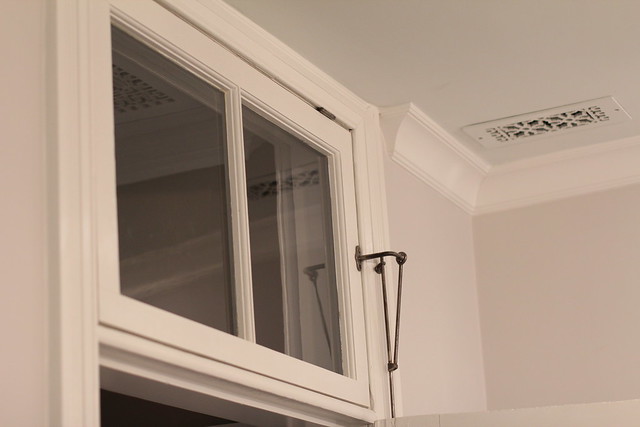
    <content type="html"><![CDATA[<p>Old windows are glorious things of beauty, and the wavy glass they possess are no small part of their classic winning looks.</p>
<p>If you've ever had a chance to see the undulations of light cast by a ray of sun through imperfect included glass, or enjoyed the subtle dance of fractured and warped reflections caused by true divided light windows with subtly bubbled and wrinkled glass, you know exactly what I'm talking about.</p>
<p>
</p>
<div class="MediaContainer PhotoContainer"><a href="https://farm9.staticflickr.com/8092/8504435309_5c8418126b_z.jpg" rel="PhotoPopup" popupheight="427" popupwidth="640"><img alt="" src="https://farm9.staticflickr.com/8092/8504435309_5c8418126b.jpg" width="500" height="333" style="border-width: 0px; border-style: solid;" /></a></div>

<p>In our window restoration we've gone to great lengths to <a href="https://www.oldtownhome.com/2017/10/2/DIY-Stripping-Steam-Box-for-Antique-Window-Glazing-Removal-and-Restoration/" target="_blank">build a steam box</a> in order to r<a href="https://www.oldtownhome.com/2017/11/7/Real-Progress-on-Our-Window-Restoration-Project-Part-1/" target="_blank">emove and protect the unbroken original glass</a> from our window sash. We consider ourselves extremely fortunate to have many panes of our original 130 plus year old glass. Even though many of the pieces are scratched from years of use, we will certainly protect, restore, and reinstall these original panes whenever possible. However, some of the panes of glass are cracked or have been replaced with modern glass over the years.&nbsp;&nbsp;</p>
<p>Of the four panes of glass I had removed from the first set of two over two window sash we're restoring, one was a more modern replacement, one was broken in the corner, and two were still usable and in good shape.</p>
<p>We planned to replace the broken and modern pieces of glass, so the hunt for the replacement began. I set the two that I was going to use off to the side to glaze them, and set out to find my replacement glass for the other two pieces.&nbsp;</p>
<h2>Where Do You Find Wavy Glass?</h2>
<p>For replacement wavy glass we really have three options.</p>
<p><strong>1. Buy New Wavy Glass </strong>- We can source the glass from a vendor the reproduces "handmade" glass using modern techniques to create the historic look. There are a few popular places that sell new old style wavy glass, <a href="https://www.agwglass.com/" target="_blank">Artisan Glass Works (AGW)</a>, <a href="http://www.restorationwindowglass.com/" target="_blank">Hollander Historic Glass</a>,&nbsp;and <a href="https://www.bendheimcabinetglass.com/productCatalog.cfm/Type/Hand-Made-Cabinet-Glass" target="_blank">Bendheim Glass</a>. Of these two, Bendheim tends to be pretty expensive, and their glass is intended for cabinets. AGW produces wavy safety and energy efficient glass, and they are actually less than an hour from us, so that may be a good option for us in the future.</p>
<p><strong>2. Order Old Wavy Glass</strong> - We can order salvaged wavy glass from a variety of locations, such as salvage yards. There used to be a guy that would advertise in Old House Journal, and he was located in Frederick, Maryland, so we ordered some old wavy glass from him about 14 years ago. In these cases we specify the exact size and style (level of imperfections) we're looking for, and the service will find glass that meets our needs and cut to our specifications. This certainly takes a fair amount of the guess work out of getting old glass, and the glass you're getting is truly antique, not a reproduction. However, the service comes at a premium and you'll likely pay double or more than what you'll pay if you do it yourself.</p>
<p><strong>3. Salvage Wavy Glass Yourself</strong> - We can go to the salvage yard and find ourselves an old sash that has glass with the look and size we need, buy the whole sash, and then take it home to pull the glass and cut to size ourselves. This certainly takes the most time, and is also the most risk as you can run into issues whenever you're cutting old glass, but you get to pick exactly what you want. This is often a very important aspect of selecting the glass that's right for you. Iron levels in old glass impact how green they tend to look, and if you're trying to match the glass you select to some existing glass, getting the right tint can be critical.</p>
<p>Can you guess which approach we decided to go with? Don't worry, we won't keep you in any suspense.</p>
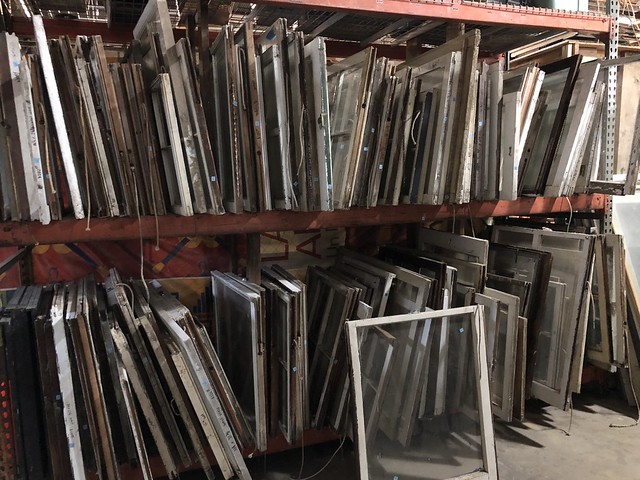
<p><strong>We decided on option #3, "Salvage Wavy Glass Yourself." </strong>Our search took me to one or our favorite local salvage and re-use yards, <a href="http://communityforklift.org/" target="_blank">Community Forklift</a>.</p>
<p>
</p>
<div class="MediaContainer PhotoContainer"><a href="https://farm1.staticflickr.com/815/40699169735_9ef60cf9f6_z.jpg" rel="PhotoPopup" popupheight="480" popupwidth="640"><img alt="" src="https://farm1.staticflickr.com/815/40699169735_9ef60cf9f6.jpg" width="500" height="375" style="border-width: 0px; border-style: solid;" /></a></div>
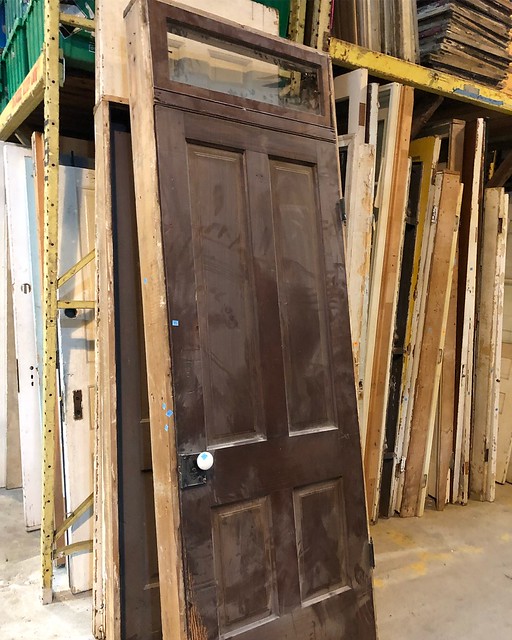
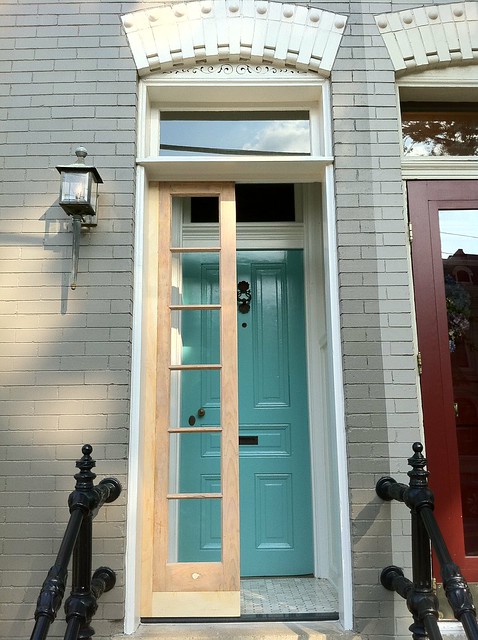
<p>Aside from finding a whole ton of amazing stuff that I really wanted to take home, including this whole door in jamb assembly with intact transom, rim lock, knobs, rosettes, escutcheon, and hinges for just $90!!!!...</p>
<p>
</p>
<div class="MediaContainer PhotoContainer"><a href="https://farm1.staticflickr.com/893/39782927690_65d2136922_z.jpg" rel="PhotoPopup" popupheight="640" popupwidth="512"><img alt="" src="https://farm1.staticflickr.com/893/39782927690_65d2136922.jpg" width="400" height="500" style="border-width: 0px; border-style: solid;" /></a></div>
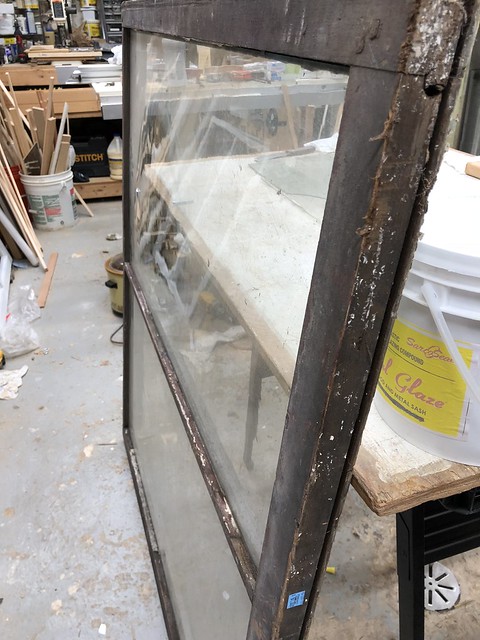
<p>I also found a great window for our purpose. The trick here is finding sash that has large enough pieces of wavy glass that it will be easy to trim it to the the correct size after freeing it from its existing sash.</p>
<p>
</p>
<div class="MediaContainer PhotoContainer"><a href="https://farm1.staticflickr.com/858/41550714982_ca46c209d5_z.jpg" rel="PhotoPopup" popupheight="640" popupwidth="480"><img alt="" src="https://farm1.staticflickr.com/858/41550714982_ca46c209d5.jpg" width="375" height="500" style="border-width: 0px; border-style: solid;" /></a></div>
<p>If the glass is only a little larger than what we need, it will be near impossible to cut it to the correct size due to the limited leverage we can establish for the cut. If you've ever cut glass, you know what I'm talking about. I always look for glass that is either exactly the right size or at least 4" or more larger than what we need.</p>
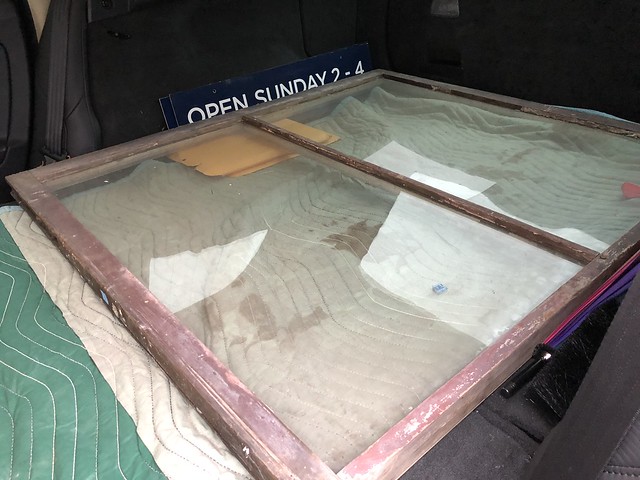
<p>The sash I found was fairly large, and had two really nice pieces of wavy glass in it. Total cost was $86, and I decided to live dangerously, tempting fate by only purchasing this single sash with just enough glass. This meant the window restoration gods had to look kindly upon me and not allow me to screw up the cuts.</p>
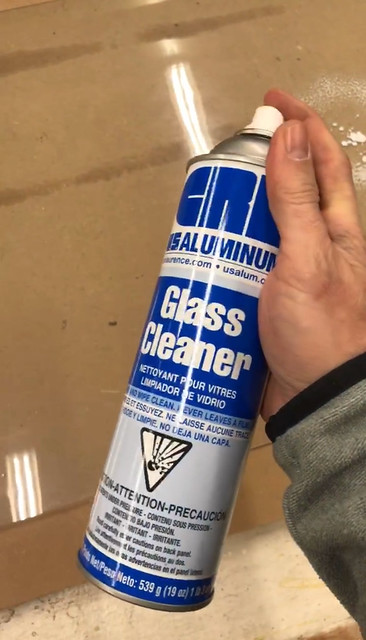
<p><strong><em>Wavy Glass Shopping Pro Tip - Bring Glass Cleaner and Paper Towels to the Salvage Yard!</em></strong></p>
<p><strong><em>
</em></strong></p>
<div class="MediaContainer PhotoContainer"><strong><em><a href="https://farm1.staticflickr.com/912/39782875360_5c5b6fe0a7_z.jpg" rel="PhotoPopup" popupheight="640" popupwidth="480"><img alt="" src="https://farm1.staticflickr.com/912/39782875360_5c5b6fe0a7.jpg" width="375" height="500" style="border-width: 0px; border-style: solid;" /></a></em></strong></div>
<strong><em>
</em></strong>
<p>When shopping for salvaged glass it's important to remember that these old sash are usually very dirty! When the glass is extremely dirty, it's very hard to see whether the glass you're getting is actually wavy to the degree you need it to be or not. So if you have some cleaner on hand you can give it a quick rinse to check the adequacy of the imperfections.&nbsp;</p>
<p>
</p>
<div class="MediaContainer PhotoContainer"><a href="https://farm1.staticflickr.com/917/39782875210_35215c7e2f_z.jpg" rel="PhotoPopup" popupheight="480" popupwidth="640"><img alt="" src="https://farm1.staticflickr.com/917/39782875210_35215c7e2f.jpg" width="500" height="375" style="border-width: 0px; border-style: solid;" /></a></div>
<p>After a tenuous trip home over what I swear are some of the roughest and most pothole filled roads in the DC metro area, I successfully transferred the sash into our basement without breaking any glass! A minor miracle, I assure you.</p>
<p>
</p>
<div class="MediaContainer PhotoContainer"><a href="https://farm1.staticflickr.com/868/39782847490_964d6f9a10_z.jpg" rel="PhotoPopup" popupheight="640" popupwidth="480"><img alt="" src="https://farm1.staticflickr.com/868/39782847490_964d6f9a10.jpg" width="375" height="500" style="border-width: 0px; border-style: solid;" /></a></div>
<p>Beyond the size of the glass, one of the best parts about this sash is the fact that the glazing putty had been so poorly maintained that it almost fell out without effort. It simultaneously made me feel sad for the house it came from, and happy I had to do a little less work. Freeing the glass from the sash was only a matter of removing a few glazing point triangles and loving when a plan comes together.</p>
<p>
</p>
<div class="MediaContainer PhotoContainer"><a href="https://farm1.staticflickr.com/895/39782851150_7490033c0b_z.jpg" rel="PhotoPopup" popupheight="640" popupwidth="480"><img alt="" src="https://farm1.staticflickr.com/895/39782851150_7490033c0b.jpg" width="375" height="500" style="border-width: 0px; border-style: solid;" /></a></div>
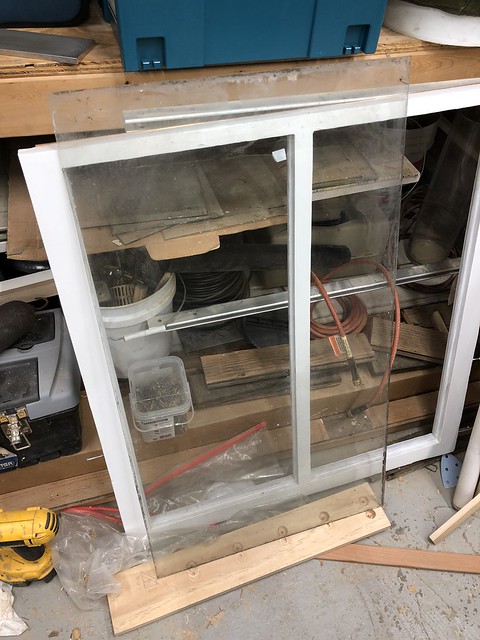
<p>With the glass free from the sash I could see just how much larger the pieces were than the sash it was destined to go into.</p>
<p>
</p>
<div class="MediaContainer PhotoContainer"><a href="https://farm1.staticflickr.com/820/40880034814_228144d0f6_z.jpg" rel="PhotoPopup" popupheight="640" popupwidth="480"><img alt="" src="https://farm1.staticflickr.com/820/40880034814_228144d0f6.jpg" width="375" height="500" style="border-width: 0px; border-style: solid;" /></a></div>
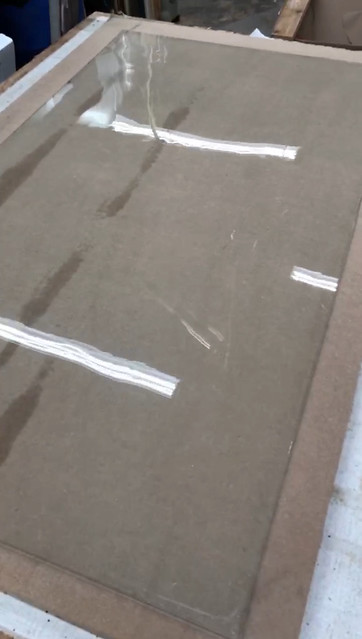
<p>I gave both pieces a thorough cleaning with a foaming glass cleaner and a razor to get any residual gunk off. This is an important step to as it allows you to see any glaring imperfections you may want to avoid when cutting to size.</p>
<p>
</p>
<div class="MediaContainer PhotoContainer"><a href="https://farm2.staticflickr.com/1729/41584795365_0241cd43fc_z.jpg" rel="PhotoPopup" popupheight="640" popupwidth="366"><img alt="" src="https://farm2.staticflickr.com/1729/41584795365_0241cd43fc.jpg" width="286" height="500" style="border-width: 0px; border-style: solid;" /></a></div>
<p>Things like scratches or scoring lines that could end in an easier fracture can often be eliminated from the final piece of glass with a little bit of careful planning.</p>
<p>
</p>
<div class="MediaContainer PhotoContainer"><a href="https://farm2.staticflickr.com/1751/27616797607_9fff15455a_z.jpg" rel="PhotoPopup" popupheight="640" popupwidth="363"><img alt="" src="https://farm2.staticflickr.com/1751/27616797607_9fff15455a.jpg" width="283" height="500" style="border-width: 0px; border-style: solid;" /></a></div>
<h2>Tools You Need For Cutting Wavy Glass</h2>
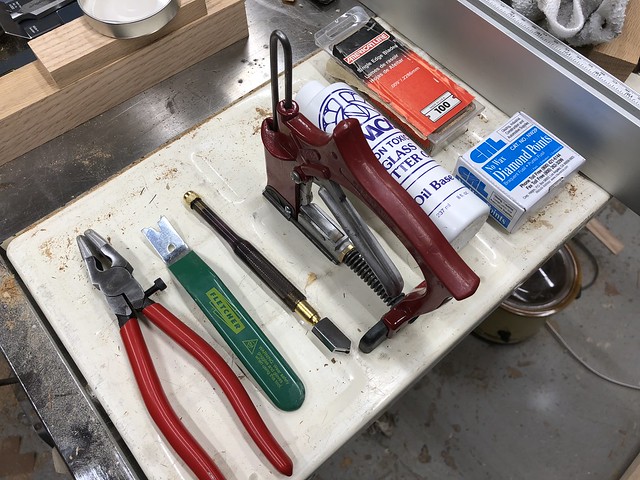
<p>When it comes to cutting wavy glass, it's often an intimidating project that, in reality and execution, is actually very easy. First of all, it's extremely important that you have a handful of inexpensive tools and supplies.</p>
<p class="MediaContainer PhotoContainer"><a href="https://farm1.staticflickr.com/911/41137310834_ce065bea82_z.jpg" rel="PhotoPopup" popupheight="480" popupwidth="640"><img alt="" src="https://farm1.staticflickr.com/911/41137310834_ce065bea82.jpg" width="500" height="375" style="border-width: 0px; border-style: solid;" /></a></p>
<p class="MediaContainer PhotoContainer"><em>Glass Cutting Tools (and a few glazing tools)</em></p>
<p>The following are the invaluable tools and supplies you'll want to pick up if you're looking to do a little glass cutting.</p>
<ol>
    <li>Sharpie</li>
    <li>Straight Edge</li>
    <li><a href="https://amzn.to/2szJH1o" target="_blank">Oil Fed Glass Cutter</a></li>
    <li><a href="https://amzn.to/2LNKJzm" target="_blank">Cutting Oil</a></li>
    <li><a href="https://amzn.to/2LeIJzk" target="_blank">Glass Running Pliers</a></li>
    <li><a href="https://amzn.to/2JovPS4" target="_blank">Cut Resistent Gloves</a></li>
</ol>
<p>Cutting glass is methodic and not particularly difficult endeavor, but certainly has a process. The key is to measure carefully, really carefully, and then just cut once. When I cut I measure the opening size of the glass needed and deduct 1/8" from the measurement. This will allow for a little wiggle room for movement and contraction that could occur, as well as a possibly imperfect opening where you're placing the glass.</p>
<p>I like to measure and mark the glass using a sharpie so I know right where I'm going to be cutting. The sharpie line is simply a point of reference than anything I'm really trying to follow on straight cuts, and it washes off easily after I'm all done. After marking with the sharpie I gently clamp the straight edge just off of the line so that my glass cutter can ride the straight edge the whole length of the cut.&nbsp;</p>
<p>
</p>
<div class="MediaContainer PhotoContainer"><a href="https://farm1.staticflickr.com/837/41555566732_c65b030395_z.jpg" rel="PhotoPopup" popupheight="480" popupwidth="640"><img alt="" src="https://farm1.staticflickr.com/837/41555566732_c65b030395.jpg" width="500" height="375" style="border-width: 0px; border-style: solid;" /></a></div>
<p>If you're doing a curved cut you'll probably need to free hand things a little, but straight cuts almost always go easier if you're using a straight edge.</p>
<p>
</p>
<div class="MediaContainer PhotoContainer"><a href="https://farm1.staticflickr.com/793/26727572787_d870a2de8d_z.jpg" rel="PhotoPopup" popupheight="640" popupwidth="480"><img alt="" src="https://farm1.staticflickr.com/793/26727572787_d870a2de8d.jpg" width="375" height="500" style="border-width: 0px; border-style: solid;" /></a></div>
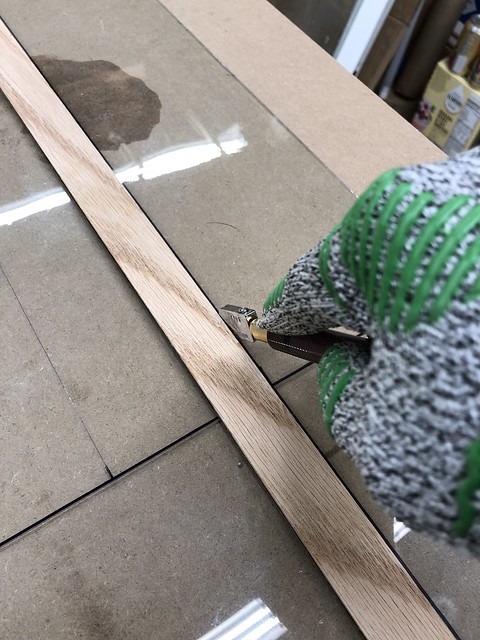
<p>After the glass has been marked it's time to score using the glass cutter. A sharp cutting wheel is paramount to a successful cut. It's debatable whether cutting oil is useful or not, but I've always had better luck with cutters that incorporate auto fed oil as part of the cutting process.&nbsp;</p>
<p>Actually, calling this tool a "glass cutter" is a bit misleading. This is really a glass scorer. It's job is simply to score the glass on a line that will give the glass a predictable line where it wants to cut. The slight relief the score makes in the surface of the glass should be just enough encouragement the glass needs to break along the line you want it to break on. When scoring the glass the single most important tip is to make a single slow pass with even and not too hard of downward pressure on the scoring wheel. Remember, you're not trying to cut the glass with the wheel, you're just trying to score it enough to encourage it to break on that line.</p>
<p>
</p>
<div class="MediaContainer PhotoContainer"><a href="https://farm1.staticflickr.com/810/41595563561_0088e06384_z.jpg" rel="PhotoPopup" popupheight="640" popupwidth="480"><img alt="" src="https://farm1.staticflickr.com/810/41595563561_0088e06384.jpg" width="375" height="500" style="border-width: 0px; border-style: solid;" /></a></div>
<p><em>Notice that I'm wearing the cut resistant gloves? This isn't just to protect me in the event I accidentally shatter the glass, it's also because freshly cut class is often very very sharp. It can slice your skin before you know it and it's a nasty type of cut that's painful and takes a long time to heal. So at the risk of sounding like a "The more you know" campaign, be sure to wear your safety gloves when cutting wavy glass.</em></p>
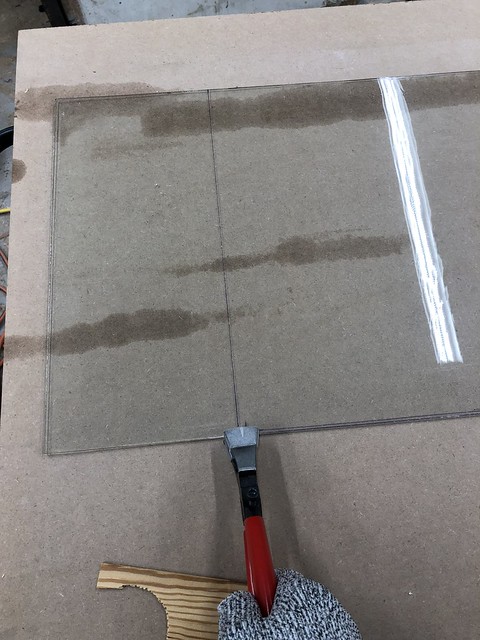
<p>Once you have your glass scored on its first line, grab your pair of running pliers. These pliers are mostly flat but have a very slight flair on either side of the center line. The pliers are also usually covered at the end with a rubber sleeve that will protect the glass. When you line the pliers up with your score line you apply subtle pressure that's just enough to start the glass breaking along the score line. When it works well you can see the glass snap and start to crack along the line.&nbsp;</p>
<p>
</p>
<div class="MediaContainer PhotoContainer"><a href="https://farm1.staticflickr.com/788/39784862280_f05d687c50_z.jpg" rel="PhotoPopup" popupheight="640" popupwidth="480"><img alt="" src="https://farm1.staticflickr.com/788/39784862280_f05d687c50.jpg" width="375" height="500" style="border-width: 0px; border-style: solid;" /></a></div>
<p>After you start the break on one side of the glass move over and repeat it on the other side. Then use the back of your glass cutter tool to tap along the line to encourage the crack to continue. When all goes well, you can apply a little downward pressure on the glass and the piece will cleanly break off for you. Sometime, when that's not working, it works well to hang the glass over the side of your work surface, supporting it on either side with both hands. Then, with the line sitting right at the edge of your surface, let gravity do its thing and put a little pressure on the glass. It should crack right along the line.</p>
<p>Now, don't expect every single cut to be flawless. In fact, plan for it to not be particularly flawless! In my case the glass pieces were large enough that they allowed me to situate my cut lines to accommodate a little mistake. Lucky for me I was thinking ahead, because a mistake was certainly made.</p>
<p>
</p>
<div class="MediaContainer PhotoContainer"><a href="https://farm1.staticflickr.com/912/41595564011_5882b9eef1_z.jpg" rel="PhotoPopup" popupheight="640" popupwidth="480"><img alt="" src="https://farm1.staticflickr.com/912/41595564011_5882b9eef1.jpg" width="375" height="500" style="border-width: 0px; border-style: solid;" /></a></div>
<p>As you can see from the photo, even though the entire rest of the cut was perfect, the last 8" or so of the cut unexpectedly skewed off to the side by about 1/2". Luckily the break didn't suddenly jump across the glass (which happens). I was able to setup my straight edge and score it over 3" to the left, which broke exactly where I wanted it to break. I breathed a sigh of relief after the last cut and thanked the wavy glass gods for their support.</p>
<p>
</p>
<div class="MediaContainer PhotoContainer"><a href="https://farm1.staticflickr.com/861/26727573667_f3fb929c78_z.jpg" rel="PhotoPopup" popupheight="640" popupwidth="480"><img alt="" src="https://farm1.staticflickr.com/861/26727573667_f3fb929c78.jpg" width="375" height="500" style="border-width: 0px; border-style: solid;" /></a></div>
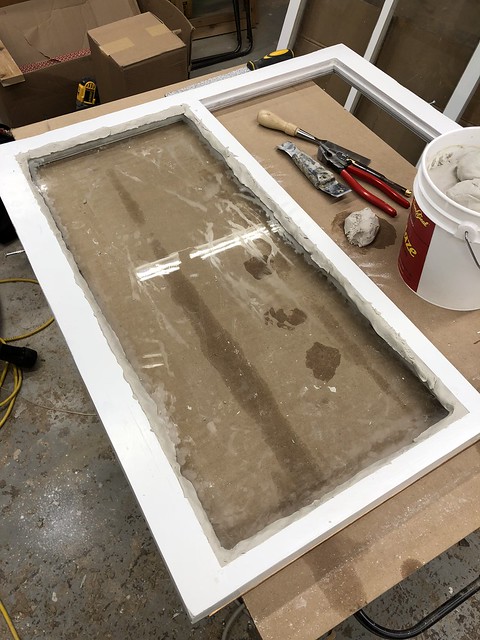
<p>At this point we had ourselves four pieces of wavy glass waiting for reinstall among the two repaired, prepared, and ready to be restored original window sash.</p>
<p>Next time I'll fill you all in on the tedious, sometimes frustrating, but often fulfilling process of glazing old window sash. When you have the right tools, materials, and a little experience, applying glazing putty can be an oddly relaxing process.</p>
<p>
</p>
<div class="MediaContainer PhotoContainer"><a href="https://farm1.staticflickr.com/931/27726032088_46dfe232cc_z.jpg" rel="PhotoPopup" popupheight="640" popupwidth="480"><img alt="" src="https://farm1.staticflickr.com/931/27726032088_46dfe232cc.jpg" width="375" height="500" style="border-width: 0px; border-style: solid;" /></a></div>
<p>Do you have any experience cutting or sourcing wavy glass? Do you find cutting glass to be a soothing or intimidating proposition? Also, I think I'm going to be headed back to Community Forklift this month to pick up a bunch more glass that I'll need. I just saw on their website that all of their window sash are 40% off for the month of June! I love a good wavy glass bargain!</p><p><a href="https://www.oldtownhome.com/2018/6/1/Window-Sash-Restoration-Part-5-Sourcing-and-Cutting-New-or-Salvaged-Wavy-Glass/">Read Full Post</a></p>]]></content>
    <category term="Header Image" />
    <category term="Projects:Salvage" />
    <category term="Salvage" />
    <category term="Wavy Glass" />
    <category term="Window Restoration" />
    <category term="Window Restoration Series" />
    <PostImage>https://c2.staticflickr.com/2/1741/42494651851_6d464e98f4_c.jpg</PostImage>
    <media:thumbnail url="https://c2.staticflickr.com/2/1741/42494651851_6d464e98f4_t.jpg" />
    <ExtensionElements>
      <Item>PostImage</Item>
      <Item>media:thumbnail</Item>
    </ExtensionElements>
  </entry>
  <entry>
    <guid>22bdbb9c-9520-456e-b240-6b65bb0967fc</guid>
    <id>https://www.oldtownhome.com/2018/3/9/Keep-Cast-Iron-Rust-Free-With-a-Linseed-Oil-Bath---Window-Restoration-Part-3/</id>
    <title>Keep Cast Iron Rust Free With a Linseed Oil Bath - Window Restoration Part 3</title>
    <summary type="html"><![CDATA[<p>Antique cast iron architectural hardware is beautiful, but what's the best way to protect it from rusting? Would you believe it may be as simple as giving it a bath? </p><p>
</p><div class="MediaContainer PhotoContainer"><a href="https://farm5.staticflickr.com/4790/26837624808_5eb01d2b94_z.jpg" rel="PhotoPopup" popupheight="480" popupwidth="640"><img alt="" src="https://farm5.staticflickr.com/4790/26837624808_5eb01d2b94.jpg" width="500" height="375" style="border-width: 0px; border-style: solid;"></a></div><p>I picked up this method of treating cast iron many years ago while working in a window restoration shop. It's a tried and true method for protecting cast iron from rust, but there isn't a whole lot of information about it on the Internet. So it's our hope this will go a long way to helping others looking to restore their windows or other cast iron hardware in a classic and lasting manner.</p><p>We're very fortunate to have several of our original windows almost completely intact. This means that our original cast iron sash pulleys are also in place and fully functional. However, they were all creatively disguised by many layers of paint, hiding their utilitarian beauty.</p><p>
</p><div class="MediaContainer PhotoContainer"><a href="https://farm5.staticflickr.com/4775/39814327955_399716a105_z.jpg" rel="PhotoPopup" popupheight="640" popupwidth="480"><img alt="" src="https://farm5.staticflickr.com/4775/39814327955_399716a105.jpg" width="375" height="500" style="border-width: 0px; border-style: solid;"></a></div><p>As beautiful as these original architectural details may be once stripped, they're also made of cast iron and are prone to rust. A few years ago we stripped and reinstalled several of our pulleys without protecting them from the elements. Even though they aren't directly exposed to water, the humidity in the air and blowing rain or snow is enough to leave surface rust on exposed portions of the iron. The end result after a few years in the window frame is a fine coating of the orange-brown patina we'd like to avoid, especially since it begins to stain the sash ropes.</p> <a href="https://www.oldtownhome.com/2018/3/9/Keep-Cast-Iron-Rust-Free-With-a-Linseed-Oil-Bath---Window-Restoration-Part-3/">more</a>]]></summary>
    <published>2018-03-09T10:30:00.000-05:00</published>
    <updated>2018-03-09T10:30:00.000-05:00</updated>
    <link rel="alternate" href="https://www.oldtownhome.com/2018/3/9/Keep-Cast-Iron-Rust-Free-With-a-Linseed-Oil-Bath---Window-Restoration-Part-3/" />
    <author>
      <name>Alex</name>
    </author>
    <content type="html"><![CDATA[<p>Antique cast iron architectural hardware is beautiful, but what's the best way to protect it from rusting? Would you believe it may be as simple as giving it a bath? </p>
<p>
</p>
<div class="MediaContainer PhotoContainer"><a href="https://farm5.staticflickr.com/4790/26837624808_5eb01d2b94_z.jpg" rel="PhotoPopup" popupheight="480" popupwidth="640"><img alt="" src="https://farm5.staticflickr.com/4790/26837624808_5eb01d2b94.jpg" width="500" height="375" style="border-width: 0px; border-style: solid;" /></a></div>

<p>I picked up this method of treating cast iron many years ago while working in a window restoration shop. It's a tried and true method for protecting cast iron from rust, but there isn't a whole lot of information about it on the Internet. So it's our hope this will go a long way to helping others looking to restore their windows or other cast iron hardware in a classic and lasting manner.</p>
<p>We're very fortunate to have several of our original windows almost completely intact. This means that our original cast iron sash pulleys are also in place and fully functional. However, they were all creatively disguised by many layers of paint, hiding their utilitarian beauty.</p>
<p>
</p>
<div class="MediaContainer PhotoContainer"><a href="https://farm5.staticflickr.com/4775/39814327955_399716a105_z.jpg" rel="PhotoPopup" popupheight="640" popupwidth="480"><img alt="" src="https://farm5.staticflickr.com/4775/39814327955_399716a105.jpg" width="375" height="500" style="border-width: 0px; border-style: solid;" /></a></div>

<p>As beautiful as these original architectural details may be once stripped, they're also made of cast iron and are prone to rust. A few years ago we stripped and reinstalled several of our pulleys without protecting them from the elements. Even though they aren't directly exposed to water, the humidity in the air and blowing rain or snow is enough to leave surface rust on exposed portions of the iron. The end result after a few years in the window frame is a fine coating of the orange-brown patina we'd like to avoid, especially since it begins to stain the sash ropes.</p>
<p>
</p>
<div class="MediaContainer PhotoContainer"><a href="https://farm5.staticflickr.com/4780/39788595415_75049c4b98_z.jpg" rel="PhotoPopup" popupheight="640" popupwidth="480"><img alt="" src="https://farm5.staticflickr.com/4780/39788595415_75049c4b98.jpg" width="375" height="500" style="border-width: 0px; border-style: solid;" /></a></div>

<p>In the past we've coated some of our cast iron hardware, like rim locks and hinges, or other ferrous metal that may get wet (<a href="https://www.oldtownhome.com/2017/4/14/Bringing-Vintage-Chairs-Back-from-the-Brink-Using-Penetrol/">like outdoor chairs</a>), with low luster poly or Penetrol, but neither of those are very good options for these sash pulleys. The fact that the pulleys have moving parts and the sash ropes cause friction through use means that coating this hardware with something that can fracture and flake off isn't a great solution. </p>
<p>Last week we touted the rejuvenating characteristics of <a href="https://www.oldtownhome.com/2018/3/2/Window-Sash-Restoration-Part-2---Protecting-the-Sash-with-BLOPentine/">boiled linseed oil and turpentine (or Blopentine)</a> for breathing life into our old window sash, but what can linseed oil do for ferrous metal? Turns out, it can be a great option for keeping cast iron from rusting.</p>
<p>If you've ever tried seasoning cast iron (like what you might do to cast iron cookware) you might be familiar with using oil to keep it from rusting. The idea in what we're doing is very similar. Heating the pan and allowing the oil (often flaxseed oil for cast iron pots) to coat and protect the cast iron helps prevent the cast iron from rusting by keeping water away from direct contact with the metal. It essentially forms a thin protective film over the iron's pitted and porous surface.</p>
<p>In our case we're using some <a href="http://www.solventfreepaint.com/linseed_soap.htm" target="_blank">Linseed Oil Soap</a> from Allback, and we're giving our sash pulleys a linseed oil bath. The linseed oil soap is a mixture of organic linseed oil (not boiled linseed oil) and water, and can be diluted by adding it to the water in our "bath."</p>
<p>
</p>
<div class="MediaContainer PhotoContainer"><a href="https://farm5.staticflickr.com/4789/39788938135_96fb0211ea_z.jpg" rel="PhotoPopup" popupheight="640" popupwidth="480"><img alt="" src="https://farm5.staticflickr.com/4789/39788938135_96fb0211ea.jpg" width="375" height="500" style="border-width: 0px; border-style: solid;" /></a></div>

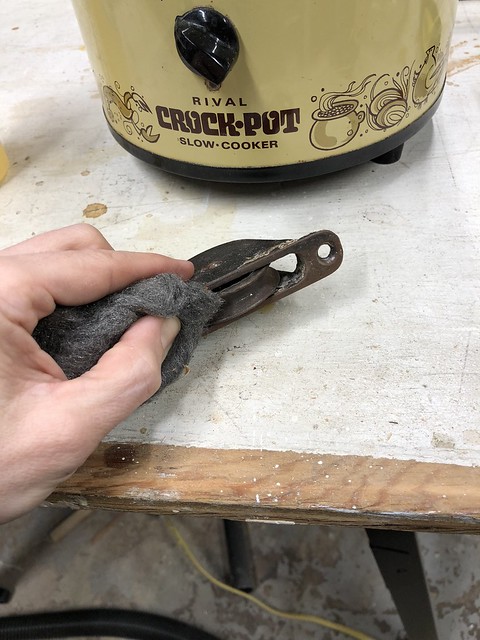
<p>For us the first step is to clean the sash pulleys of their rush with a little steel wool. We previously used a wire wheel to completely clean the paint, but this thin layer of rust was no match for a #1 and #00 steel wool pad. </p>
<p>
</p>
<div class="MediaContainer PhotoContainer"><a href="https://farm5.staticflickr.com/4784/39788595535_33a5f82c70_z.jpg" rel="PhotoPopup" popupheight="640" popupwidth="480"><img alt="" src="https://farm5.staticflickr.com/4784/39788595535_33a5f82c70.jpg" width="375" height="500" style="border-width: 0px; border-style: solid;" /></a></div>

<p>Once clean we moved onto the bath. We're using the vintage Crock-Pot I scored for free, coincidentally on the day after it was revealed on This Is Us (<strong><em>*SPOILER ALERT*</em></strong>) that Jack was killed by a vintage slow cooker, some crazy irony there, right?&nbsp;</p>
<p>
</p>
<div class="MediaContainer PhotoContainer"><a href="https://farm5.staticflickr.com/4785/26812327398_9f04c45db3_z.jpg" rel="PhotoPopup" popupheight="640" popupwidth="480"><img alt="" src="https://farm5.staticflickr.com/4785/26812327398_9f04c45db3.jpg" width="375" height="500" style="border-width: 0px; border-style: solid;" /></a></div>

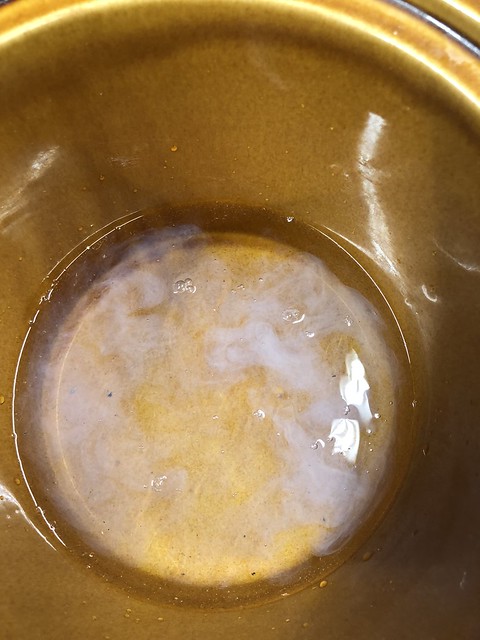
<p>I added enough water to fully cover the sash pulleys and then put in a few squirts of the linseed oil soap. </p>
<p>
</p>
<div class="MediaContainer PhotoContainer"><a href="https://farm5.staticflickr.com/4774/40641608912_1d8518c733_z.jpg" rel="PhotoPopup" popupheight="480" popupwidth="640"><img alt="" src="https://farm5.staticflickr.com/4774/40641608912_1d8518c733.jpg" width="500" height="375" style="border-width: 0px; border-style: solid;" /></a></div>

<p>The soap is slightly clouding the water to start...</p>
<p>
</p>
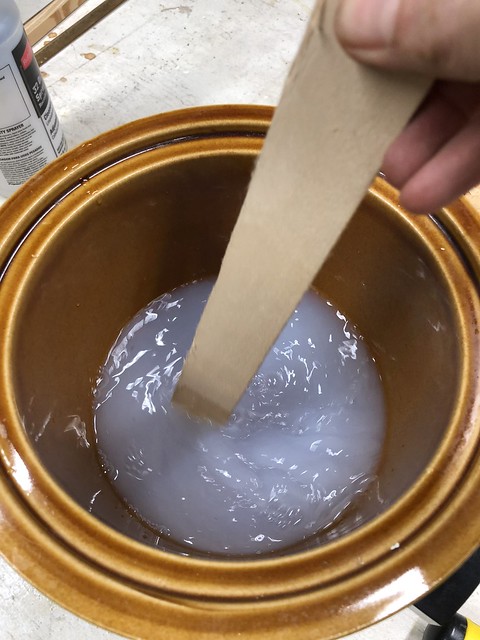
<div class="MediaContainer PhotoContainer"><a href="https://farm5.staticflickr.com/4777/40683812951_a25b023582_z.jpg" rel="PhotoPopup" popupheight="640" popupwidth="480"><img alt="" src="https://farm5.staticflickr.com/4777/40683812951_a25b023582.jpg" width="375" height="500" style="border-width: 0px; border-style: solid;" /></a></div>

<p>...but mixes easily with the water to fully disperse.&nbsp;</p>
<p>
</p>
<div class="MediaContainer PhotoContainer"><a href="https://farm5.staticflickr.com/4789/39788595345_590dbca28a_z.jpg" rel="PhotoPopup" popupheight="640" popupwidth="480"><img alt="" src="https://farm5.staticflickr.com/4789/39788595345_590dbca28a.jpg" width="375" height="500" style="border-width: 0px; border-style: solid;" /></a></div>

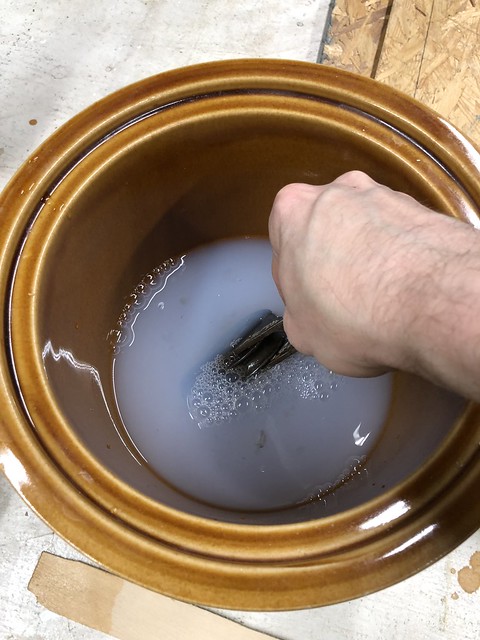
<p>I went ahead and put the Crock-Pot on high to warm the soapy water up, and dropped the pulleys into the cloud. </p>
<p>
</p>
<div class="MediaContainer PhotoContainer"><a href="https://farm5.staticflickr.com/4793/39973568864_5a7153d8be_z.jpg" rel="PhotoPopup" popupheight="640" popupwidth="480"><img alt="" src="https://farm5.staticflickr.com/4793/39973568864_5a7153d8be.jpg" width="375" height="500" style="border-width: 0px; border-style: solid;" /></a></div>

<p>Allowing them to soak in the hot mixture for several hours gives the linseed oil a chance to heat and fully coat and protect the cast iron. Also, this gives the mixture a chance to smell a little bit like hot gross fish. If you're into hot gross smelling fish, you'll really love this whole process!</p>
<p>While they cooked the water started to turn a bit brown. I periodically spun the pulleys around to make sure there was no trapped air or areas not fully exposed to the bath. As you can see from the photos, the case iron did slightly darken from the water and oil, but that's expected.</p>
<p>
</p>
<div class="MediaContainer PhotoContainer"><a href="https://farm5.staticflickr.com/4792/25812827877_789b70f9ca_z.jpg" rel="PhotoPopup" popupheight="640" popupwidth="480"><img alt="" src="https://farm5.staticflickr.com/4792/25812827877_789b70f9ca.jpg" width="375" height="500" style="border-width: 0px; border-style: solid;" /></a></div>

<p>After three hours or so I checked on the progress. Removing the pulleys from the hot oil bath revealed a great looking piece of hardware that's ready for another 100 years of service. </p>
<p>
</p>
<div class="MediaContainer PhotoContainer"><a href="https://farm5.staticflickr.com/4779/25814113087_0aa9e61788_z.jpg" rel="PhotoPopup" popupheight="640" popupwidth="480"><img alt="" src="https://farm5.staticflickr.com/4779/25814113087_0aa9e61788.jpg" width="375" height="500" style="border-width: 0px; border-style: solid;" /></a></div>

<p>The pulleys are slightly tacky right after they've been removed from the bath, but allowing them to dry overnight yielded a smooth and fully dried end result. The final finish is very matte and there is not a plastic film look to it at all, as you'd expect from a traditional poly.</p>
<p>
</p>
<div class="MediaContainer PhotoContainer"><a href="https://farm5.staticflickr.com/4780/39813889895_36fa711515_z.jpg" rel="PhotoPopup" popupheight="640" popupwidth="480"><img alt="" src="https://farm5.staticflickr.com/4780/39813889895_36fa711515.jpg" width="375" height="500" style="border-width: 0px; border-style: solid;" /></a></div>

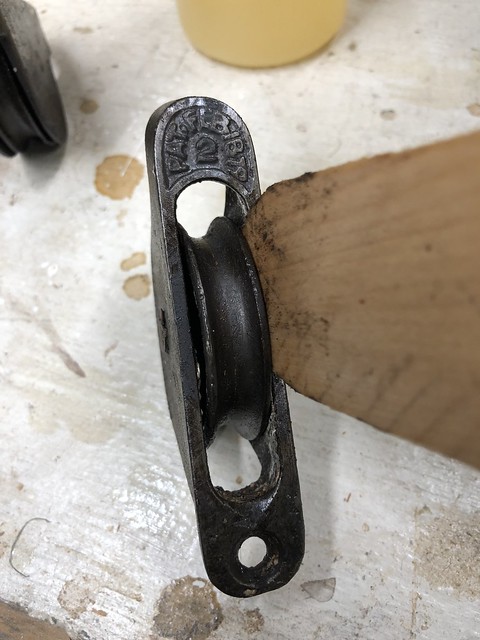
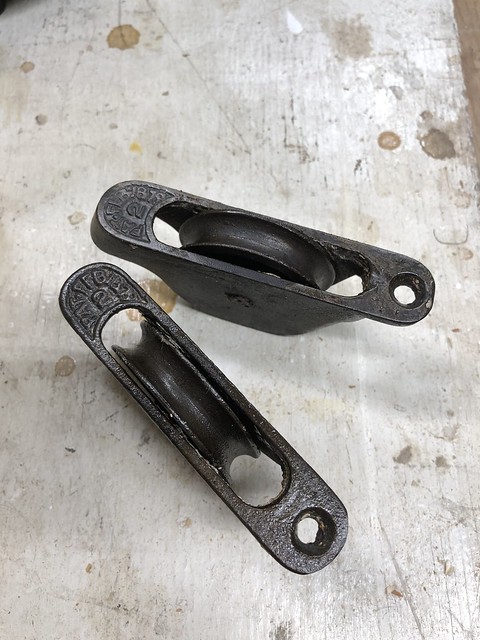
<p>Our sash pulleys, with patent date of Feb 1879, are once again ready for reinstall. These one screw Norris style pulleys (based on their shape and the specialized mortise necessary for the window frame) should no longer be prone to rust if they encounter a little bit of moisture. After the linseed oil bath they now have that classic cast iron dark grey patina. There is no film left following the bath and the coating is more or less baked in over the entire pulley. </p>
<p>
</p>
<div class="MediaContainer PhotoContainer"><a href="https://farm5.staticflickr.com/4790/26837624808_5eb01d2b94_z.jpg" rel="PhotoPopup" popupheight="480" popupwidth="640"><img alt="" src="https://farm5.staticflickr.com/4790/26837624808_5eb01d2b94.jpg" width="500" height="375" style="border-width: 0px; border-style: solid;" /></a></div>

<p>This linseed oil bath is a great option for hardware with movable parts that may be exposed to moisture. At the same time, it's even a great option if you want that raw cast iron look without the need for maintenance or a glossy coating of poly. We'll probably be using this method for future restoration of our rim locks after we're done cleaning off all of the rust.</p>
<p>Have you ever heard of using a linseed oil bath on cast iron hardware? Or maybe you're a fan of linseed oil soap as an organic and environmentally friendly method to cleanse difficult to clean surfaces? Would love to know if you found this tip useful and if you think you'll try it out some day.</p><p><a href="https://www.oldtownhome.com/2018/3/9/Keep-Cast-Iron-Rust-Free-With-a-Linseed-Oil-Bath---Window-Restoration-Part-3/">Read Full Post</a></p>]]></content>
    <category term="Hardware" />
    <category term="Header Image" />
    <category term="Projects:Salvage" />
    <category term="Restoration" />
    <category term="Salvage" />
    <category term="Tips and Tricks" />
    <category term="Window Restoration" />
    <category term="Window Restoration Series" />
    <PostImage>https://c1.staticflickr.com/5/4795/40668041682_993dcc2257_c.jpg</PostImage>
    <media:thumbnail url="https://c1.staticflickr.com/5/4795/40668041682_993dcc2257_t.jpg" />
    <ExtensionElements>
      <Item>PostImage</Item>
      <Item>media:thumbnail</Item>
    </ExtensionElements>
  </entry>
  <entry>
    <guid>e8a59de0-a877-41a6-a1f8-aec05e7c220d</guid>
    <id>https://www.oldtownhome.com/2017/12/4/How-To-Install-a-Salvaged-Door-with-Antique-Hinges/</id>
    <title>How To Install a Salvaged Door with Antique Hinges</title>
    <summary type="html"><![CDATA[<p>We love architectural salvage! But sometimes making something old fit in something new can be a challenge.&nbsp;</p><p>Over the years we've worked to install various old architectural salvage items in our home. From transom windows to doors and hinges to locks, using old materials in your renovation not only adds character you just can't get from new products, it can also make a renovation look appropriate in an old home, like it's always been that way.&nbsp;</p><p>For example, our entry hall before and after, with reproduction mouldings, a salvaged leaded glass transom with antique hardware, and minor reconfiguration.</p><p>
</p><p class="MediaContainer PhotoContainer"><a href="https://farm5.staticflickr.com/4548/38816782701_458e4b1a28_z.jpg" rel="PhotoPopup" popupheight="427" popupwidth="640"><img alt="" src="https://farm5.staticflickr.com/4548/38816782701_458e4b1a28.jpg" width="500" height="333" style="border-width: 0px; border-style: solid;"></a></p><p class="MediaContainer PhotoContainer"><em>Before and After of our entry hallway with salvaged leaded glass transom</em></p> <a href="https://www.oldtownhome.com/2017/12/4/How-To-Install-a-Salvaged-Door-with-Antique-Hinges/">more</a>]]></summary>
    <published>2017-12-04T13:42:00.000-05:00</published>
    <updated>2017-12-04T13:42:00.000-05:00</updated>
    <link rel="alternate" href="https://www.oldtownhome.com/2017/12/4/How-To-Install-a-Salvaged-Door-with-Antique-Hinges/" />
    <author>
      <name>Alex</name>
    </author>
    <content type="html"><![CDATA[<p>We love architectural salvage! But sometimes making something old fit in something new can be a challenge.&nbsp;</p>
<p>Over the years we've worked to install various old architectural salvage items in our home. From transom windows to doors and hinges to locks, using old materials in your renovation not only adds character you just can't get from new products, it can also make a renovation look appropriate in an old home, like it's always been that way.&nbsp;</p>
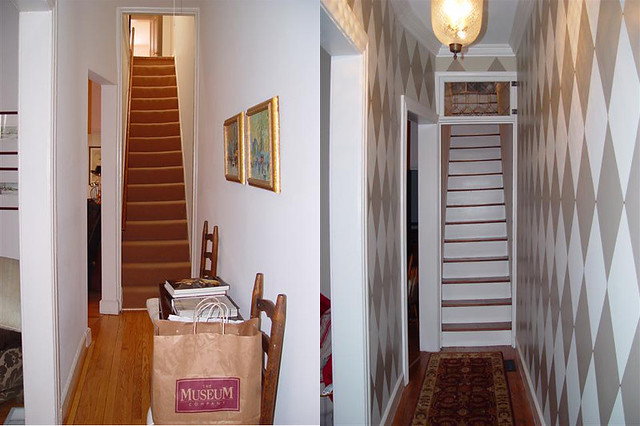
<p>For example, our entry hall before and after, with reproduction mouldings, a salvaged leaded glass transom with antique hardware, and minor reconfiguration.</p>
<p>
</p>
<p class="MediaContainer PhotoContainer"><a href="https://farm5.staticflickr.com/4548/38816782701_458e4b1a28_z.jpg" rel="PhotoPopup" popupheight="427" popupwidth="640"><img alt="" src="https://farm5.staticflickr.com/4548/38816782701_458e4b1a28.jpg" width="500" height="333" style="border-width: 0px; border-style: solid;" /></a></p>
<p class="MediaContainer PhotoContainer"><em>Before and After of our entry hallway with salvaged leaded glass transom</em></p>
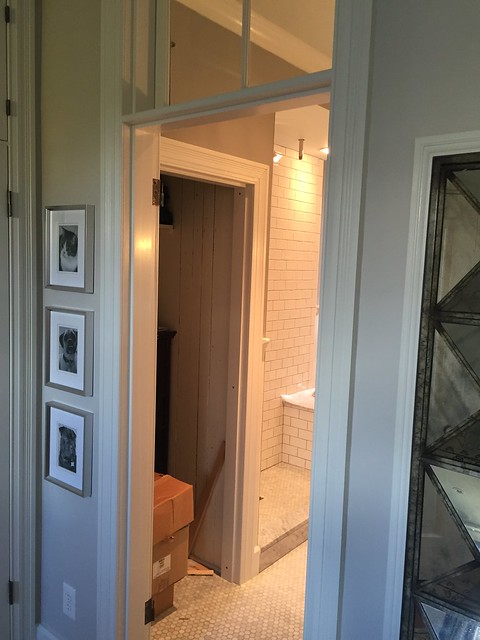
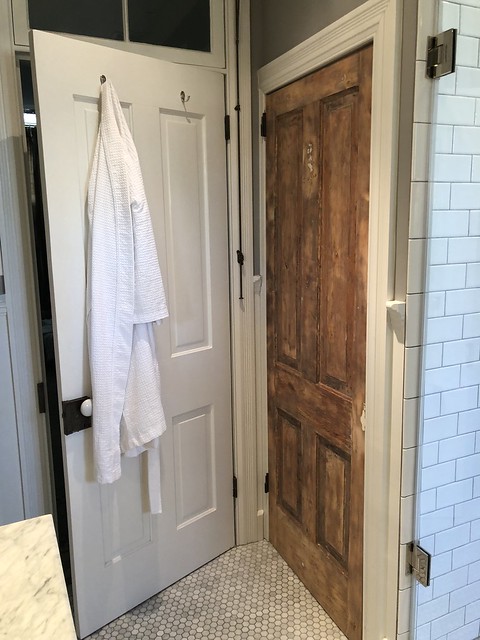
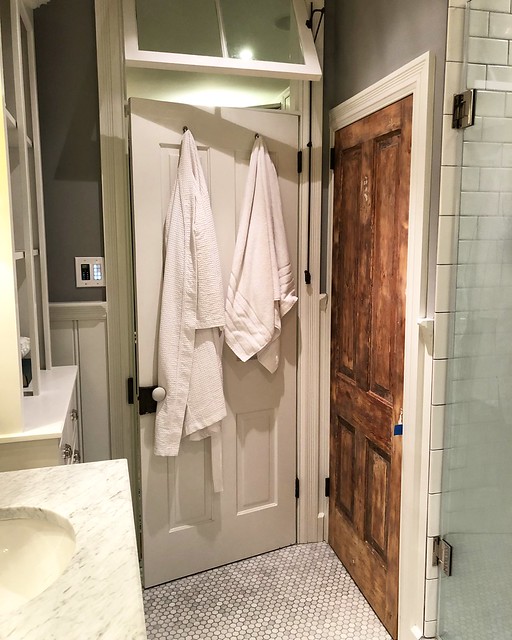
<p>Or our master bathroom door with custom reproduction door jamb, salvaged door, custom reproduction transom window with wavy glass, and salvaged hinges, door lock, and transom lift mechanism.</p>
<p>
</p>
<div class="MediaContainer PhotoContainer"><a href="https://farm6.staticflickr.com/5575/14976647181_a46a1c4cd9_z.jpg" rel="PhotoPopup" popupheight="640" popupwidth="480"><img alt="" src="https://farm6.staticflickr.com/5575/14976647181_a46a1c4cd9.jpg" width="375" height="500" style="border-width: 0px; border-style: solid;" /></a></div>
<p>But one of the most significant challenges we've faced in our home is the seemingly simple task of making an old salvaged door work in a jamb for which it wasn't built. However, we've accomplished this very job in scenarios where the door was too large, too small, out of square, or badly damaged. It wasn't without struggle, and we've gotten much better at it over the years. I'm sure there are tons of tips and tricks out there to make this process much easier, but the following is our process, advice, and useful guidance that has worked well for us in our experiences as we've honed our skills.</p>
<p>
</p>
<div class="MediaContainer PhotoContainer"><a href="https://farm7.staticflickr.com/6206/6134838451_33a1550ac7_z.jpg" rel="PhotoPopup" popupheight="640" popupwidth="478"><img alt="" src="https://farm7.staticflickr.com/6206/6134838451_33a1550ac7.jpg" width="374" height="500" style="border-width: 0px; border-style: solid;" /></a></div>
<p>Our master bathroom has a small closet nestled between the doorway to the room and the shower. This closet is both extra storage and houses many of my clothes.&nbsp;</p>
<p>
</p>
<div class="MediaContainer PhotoContainer"><a href="https://farm4.staticflickr.com/3949/15146304673_93ce356273_z.jpg" rel="PhotoPopup" popupheight="640" popupwidth="480"><img alt="" src="https://farm4.staticflickr.com/3949/15146304673_93ce356273.jpg" width="375" height="500" style="border-width: 0px; border-style: solid;" /></a></div>
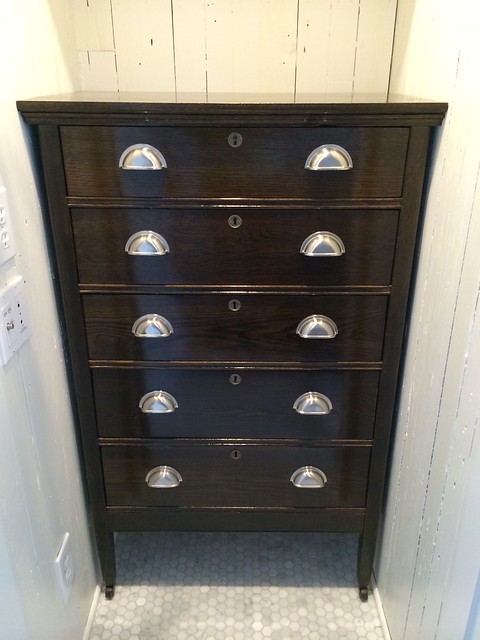
<p>Its walls are made up of original pine flooring and it sports an antique oak dresser that's essentially built right into the opening. It's not coming out any time soon, but we've build the door jamb and casings so they can be removable in the event someone wants to take the dresser out without destroying it.</p>
<p>
</p>
<div class="MediaContainer PhotoContainer"><a href="https://farm4.staticflickr.com/3881/15001463805_86c82238df_z.jpg" rel="PhotoPopup" popupheight="640" popupwidth="480"><img alt="" src="https://farm4.staticflickr.com/3881/15001463805_86c82238df.jpg" width="375" height="500" style="border-width: 0px; border-style: solid;" /></a></div>
<p>This tight space is also home to a pretty great plaster rhino that I tend to use as a hat rack of sorts.</p>
<p>
</p>
<div class="MediaContainer PhotoContainer"><a href="https://farm5.staticflickr.com/4537/38118736234_a0e61c0d5c_z.jpg" rel="PhotoPopup" popupheight="640" popupwidth="480"><img alt="" src="https://farm5.staticflickr.com/4537/38118736234_a0e61c0d5c.jpg" width="375" height="500" style="border-width: 0px; border-style: solid;" /></a></div>
<p>The door jamb in this closet is a custom jamb built from 4/5 poplar and meant to be a similar size and look to the original jambs in our 1886 house. This means that the opening is completely custom, which certainly makes mounting a door somewhat of a challenge.&nbsp;</p>
<p>One other wrinkle here is that I wanted the light in the closet to turn on when the door was opened, and off when it was closed. As a result we mounted a contact closure switch in the jamb to work in conjunction with the light switch on the wall.</p>
<h2>Prerequisites</h2>
<p>When I'm working to mount a salvaged door there are a few prerequisites I like to check before we get started.&nbsp;</p>
<h3>Prereq 1 - Jamb</h3>
<p>The jamb and door opening are critical when working with salvaged doors. The ideal scenario is to have an opening that is square, plumb, and level. Sometimes this is not possible, sometimes it is. Regardless, you need understand if the opening is out of square, has a wonky angle somewhere, or has some other issue to be aware of (like if the floor is going to be an obstruction as the door is opened). This will all impact how you ultimately trim your door to fit.</p>
<p>
</p>
<div class="MediaContainer PhotoContainer"><a href="https://farm5.staticflickr.com/4578/27058518639_0b964ceef1_z.jpg" rel="PhotoPopup" popupheight="640" popupwidth="480"><img alt="" src="https://farm5.staticflickr.com/4578/27058518639_0b964ceef1.jpg" width="375" height="500" style="border-width: 0px; border-style: solid;" /></a></div>
<p>Once you have a good idea on the jamb, it's time to move on to the next item.</p>
<h3>Prereq 2 - The Door</h3>
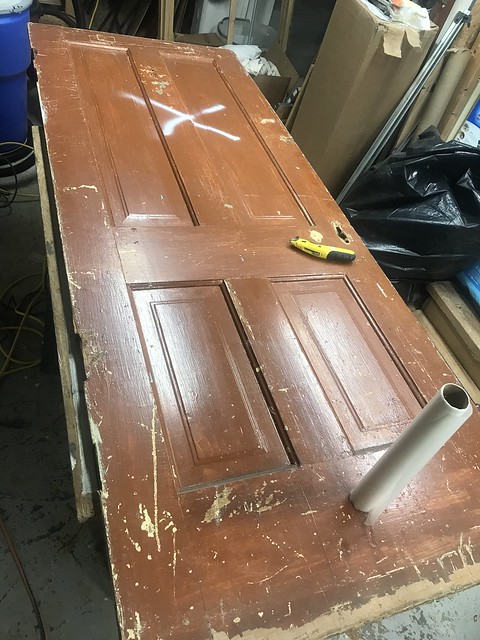
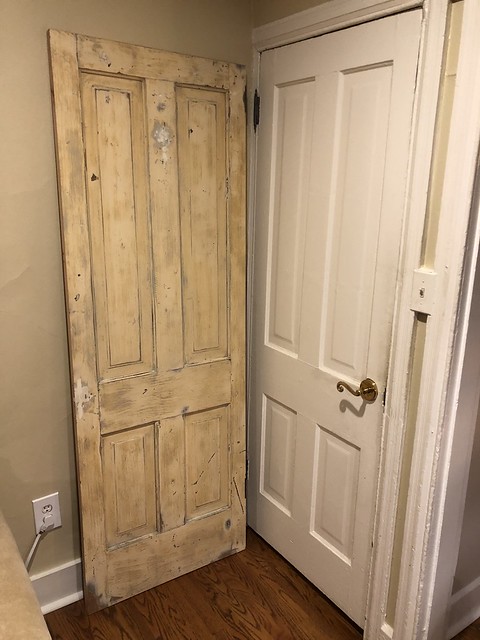
<p>First, the door. Our primary goal is always to find a door with the right look and profiles to match the other doors or general style of our house. For us we have two styles of interior doors, both of which are four panel raised panel doors. One style has a single bevel on the panel and is for the bedrooms. The other is a double bevel panel and is primarily used for smaller rooms and closets. We were lucky enough several years ago to find a large set of doors that were nearly an identical match to our closet doors. We bought six of these doors many years ago (f<a href="https://www.oldtownhome.com/2013/1/22/Master-Bedroom-Building-Our-Dream-Closet-Part-1/">ive were used for our bedroom closets</a>) and one has been patiently waiting in our basement to eventually be our bathroom's closet door.</p>
<p>
</p>
<div class="MediaContainer PhotoContainer"><a href="https://farm5.staticflickr.com/4448/23878431728_bd56af1aec_z.jpg" rel="PhotoPopup" popupheight="640" popupwidth="480"><img alt="" src="https://farm5.staticflickr.com/4448/23878431728_bd56af1aec.jpg" width="375" height="500" style="border-width: 0px; border-style: solid;" /></a></div>
<p>From this point forward I plan to only ever work with doors that will either fit the current opening, or are larger than the current opening. It's pretty easy to cut doors down to size, but it's a whole other thing to make them larger. We did this very thing on several of our interior doors as well as our new front door and French doors, and it was an undertaking that I'd like to avoid in the future.</p>
<p>
</p>
<div class="MediaContainer PhotoContainer"><a href="https://farm7.staticflickr.com/6150/5997625687_b53b391dd2_z.jpg" rel="PhotoPopup" popupheight="480" popupwidth="640"><img alt="" src="https://farm7.staticflickr.com/6150/5997625687_b53b391dd2.jpg" width="500" height="375" style="border-width: 0px; border-style: solid;" /></a></div>
<p>The other thing that's important to consider about your door is warping. Quite often salvaged doors have some level of warp to them. In many scenarios, this is not a problem as it is minor and will be disguised by the door's opening. But if you're doing a double door (like our closet for example), and the two doors warp away from each other, the problem will be very noticeable and they'll never look like they are completely closed. You need to determine your tolerance for warping in your situation and take a square and straight edge with you to the salvage yard.</p>
<p class="MediaContainer PhotoContainer"><a href="https://farm5.staticflickr.com/4531/26901705599_c618494292_z.jpg" rel="PhotoPopup" popupheight="640" popupwidth="480"><img alt="" src="https://farm5.staticflickr.com/4531/26901705599_c618494292.jpg" width="375" height="500" style="border-width: 0px; border-style: solid;" /></a></p>
<p class="MediaContainer PhotoContainer"><em>The door on the right is the final remaining original unstripped door with 1980s hardware in the house. The door on the left is our matched salvaged door.</em></p>
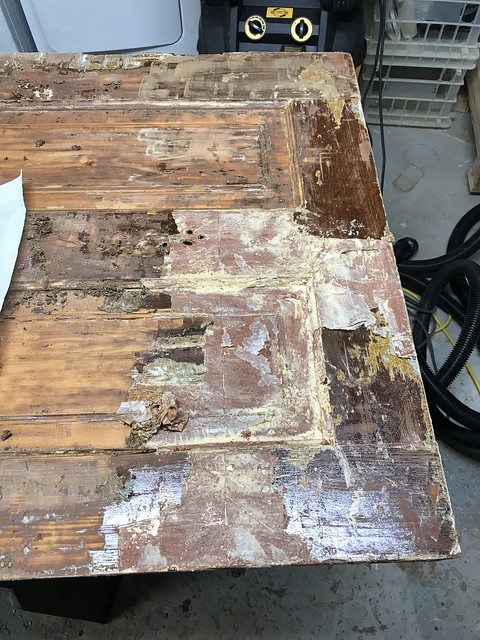
<p>Once the door is selected, I like to start the process by doing any paint stripping and repair before I get to mounting it in its opening. It certainly means more work up front, but it helps ensure that the work you do to square and mount the door isn't impacted by any repairs you need to make later.</p>
<p>
</p>
<div class="MediaContainer PhotoContainer"><a href="https://farm5.staticflickr.com/4474/37717127412_abcef21c65_z.jpg" rel="PhotoPopup" popupheight="640" popupwidth="480"><img alt="" src="https://farm5.staticflickr.com/4474/37717127412_abcef21c65.jpg" width="375" height="500" style="border-width: 0px; border-style: solid;" /></a></div>
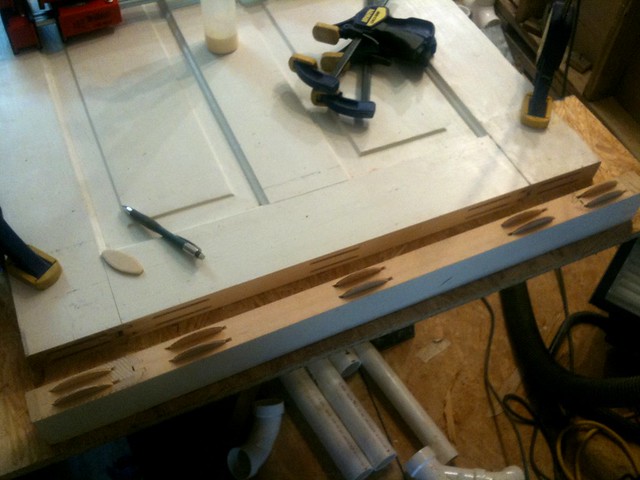
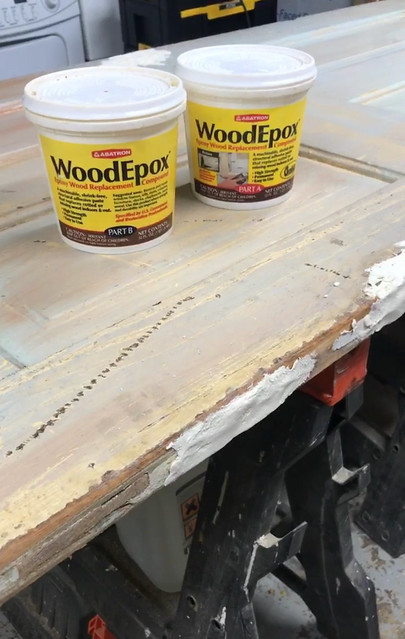
<p>After stripping if the door is loose or has any missing parts or major issues, I'll re-glue, apply epoxy, and do my initial sanding to get everything ready for mounting. This includes filling any old hinge mortises with epoxy to give myself a clean slate to work from. I'd rather do this than try to deal with trying to make old hinge mortises match up in the door jamb.&nbsp;(But keep in mind, if you're trimming large pieces of the sides off, there's no need to epoxy the old hinge mortises since you'll just cut it all off. I've made this stupid move several times.)&nbsp;</p>
<p>
</p>
<div class="MediaContainer PhotoContainer"><a href="https://farm5.staticflickr.com/4520/38835092841_3484d00a1c_z.jpg" rel="PhotoPopup" popupheight="640" popupwidth="405"><img alt="" src="https://farm5.staticflickr.com/4520/38835092841_3484d00a1c.jpg" width="316" height="500" style="border-width: 0px; border-style: solid;" /></a></div>
<p>When the door is all set and any epoxy is sanded, we're ready for the next item.</p>
<h3>Prereq 3 - Hardware</h3>
<p>You'll want to figure out the hardware you're using early in the process. Figuring out the hinges you want to use is the most important piece, but the lockset and anything else is important as well. We're using antique cast iron hinges and surface mount rim locks on all of our doors, so consistency has certainly helped us hone our process.</p>
<p>
</p>
<div class="MediaContainer PhotoContainer"><a href="https://farm5.staticflickr.com/4555/38787465922_4c5ff01d47_z.jpg" rel="PhotoPopup" popupheight="480" popupwidth="640"><img alt="" src="https://farm5.staticflickr.com/4555/38787465922_4c5ff01d47.jpg" width="500" height="375" style="border-width: 0px; border-style: solid;" /></a></div>
<p>If you're doing your whole house, even over a long period of time, take some time up front to come up with the plan you want to follow for all of your house's hardware. While salvaged hardware may be a bit harder to source and work with, the end result of using only salvaged hardware is really the icing on the cake of an old house renovation.</p>
<p>But one thing you must do, please use plain old slot head screws. And where appropriate, <a href="https://www.oldtownhome.com/2012/2/24/How-To-Easily-Antique-Screws/">antique those screws to look old</a>, not all shiny and new.</p>
<h3>Prereq 4 - Tools</h3>
<p>The following tools are the tools that we've found work best and are invaluable for this process, beyond the standards of tape measure, pencil, etc.&nbsp;</p>
<p>
</p>
<div class="MediaContainer PhotoContainer"><a href="https://farm5.staticflickr.com/4528/27039233019_cd48f3a1f9_z.jpg" rel="PhotoPopup" popupheight="479" popupwidth="640"><img alt="" src="https://farm5.staticflickr.com/4528/27039233019_cd48f3a1f9.jpg" width="500" height="375" style="border-width: 0px; border-style: solid;" /></a></div>
<p>I'm also outlining the specific model of tool we're using for each.</p>
<ol>
    <li>Laser Distance Measurer - <a target="_blank" href="https://www.amazon.com/gp/product/B072NF73DS/ref=as_li_tl?ie=UTF8&amp;camp=1789&amp;creative=9325&amp;creativeASIN=B072NF73DS&amp;linkCode=as2&amp;tag=oltoho-20&amp;linkId=0a3f500d3a4c6bcad798f877f3b720ff">DeWALT Pocket Laser Distance Measurer</a><img alt="" src="//ir-na.amazon-adsystem.com/e/ir?t=oltoho-20&amp;l=am2&amp;o=1&amp;a=B072NF73DS" width="1" height="1" style="border: none !important; margin: 0px !important;" /></li>
    <li>Hinge Mortising Jig - <a target="_blank" href="https://www.amazon.com/gp/product/B00004TI3O/ref=as_li_tl?ie=UTF8&amp;camp=1789&amp;creative=9325&amp;creativeASIN=B00004TI3O&amp;linkCode=as2&amp;tag=oltoho-20&amp;linkId=a5d5c314c406298f0eda62e6a17edb71">Porter-Cable Hinge Template</a><img alt="" src="//ir-na.amazon-adsystem.com/e/ir?t=oltoho-20&amp;l=am2&amp;o=1&amp;a=B00004TI3O" width="1" height="1" style="border: none !important; margin: 0px !important;" /></li>
    <li>Router - <a target="_blank" href="https://www.amazon.com/gp/product/B074C31YML/ref=as_li_tl?ie=UTF8&amp;camp=1789&amp;creative=9325&amp;creativeASIN=B074C31YML&amp;linkCode=as2&amp;tag=oltoho-20&amp;linkId=9d7bcc0a0d83630e725d5f52b01ee9a6">Makita Cordless Compact Router</a><img alt="" src="//ir-na.amazon-adsystem.com/e/ir?t=oltoho-20&amp;l=am2&amp;o=1&amp;a=B074C31YML" width="1" height="1" style="border: none !important; margin: 0px !important;" /></li>
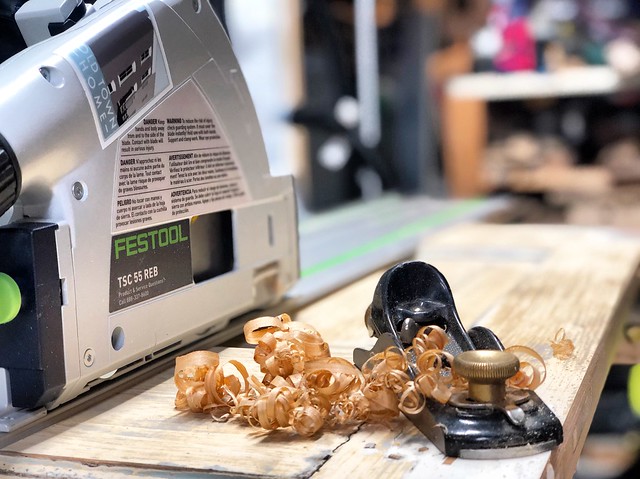
    <li>Track Saw - <a target="_blank" href="https://www.amazon.com/gp/product/B01LG5X8Z6/ref=as_li_tl?ie=UTF8&amp;camp=1789&amp;creative=9325&amp;creativeASIN=B01LG5X8Z6&amp;linkCode=as2&amp;tag=oltoho-20&amp;linkId=420e9ac2109ee29188b02cd9a3c24685">Festool Cordless Track Saw</a><img alt="" src="//ir-na.amazon-adsystem.com/e/ir?t=oltoho-20&amp;l=am2&amp;o=1&amp;a=B01LG5X8Z6" width="1" height="1" style="border: none !important; margin: 0px !important;" /></li>
    <li>Chisels - <a target="_blank" href="https://www.amazon.com/gp/product/B0051PCQ7Y/ref=as_li_tl?ie=UTF8&amp;camp=1789&amp;creative=9325&amp;creativeASIN=B0051PCQ7Y&amp;linkCode=as2&amp;tag=oltoho-20&amp;linkId=7213884a3b9c6b0b81a35a87ea829161">Stanley 750 Series Chisel Set</a><img alt="" src="//ir-na.amazon-adsystem.com/e/ir?t=oltoho-20&amp;l=am2&amp;o=1&amp;a=B0051PCQ7Y" width="1" height="1" style="border: none !important; margin: 0px !important;" /></li>
    <li>Hand Plane - <a target="_blank" href="https://www.amazon.com/gp/product/B0000223QX/ref=as_li_tl?ie=UTF8&amp;camp=1789&amp;creative=9325&amp;creativeASIN=B0000223QX&amp;linkCode=as2&amp;tag=oltoho-20&amp;linkId=4682fd3019305c6bba14d5bfa821eeb5">Stanley Low Angle Plane</a><img alt="" src="//ir-na.amazon-adsystem.com/e/ir?t=oltoho-20&amp;l=am2&amp;o=1&amp;a=B0000223QX" width="1" height="1" style="border: none !important; margin: 0px !important;" /></li>
</ol>
<p><strong>Okay, lets get started!</strong></p>
<h2>Step 1 - Jamb Hinge Mortising</h2>
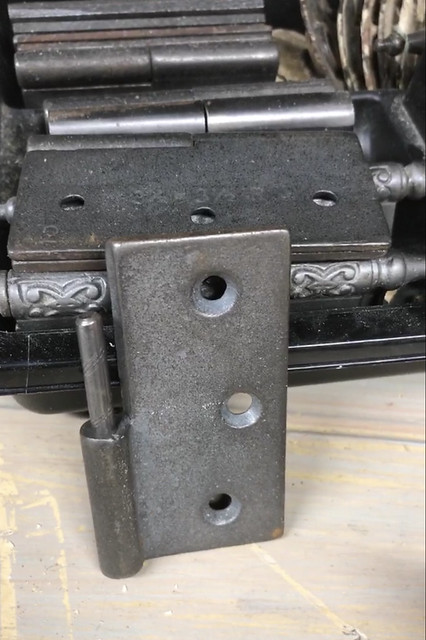
<p>Once our door is ready to go I'm going to actually turn my attention to the hinge jamb mortising. In our case we are using 3-1/2"x3-1/2" antique cast iron lift off hinges for our doors throughout our second floor. We're using decorative salvaged removable pin hinges on the first floor, but these old lift-off hinges upstairs are great. They are moderately forgiving when it comes to alignment, can be mounted easily by one person, and have a great old look to them.</p>
<p>
</p>
<div class="MediaContainer PhotoContainer"><a href="https://farm5.staticflickr.com/4516/23910026947_7fd53b10df_z.jpg" rel="PhotoPopup" popupheight="640" popupwidth="426"><img alt="" src="https://farm5.staticflickr.com/4516/23910026947_7fd53b10df.jpg" width="333" height="500" style="border-width: 0px; border-style: solid;" /></a></div>
<p>Since the door had its prior hinge mortises filled with epoxy, we can mount our hinges pretty much wherever we need them to sit in the jamb. To do this I simply held the hinges in place and gave myself some pencil marks where the hinge mortises need to sit.&nbsp;</p>
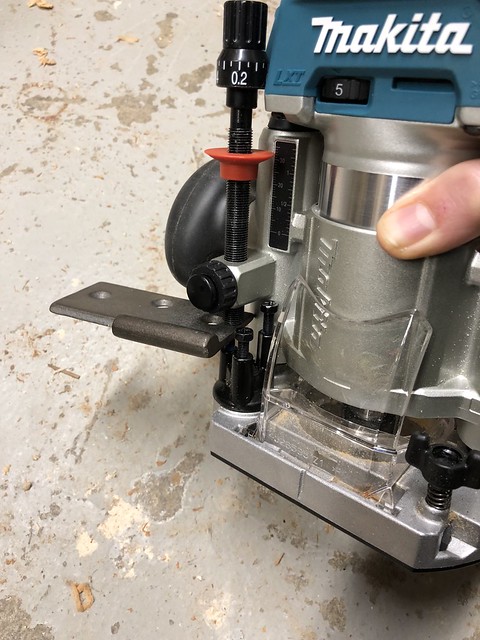
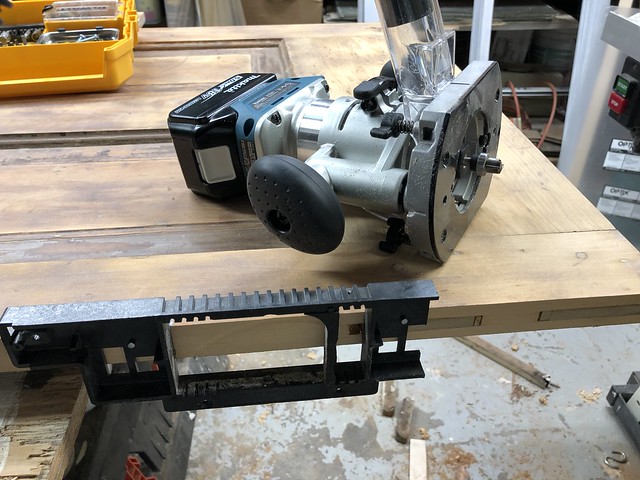
<p>Using a standard mortising template and router with collared bit I cut out the mortises for the hinges. In this case we are doing this in a finished space, and are using the new Makita cordless router with the plunge base and dust extraction attachment. This really helped to keep the mess down on what is typically a pretty dusty process. The mortising template expects a modern jamb and door, so I've had to modify it a bit to work for our needs. I cut off the end then drove a few nails through the middle of it to hold it in place.</p>
<p>
</p>
<div class="MediaContainer PhotoContainer"><a href="https://farm5.staticflickr.com/4490/37862060702_ce86353dcd_z.jpg" rel="PhotoPopup" popupheight="640" popupwidth="480"><img alt="" src="https://farm5.staticflickr.com/4490/37862060702_ce86353dcd.jpg" width="375" height="500" style="border-width: 0px; border-style: solid;" /></a></div>
<p>Setting the correct depth on the router is key here. I find using a plunge base tends to really help this situation. I can essentially zero out the setting so that the router bit is flush with the jamb, then I pull the stop on the plunge base up a little and actually use one side of the hinge to set a gap between the stop of the router and the base. Then, removing the hinge you can let the bit plunge all of the way down to the stop and you've got yourself a perfect depth. This is important with old hinges since they are always just a little variable on size. And on the lift-off hinges we're using, the thickness is tapered from the front to back, so we set our depth to by the midway point of the hinge.</p>
<p>
</p>
<div class="MediaContainer PhotoContainer"><a href="https://farm5.staticflickr.com/4524/23970624697_b02531daa2_z.jpg" rel="PhotoPopup" popupheight="640" popupwidth="480"><img alt="" src="https://farm5.staticflickr.com/4524/23970624697_b02531daa2.jpg" width="375" height="500" style="border-width: 0px; border-style: solid;" /></a></div>
<p>If you're using old hinges (or any hinges) with square corners, you're going to need to make the rounded corners of your mortises square. There are several tools that promise to do this quickly and easily, but I find using a good and sharp chisel is all you really need. Mark the edges of the corner with the chisel, then begin working the material until it's a nice and flat corner. I also try to remove a little more material with the chisel in order to accommodate the slightly graduated thickness of the hinge.</p>
<p>
</p>
<div class="MediaContainer PhotoContainer"><a href="https://farm5.staticflickr.com/4478/37183309644_dda0625794_z.jpg" rel="PhotoPopup" popupheight="640" popupwidth="480"><img alt="" src="https://farm5.staticflickr.com/4478/37183309644_dda0625794.jpg" width="375" height="500" style="border-width: 0px; border-style: solid;" /></a></div>
<p>A little sanding after the chisel and you've got yourself a nice flat hinge mortise.</p>
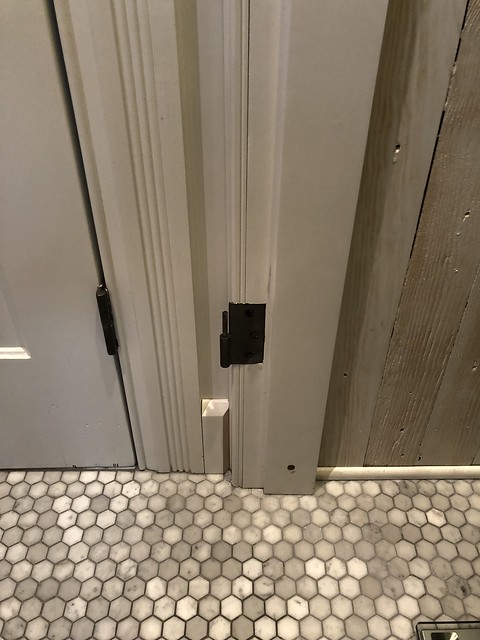
<p>After mortising the jamb I mount the jamb half of the hinges into the mortise and then move onto the next step.&nbsp;</p>
<p class="MediaContainer PhotoContainer"><a href="https://farm5.staticflickr.com/4555/38803765932_11da1c3a5e_z.jpg" rel="PhotoPopup" popupheight="640" popupwidth="480"><img alt="" src="https://farm5.staticflickr.com/4555/38803765932_11da1c3a5e.jpg" width="375" height="500" style="border-width: 0px; border-style: solid;" /></a></p>
<p class="MediaContainer PhotoContainer"><em>The tiny baseboard piece is just resting in place right now.</em></p>
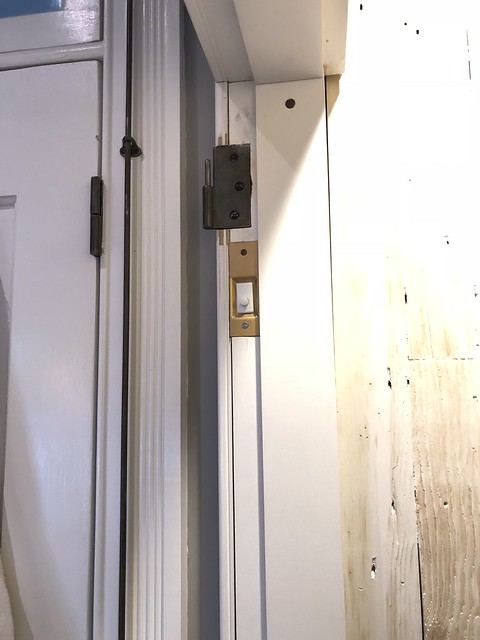
<p>You might notice that our upper hinge in this door is very high. That's as a result of a mistake I made on the contact closure switch. I mounted the switch too high on the jamb and as a result the hinge had to be a little too high or WAY too low.&nbsp;</p>
<p>
</p>
<div class="MediaContainer PhotoContainer"><a href="https://farm5.staticflickr.com/4548/27058515509_d3ae534916_z.jpg" rel="PhotoPopup" popupheight="640" popupwidth="480"><img alt="" src="https://farm5.staticflickr.com/4548/27058515509_d3ae534916.jpg" width="375" height="500" style="border-width: 0px; border-style: solid;" /></a></div>
<p>I went with a little too high. I also had a minor issue with the router bit and template, which caused it to jump slightly and took a little too much material from behind the upper hinge. I'll end up filling that with a little wood filler once everything is said and done.</p>
<h2>Step 2 - Trimming the Door</h2>
<p>With our hinges in place on the jamb we want to get the door fitting nice and tight in the opening. Please note, it will be way too tight to fit properly at this step, but it's always easy to take more off, much harder to add material back, so we want it to be slightly oversized.&nbsp;</p>
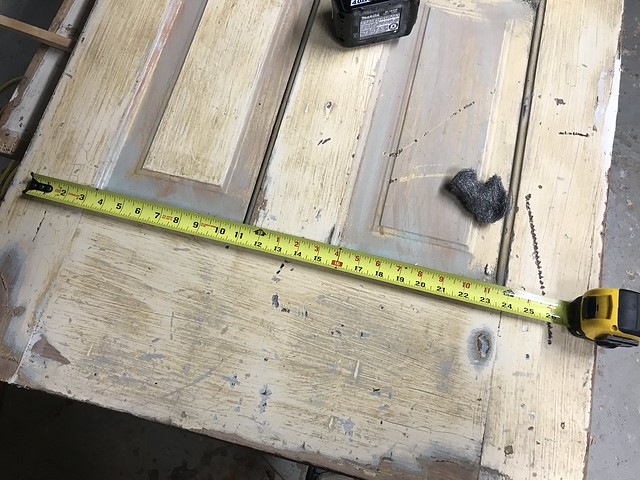
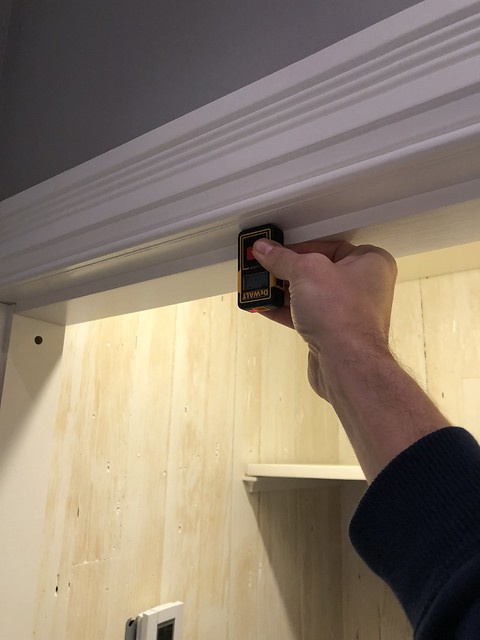
<p>My first step is to use a small laser measuring device to determine the height and width of the jamb opening at several different locations. This little DeWalt pocket laser distance measurer is perfect. It has a max range of 30', is USB chargeable, and is extremely accurate in my experience. I take measurements at three places across the top of the jamb, and at three places down the sides. The hope is that they are all the same and the opening is square. If it's close enough I can go onto the next step. But if something is seriously out of square and we'll need to transfer this over to the door, it may be easiest to make a simple template of the opening with some thin mdf and hot glue (think counter top template), and then use it to transfer the measurements over to your door.&nbsp;</p>
<p>
</p>
<div class="MediaContainer PhotoContainer"><a href="https://farm5.staticflickr.com/4543/24787173668_639c009c0f_z.jpg" rel="PhotoPopup" popupheight="640" popupwidth="480"><img alt="" src="https://farm5.staticflickr.com/4543/24787173668_639c009c0f.jpg" width="375" height="500" style="border-width: 0px; border-style: solid;" /></a></div>
<p>With our measurements of the door jamb in hand, we need to begin trimming the door. I like to start with trimming the height of the door to be correct. Keep in mind that old doors are typically built with mortise and tenon joints. This means that the door is holding itself together, and you don't want to compromise that if you don't have to. In our case, I needed to take off enough material from the height that if I cut it all from the bottom, it could have compromised the door's structure. Rather than taking it all from the bottom, I opted to take some from the bottom and some from the top.</p>
<p>
</p>
<div class="MediaContainer PhotoContainer"><a href="https://farm5.staticflickr.com/4554/24901485538_920a2beef6_z.jpg" rel="PhotoPopup" popupheight="640" popupwidth="360"><img alt="" src="https://farm5.staticflickr.com/4554/24901485538_920a2beef6.jpg" width="281" height="500" style="border-width: 0px; border-style: solid;" /></a></div>
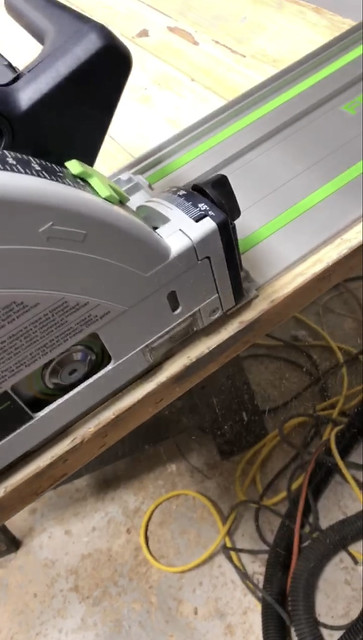
<p>To do this I marked the cut line, dropped the track on the door, and zipped the bottom off with the track saw. A track saw makes ridiculously short work of trimming a door. I can't stress enough how great a track saw is for this purpose, and if you don't have one, you should definitely consider adding it to your tool collection. Otherwise I'd be clamping straight edges based on offset measurements, then taping to prevent splintering and using our circular saw. While the Festool is an expensive model, <a target="_blank" href="https://www.amazon.com/gp/product/B01IVTAO8Y/ref=as_li_tl?ie=UTF8&amp;camp=1789&amp;creative=9325&amp;creativeASIN=B01IVTAO8Y&amp;linkCode=as2&amp;tag=oltoho-20&amp;linkId=be62347b8a42c77b5031229eac46b2ed">Makita</a><img alt="" src="//ir-na.amazon-adsystem.com/e/ir?t=oltoho-20&amp;l=am2&amp;o=1&amp;a=B01IVTAO8Y" width="1" height="1" style="border: none !important; margin: 0px !important;" /> and <a target="_blank" href="https://www.amazon.com/gp/product/B072K4W58Z/ref=as_li_tl?ie=UTF8&amp;camp=1789&amp;creative=9325&amp;creativeASIN=B072K4W58Z&amp;linkCode=as2&amp;tag=oltoho-20&amp;linkId=1a93979dddcbc93ebd1b63b06af2e07b">DeWalt</a><img alt="" src="//ir-na.amazon-adsystem.com/e/ir?t=oltoho-20&amp;l=am2&amp;o=1&amp;a=B072K4W58Z" width="1" height="1" style="border: none !important; margin: 0px !important;" /> both have cordless track saws that are far less expensive and work just as well. Best of all, these saws all work universally on the various other brand tracks with minor adjustments. So you can mix and match based on best deal.</p>
<p>
</p>
<div class="MediaContainer PhotoContainer"><a href="https://farm5.staticflickr.com/4556/37887801745_19949511b3_z.jpg" rel="PhotoPopup" popupheight="640" popupwidth="363"><img alt="" src="https://farm5.staticflickr.com/4556/37887801745_19949511b3.jpg" width="283" height="500" style="border-width: 0px; border-style: solid;" /></a></div>
<p>After cutting the top and bottom I move onto trimming<strong>&nbsp;the hinge side of the door.</strong> It's important to determine the total amount you need to take off of the door's width, and then trim from each side accordingly to make sure the trimmed door is balanced with equal sized stiles on either side. Assuming a square door opening, I make sure the amount I'm trimming from the hinges side of the door is square to the cut on the top and bottom of the door. Again, I measure everything, make my marks, and then drop the track on the door and cut.</p>
<p>
</p>
<div class="MediaContainer PhotoContainer"><a href="https://farm5.staticflickr.com/4492/37611644200_5291af39e7_z.jpg" rel="PhotoPopup" popupheight="480" popupwidth="640"><img alt="" src="https://farm5.staticflickr.com/4492/37611644200_5291af39e7.jpg" width="500" height="375" style="border-width: 0px; border-style: solid;" /></a></div>
<p>Next, I double and triple check my measurements, and maybe even take the door to the opening to test fit and make sure I'm on the right track with things. Then I do the same on the knob side of the door and trim off only enough material to make the door just fit in the opening. This is important, just keep thinking "measure 800 times, cut a bunch but only what you need to cut."</p>
<p>
</p>
<div class="MediaContainer PhotoContainer"><a href="https://farm5.staticflickr.com/4571/38660217961_4952f2a638_z.jpg" rel="PhotoPopup" popupheight="640" popupwidth="480"><img alt="" src="https://farm5.staticflickr.com/4571/38660217961_4952f2a638.jpg" width="375" height="500" style="border-width: 0px; border-style: solid;" /></a></div>
<p>Once the final side is cut I take the door to the opening and prop it in place checking for a good snug fit (that is ultimately way too tight of a fit for it to actually work once hinges are on).</p>
<h2>Step 3 - Hinge Mortising</h2>
<p>With the door theoretically cut to the correct rough size it needs to be, we're ready for the next step of marking the hinge locations and mortising the hinges on the side of the door.&nbsp;</p>
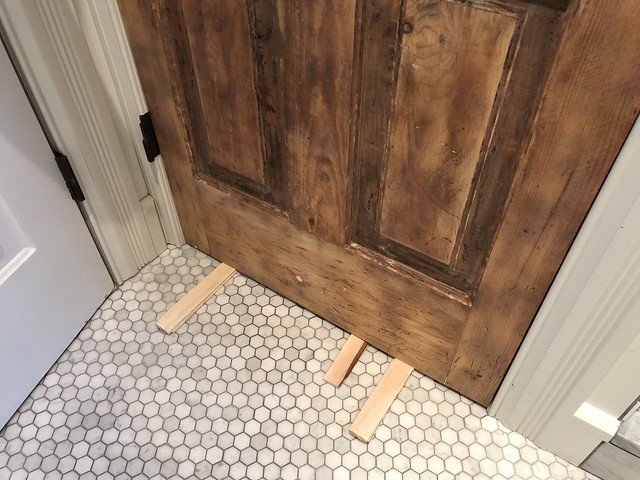
<p>When it comes to doors, it's always better to have more space at the bottom of the door than the top. A minor gap at the bottom won't be noticed, but at the top it will always stand out since it's much closer to eye level. So before marking the hinge locations I like to slide several shims under the door when it's propped in the opening to force it to the top of the doorway.&nbsp;</p>
<p>
</p>
<div class="MediaContainer PhotoContainer"><a href="https://farm5.staticflickr.com/4583/38628721512_87eb925baa_z.jpg" rel="PhotoPopup" popupheight="480" popupwidth="640"><img alt="" src="https://farm5.staticflickr.com/4583/38628721512_87eb925baa.jpg" width="500" height="375" style="border-width: 0px; border-style: solid;" /></a></div>
<p>Once the door is forced to the top of the opening, then you can use a pencil to mark the locations of the hinge mortises based on where you cut them in the first step of the install. Make clear and simple lines at the top and bottom of each hinge, then transfer those marks onto the side of the door with a carpenter's/rafter square.</p>
<p>Next up, grab your router and the same hinge template you used in step 1. Hopefully you have the same depth settings on the router and you can just tack the hinge template onto the side of the door and route out your mortises for your hinges.&nbsp;</p>
<p>
</p>
<div class="MediaContainer PhotoContainer"><a href="https://farm5.staticflickr.com/4568/26901707829_e113c1b191_z.jpg" rel="PhotoPopup" popupheight="480" popupwidth="640"><img alt="" src="https://farm5.staticflickr.com/4568/26901707829_e113c1b191.jpg" width="500" height="375" style="border-width: 0px; border-style: solid;" /></a></div>
<p>In our case the mortise template made a mortise that was just a hair too small for our hinges, so I needed to widen it ever so slightly with our chisels. Since the door we're using is a little thinner than many old doors, the hinge mortising went straight through front to back, so there were no rounded corners to carve out. But just like in step 1, if you need to you can just use a good sharp chisel.</p>
<p>
</p>
<div class="MediaContainer PhotoContainer"><a href="https://farm5.staticflickr.com/4572/37887803585_cf3e29266e_z.jpg" rel="PhotoPopup" popupheight="640" popupwidth="403"><img alt="" src="https://farm5.staticflickr.com/4572/37887803585_cf3e29266e.jpg" width="315" height="500" style="border-width: 0px; border-style: solid;" /></a></div>
<p>With the hinge mortises cut on the door, I mount the hinges in their opening. In our scenario I can mount the hinges as far forward or backward as needed to get the right look in the door opening. In our case I mounted them slightly overhanging the rear of the door. Ideally we would have had 3-1/2" x 3" hinges so there's be no overlap, but finding exact salvaged hardware can be difficult, and I knew this would still work well. The only consider I'll need to worry about later is possibly placing a few smaller stop blocks on the jamb to ensure the thinner door doesn't try to over close when shut.</p>
<p>
</p>
<div class="MediaContainer PhotoContainer"><a href="https://farm5.staticflickr.com/4559/38835671231_ff068d98f3_z.jpg" rel="PhotoPopup" popupheight="640" popupwidth="480"><img alt="" src="https://farm5.staticflickr.com/4559/38835671231_ff068d98f3.jpg" width="375" height="500" style="border-width: 0px; border-style: solid;" /></a></div>
<p>After mounting the hinges I took the door to the opening for the first real fit. Dropping the hinges on their posts and the door was looking good. However, it was slightly "wider" now than when we initially fit it in the opening since the hinges added about 1/8" on the left of the door. Since we have the door hung we can close it as far as it will need to close and then mark the new cut line on the top and bottom of the door based on where the edge of the jamb sits. This is also a great way to account for a minor out of square situation with your jamb.</p>
<p>With the new location marked we make one final trim with the track saw, then pop the door back on the hinges and see how we're doing.&nbsp;</p>
<p>
</p>
<div class="MediaContainer PhotoContainer"><a href="https://farm5.staticflickr.com/4525/38690599391_96bb7e9fbc_z.jpg" rel="PhotoPopup" popupheight="640" popupwidth="480"><img alt="" src="https://farm5.staticflickr.com/4525/38690599391_96bb7e9fbc.jpg" width="375" height="500" style="border-width: 0px; border-style: solid;" /></a></div>
<p>And with that, we have a very old door hanging in a new opening using salvaged antique hardware.&nbsp;</p>
<p>
</p>
<div class="MediaContainer PhotoContainer"><a href="https://farm5.staticflickr.com/4581/38784395932_49d5279cbb_z.jpg" rel="PhotoPopup" popupheight="640" popupwidth="512"><img alt="" src="https://farm5.staticflickr.com/4581/38784395932_49d5279cbb.jpg" width="400" height="500" style="border-width: 0px; border-style: solid;" /></a></div>
<p>We still have lock/knob hardware to mount and install, but that will vary pretty drastically based on what kind of hardware you're using. In our case we're using a rim lock, which is one of the most forgiving to mount since it's all on the surface and requires no mortising. We'll still also need to do a final sanding of the door since the track saw leaves very sharp and clean lines that tend to look out of place on old doors. Then, when we're all done with hardware, we'll still need to paint the door.&nbsp;</p>
<p>
</p>
<div class="MediaContainer PhotoContainer"><a href="https://farm5.staticflickr.com/4526/24870324338_f335342cc8_z.jpg" rel="PhotoPopup" popupheight="640" popupwidth="480"><img alt="" src="https://farm5.staticflickr.com/4526/24870324338_f335342cc8.jpg" width="375" height="500" style="border-width: 0px; border-style: solid;" /></a></div>
<p>In a nutshell, hanging a salvaged door is far from an impossible task, and is actually quite reasonable when you take it one step at a time. It can feel daunting initially, but remembering the golden rule, measure twice, cut once, will take you far.&nbsp;</p>
<p>Do you have any experience hanging salvaged doors? If so, any tips or tricks you'd like to share that might help? And if you've never done it before but have wanted to, does this seem like something you'd be willing to try given what we've outlined? Would love to hear some of your experiences.</p>
<p>&nbsp;&nbsp;&nbsp;</p><p><a href="https://www.oldtownhome.com/2017/12/4/How-To-Install-a-Salvaged-Door-with-Antique-Hinges/">Read Full Post</a></p>]]></content>
    <category term="Header Image" />
    <category term="How To" />
    <category term="Projects:Salvage" />
    <category term="Salvage" />
    <category term="Salvaged Doors" />
    <category term="Woodworking" />
    <PostImage>https://c1.staticflickr.com/5/4690/39061856102_5ed9a95763_c.jpg</PostImage>
    <media:thumbnail url="https://c1.staticflickr.com/5/4690/39061856102_5ed9a95763_t.jpg" />
    <ExtensionElements>
      <Item>PostImage</Item>
      <Item>media:thumbnail</Item>
    </ExtensionElements>
  </entry>
  <entry>
    <guid>3baa87f1-1d26-492f-8352-13c85888782c</guid>
    <id>https://www.oldtownhome.com/2016/9/2/Lulus-Live-TV-Debut-Old-Home-Enthusiasts-and-Some-Project-Progress/</id>
    <title>Lulu's Live TV Debut, Old Home Enthusiasts, and Some Project Progress</title>
    <summary type="html"><![CDATA[<p>Slow and steady progress across multiple major projects feels quite nice!</p><p>But before we get to our "tortoise and hare" style of renovating, we have a few fun things to update you on this week, including a live TV morning show debut!</p><p>
</p><div class="MediaContainer PhotoContainer"><a href="https://farm9.staticflickr.com/8414/29324349411_2d29c2a6d2_z.jpg" rel="PhotoPopup" popupheight="480" popupwidth="640"><img alt="" src="https://farm9.staticflickr.com/8414/29324349411_2d29c2a6d2.jpg" width="500" height="375" style="border-width: 0px; border-style: solid;"></a></div><p>First off, last Friday was National Dog Day, or #NationalDogDay if you were paying attention to the Internets. It's a day when you're supposed to celebrate your four legged canine's contribution to your life a little more than on other days. But in Old Town Alexandria pretty much every day is National Dog Day. </p><p>Our city is so incredibly dog friendly that many stores place water bowls and dog treat trays on the sidewalk near their door, shops advertise their dog friendly stance with "Pet Friendly" signs placed in their window, some restaurants have a "dog menu" for when you're sitting outside eating and your pup is under the table, there are several dog (and cat) specialty stores, there's a local weekly "Yappy Hour" in the courtyard of the Hotel Monaco, and we even have multiple parades where the highlights are either the dog show just before or the packs of dogs with their owners marching during the parade.</p><p>If you're a dog lover, you really can't beat Old Town Alexandria, and that was the focus of a live "Great Day Washington" segment for which Lulu was invited to be a model. </p> <a href="https://www.oldtownhome.com/2016/9/2/Lulus-Live-TV-Debut-Old-Home-Enthusiasts-and-Some-Project-Progress/">more</a>]]></summary>
    <published>2016-09-02T08:37:42.863-04:00</published>
    <updated>2016-09-02T08:37:42.863-04:00</updated>
    <link rel="alternate" href="https://www.oldtownhome.com/2016/9/2/Lulus-Live-TV-Debut-Old-Home-Enthusiasts-and-Some-Project-Progress/" />
    <author>
      <name>Alex</name>
    </author>
    <content type="html"><![CDATA[<p>Slow and steady progress across multiple major projects feels quite nice!</p>
<p>But before we get to our "tortoise and hare" style of renovating, we have a few fun things to update you on this week, including a live TV morning show debut!</p>
<p>
</p>
<div class="MediaContainer PhotoContainer"><a href="https://farm9.staticflickr.com/8414/29324349411_2d29c2a6d2_z.jpg" rel="PhotoPopup" popupheight="480" popupwidth="640"><img alt="" src="https://farm9.staticflickr.com/8414/29324349411_2d29c2a6d2.jpg" width="500" height="375" style="border-width: 0px; border-style: solid;"></a></div>
<p>First off, last Friday was National Dog Day, or #NationalDogDay if you were paying attention to the Internets. It's a day when you're supposed to celebrate your four legged canine's contribution to your life a little more than on other days. But in Old Town Alexandria pretty much every day is National Dog Day. </p>
<p>Our city is so incredibly dog friendly that many stores place water bowls and dog treat trays on the sidewalk near their door, shops advertise their dog friendly stance with "Pet Friendly" signs placed in their window, some restaurants have a "dog menu" for when you're sitting outside eating and your pup is under the table, there are several dog (and cat) specialty stores, there's a local weekly "Yappy Hour" in the courtyard of the Hotel Monaco, and we even have multiple parades where the highlights are either the dog show just before or the packs of dogs with their owners marching during the parade.</p>
<p>If you're a dog lover, you really can't beat Old Town Alexandria, and that was the focus of a live "Great Day Washington" segment for which Lulu was invited to be a model. </p>
<div class="MediaContainer">
<iframe width="600" height="360" style="border-width: 0px;" src="http://interactive.tegna-media.com/video/embed/embed.html?id=2342740&amp;type=video&amp;title=Visit%20to%20Virginia%20dog%20boutique%20for%20National%20Dog%20Day&amp;site=65&amp;playerid=6918249996581&amp;dfpid=32805352&amp;dfpposition=Video_prestream_external§ion=home"></iframe>
</div>
<p>Overall we think Lulu is a natural. Perhaps a bit neurotic and at times a diva, but it's the eccentricities that make the best celebs, right?</p>
<p>
</p>
<div class="MediaContainer PhotoContainer"><a href="https://farm9.staticflickr.com/8384/29350459935_183d4a35c0_z.jpg" rel="PhotoPopup" popupheight="480" popupwidth="640"><img alt="" src="https://farm9.staticflickr.com/8384/29350459935_183d4a35c0.jpg" width="500" height="375" style="border-width: 0px; border-style: solid;"></a></div>
<p>Beyond Lulu's live television appearance Wendy and I were interviewed for a piece on CBSNews.com that focused on the pros and cons of purchasing old homes. The article was published earlier this week and includes perspectives on the topic from five other sets of old home owners, including us.&nbsp;</p>
<p>You can check out the full "<a href="http://www.cbsnews.com/media/should-you-buy-a-historic-home-6-owners-share-the-pros-and-cons/" target="_blank">Buying a historic home? 6 owners share the pros and cons</a>" article. We love contributing on pieces like this one as it's one of our goals in life to recruit many more crazies to this wonderful hobby of old home renovation/restoration.</p>
<p>The article covers some valuable insight and  information for those considering the purchase of an old homes, and especially those considering the purchase as their first home. And if you currently or have ever owned an old home, it's also a good read to nod along to as you read the likely similar experiences you had along the way. </p>
<p>Okay, that's enough of the other stuff, time to get into a little under stairs storage bench progress. </p>
<p>
</p>
<div class="MediaContainer PhotoContainer"><a href="https://farm9.staticflickr.com/8775/28576712820_6feab383a4_z.jpg" rel="PhotoPopup" popupheight="480" popupwidth="640"><img alt="" src="https://farm9.staticflickr.com/8775/28576712820_6feab383a4.jpg" width="500" height="375" style="border-width: 0px; border-style: solid;"></a></div>
<p>As of the last post on this subject, we left off with the beadboard largely installed and we showed vaguely how the secret panel would work. However, I didn't do a great job showing exactly what I meant with photos, so I can rectify that today while covering what we've accomplished.</p>
<p>
</p>
<div class="MediaContainer PhotoContainer"><a href="https://farm9.staticflickr.com/8308/28927792826_da1a94436e_z.jpg" rel="PhotoPopup" popupheight="640" popupwidth="480"><img alt="" src="https://farm9.staticflickr.com/8308/28927792826_da1a94436e.jpg" width="375" height="500" style="border-width: 0px; border-style: solid;"></a></div>
<p>Since the panelling we're using is salvaged from a large pile of wood that's been in the attic for who knows how long, the paint on it is flaking, dirty, and generally gross. Though the final coats of paint are still some ways off, we wanted to get a coat of primer on the whole thing since it's right in the middle of the living space.</p>
<p>
</p>
<div class="MediaContainer PhotoContainer"><a href="https://farm9.staticflickr.com/8463/29369502276_1bf424cbaa_z.jpg" rel="PhotoPopup" popupheight="640" popupwidth="427"><img alt="" src="https://farm9.staticflickr.com/8463/29369502276_1bf424cbaa.jpg" width="333" height="500" style="border-width: 0px; border-style: solid;"></a></div>
<p>This would also give us a pretty solid indication of how it will look when fully painted and no longer a mix of natural wood, dirty antique white, and faded green. I have to say, even with a coat of primer alone it's truly night and day difference.</p>
<p>
</p>
<div class="MediaContainer PhotoContainer"><a href="https://farm9.staticflickr.com/8411/28779864534_cb64589008_z.jpg" rel="PhotoPopup" popupheight="427" popupwidth="640"><img alt="" src="https://farm9.staticflickr.com/8411/28779864534_cb64589008.jpg" width="500" height="333" style="border-width: 0px; border-style: solid;"></a></div>
<p>With everything in place it looks like a single cohesive bench and wall. The air intake is fully integrated and the panel is hidden in a way that looks natural. We'll still need to build the flip up bench top so the lower section can be storage, but let's take a second to go over how the panel removal will work. Starting in the above photo we'll be able to remove a piece of the right trim as well as the bench top by pulling it forward slightly and lifting it out. Once it's out we'll remove the interior back of the storage panel.</p>
<p>
</p>
<div class="MediaContainer PhotoContainer"><a href="https://farm9.staticflickr.com/8801/28934159411_7a7736bda9_z.jpg" rel="PhotoPopup" popupheight="640" popupwidth="480"><img alt="" src="https://farm9.staticflickr.com/8801/28934159411_7a7736bda9.jpg" width="375" height="500" style="border-width: 0px; border-style: solid;"></a></div>
<p>Then we'll slip our fingers below the removable panel on the back section of the wall.</p>
<p>
</p>
<div class="MediaContainer PhotoContainer"><a href="https://farm9.staticflickr.com/8612/28724174420_483a6ebb6a_z.jpg" rel="PhotoPopup" popupheight="640" popupwidth="480"><img alt="" src="https://farm9.staticflickr.com/8612/28724174420_483a6ebb6a.jpg" width="375" height="500" style="border-width: 0px; border-style: solid;"></a></div>
<p>The final piece to remove is the 2x4 support pieces behind the panels. This is tight in place but can slide out to open the entire area.</p>
<p>
</p>
<div class="MediaContainer PhotoContainer"><a href="https://farm9.staticflickr.com/8628/28390514164_245ec94d7b_z.jpg" rel="PhotoPopup" popupheight="640" popupwidth="480"><img alt="" src="https://farm9.staticflickr.com/8628/28390514164_245ec94d7b.jpg" width="375" height="500" style="border-width: 0px; border-style: solid;"></a></div>
<p>All told it's a pretty decent setup that will allow occasional access to the crawlspace when needed, but will look like a normal bench storage area otherwise. &nbsp;</p>
<p>The next bit of work we did on this project was to finish the interior of the storage. While the outside will be painted white, we went a slightly more simple route for the interior. We decided to use the same Pallmann X-325 sealer and X-96 finish that was used on the floor.&nbsp;</p>
<p>
</p>
<div class="MediaContainer PhotoContainer"><a href="https://farm9.staticflickr.com/8800/28905320802_2f5d87038b_z.jpg" rel="PhotoPopup" popupheight="480" popupwidth="640"><img alt="" src="https://farm9.staticflickr.com/8800/28905320802_2f5d87038b.jpg" width="500" height="375" style="border-width: 0px; border-style: solid;"></a></div>
<p>Finally, while it's somewhat tough to see in the photos above, the wall and ceiling around this storage bench is in pretty tough shape (as is the rest of the room, but that's a different project down the road). Plaster on the underside of stairs often take a beating because of the vibration of people using the stairs on a daily basis. In our case the plaster near the bottom was almost completely detached and fully separating from the lath. <a href="http://www.oldtownhome.com/2012/4/17/Toolbox-Tuesday-Plaster-Buttons-to-Fix-Your-Crumbling-Ceiling">Plaster Buttons</a> to the rescue!</p>
<p>
</p>
<div class="MediaContainer PhotoContainer"><a href="https://farm9.staticflickr.com/8242/28393216403_45fd780260_z.jpg" rel="PhotoPopup" popupheight="640" popupwidth="480"><img alt="" src="https://farm9.staticflickr.com/8242/28393216403_45fd780260.jpg" width="375" height="500" style="border-width: 0px; border-style: solid;"></a></div>
<p>After applying a massive number of buttons to the small space, the plaster was once again secure and solid. No more sag or bounciness to worry about. Now all we had to do was re-plaster the two walls and slanted ceiling of the small space.</p>
<p>I decided to use the same three coat plaster approach we used in the restoration of our living room. It really worked great in there, so why not continue the tradition? We had just enough leftover Master of Plaster base and finish coat to make this a pretty easy task to accomplish, but we'll certainly need to buy more when it comes to doing the rest of the room.</p>
<p>We started by using the first coat of Structo-Lite with embedded fiberglass screen.</p>
<p>
</p>
<div class="MediaContainer PhotoContainer"><a href="https://farm9.staticflickr.com/8333/29178889586_3d1bcd2ecb_z.jpg" rel="PhotoPopup" popupheight="640" popupwidth="480"><img alt="" src="https://farm9.staticflickr.com/8333/29178889586_3d1bcd2ecb.jpg" width="375" height="500" style="border-width: 0px; border-style: solid;"></a></div>
<p>But as I was plastering and Wendy was holding the thermostat out of my way she commented on how the wall seemed "bouncy". While I had secured the underside of the stairs with the plaster buttons, but seemed some of the wall had also broken free but I didn't notice. At this point the problem was still very fixable, so I applied a few buttons right into the plaster.</p>
<p>
</p>
<div class="MediaContainer PhotoContainer"><a href="https://farm9.staticflickr.com/8140/29295436952_9f44460617_z.jpg" rel="PhotoPopup" popupheight="640" popupwidth="480"><img alt="" src="https://farm9.staticflickr.com/8140/29295436952_9f44460617.jpg" width="375" height="500" style="border-width: 0px; border-style: solid;"></a></div>
<p>I think it's hysterical when I put buttons in over a coat of plaster because it reminds me so much of the Play-Doh Fun Factory I had as a kid. The plaster oozes through the holes and looks like fake spaghetti.</p>
<p>
</p>
<div class="MediaContainer PhotoContainer"><a href="https://farm9.staticflickr.com/8173/29295434772_e1b18d6e3a_z.jpg" rel="PhotoPopup" popupheight="480" popupwidth="640"><img alt="" src="https://farm9.staticflickr.com/8173/29295434772_e1b18d6e3a.jpg" width="500" height="375" style="border-width: 0px; border-style: solid;"></a></div>
<p>Once the wall was back in good shape I moved onto the screen application. Now that we've done this a fair amount it's a very straight forward and simple process.</p>
<p>
</p>
<div class="MediaContainer PhotoContainer"><a href="https://farm8.staticflickr.com/7466/29178876856_3cf5dc2819_z.jpg" rel="PhotoPopup" popupheight="640" popupwidth="480"><img alt="" src="https://farm8.staticflickr.com/7466/29178876856_3cf5dc2819.jpg" width="375" height="500" style="border-width: 0px; border-style: solid;"></a></div>
<p>After allowing adequate cure time we moved onto the Master of Plaster base coat application.&nbsp;</p>
<p>
</p>
<div class="MediaContainer PhotoContainer"><a href="https://farm9.staticflickr.com/8514/29115514270_f1a95009e4_z.jpg" rel="PhotoPopup" popupheight="640" popupwidth="480"><img alt="" src="https://farm9.staticflickr.com/8514/29115514270_f1a95009e4.jpg" width="375" height="500" style="border-width: 0px; border-style: solid;"></a></div>
<p>I still can't get enough of working with this plaster. It goes on so nice and smooth compared to what I've done with joint compound. But I have to say, that curved section at the top of this photo was difficult regardless of the material we were using. I think about 50% of my entire time plastering was spent making that little curve look nice and smooth. Here's an in progress shot of that curve.</p>
<p>
</p>
<div class="MediaContainer PhotoContainer"><a href="https://farm9.staticflickr.com/8146/29369286976_b42e585d76_z.jpg" rel="PhotoPopup" popupheight="640" popupwidth="480"><img alt="" src="https://farm9.staticflickr.com/8146/29369286976_b42e585d76.jpg" width="375" height="500" style="border-width: 0px; border-style: solid;"></a></div>
<p>After the finish coat was applied we are left with a wonderfully smooth, crack free, and completely repaired wall and ceiling section.</p>
<p>
</p>
<div class="MediaContainer PhotoContainer"><a href="https://farm9.staticflickr.com/8530/29403951995_c6f59bb130_z.jpg" rel="PhotoPopup" popupheight="640" popupwidth="480"><img alt="" src="https://farm9.staticflickr.com/8530/29403951995_c6f59bb130.jpg" width="375" height="500" style="border-width: 0px; border-style: solid;"></a></div>
<p>And if you notice in the photo above, we also painted the interior of the air intake with a flat black paint so you won't be able to see the shiny silver through the antique cast iron grate we're going to mount in the opening.</p>
<p>
</p>
<div class="MediaContainer PhotoContainer"><a href="https://farm9.staticflickr.com/8491/29324405651_b3a819c519_z.jpg" rel="PhotoPopup" popupheight="640" popupwidth="480"><img alt="" src="https://farm9.staticflickr.com/8491/29324405651_b3a819c519.jpg" width="375" height="500" style="border-width: 0px; border-style: solid;"></a></div>
<p>So that's where we are today on the storage bench. It's really start to take shape and look good. We'll need to caulk around the whole thing once the plaster has cured, build and paint the flip-up bench top, install and hok up the light, and finish work on the cast iron grate. But it is really coming together and starting to look how we imagined it when we starting talking about it months ago.</p>
<p>We can't wait to share more as our work progresses. The more we look at this hallway space the more excited we become. Wendy can't wait to paint and decorate the space and I can't wait until all of the walls and moldings look as good as or better than the day the house was built! Despite a really rocky first year of owning this home,&nbsp;I think the more time we spend improving this house the more we're going to fall in love with it. I mean, what's not to love?</p>
<p>
</p>
<div class="MediaContainer PhotoContainer"><a href="https://farm9.staticflickr.com/8271/29369462296_9136218ed5_z.jpg" rel="PhotoPopup" popupheight="427" popupwidth="640"><img alt="" src="https://farm9.staticflickr.com/8271/29369462296_9136218ed5.jpg" width="500" height="333" style="border-width: 0px; border-style: solid;"></a></div>
<p>What do you think so far? Is it coming together nicely?</p><p><a href="https://www.oldtownhome.com/2016/9/2/Lulus-Live-TV-Debut-Old-Home-Enthusiasts-and-Some-Project-Progress/">Read Full Post</a></p>]]></content>
    <category term="Header Image" />
    <category term="Main Hallway" />
    <category term="Plaster Repair" />
    <category term="Salvage" />
    <category term="Woodworking" />
    <PostImage>https://c1.staticflickr.com/9/8350/28784326953_113c43744a.jpg</PostImage>
    <media:thumbnail url="https://c1.staticflickr.com/9/8350/28784326953_113c43744a_t.jpg" />
    <ExtensionElements>
      <Item>PostImage</Item>
      <Item>media:thumbnail</Item>
    </ExtensionElements>
  </entry>
  <entry>
    <guid>6ffc6b3b-1bea-415c-9f0b-ae58d5458742</guid>
    <id>https://www.oldtownhome.com/2016/8/9/Scooby-Doo-Style-Hidden-Panels-in-Our-Bead-Board-Bench/</id>
    <title>Scooby Doo Style Hidden Panels in Our Bead Board Bench</title>
    <summary type="html"><![CDATA[<p>Today we're really excited to share a good amount of progress on our salvaged bead board storage bench!</p><p>Yep, that's right, we're starting to actually get stuff done...who knew that was possible with our projects?</p><p>Our last updated we gave you a <a href="http://www.oldtownhome.com/2016/7/22/Creating-Bench-Storage-from-Salvaged-Beadboard/">glimpse into the start of our beadboard application</a>. After a weekend worth of effort we went from a stud-wall skeleton covering our HVAC return duct to a partially complete beadboard covered bench and wall that helped us see the direction we were headed.</p><p>
</p><div class="MediaContainer PhotoContainer"><a href="https://farm9.staticflickr.com/8585/28774005315_ac548db87c_z.jpg" rel="PhotoPopup" popupheight="640" popupwidth="480"><img alt="" src="https://farm9.staticflickr.com/8585/28774005315_ac548db87c.jpg" width="375" height="500" style="border-width: 0px; border-style: solid;"></a></div><p>Over the last few weekends we were able to carve out a little bit of time to make a whole bunch more progress.</p><p>I don't know about you, but I'm a little bit obsessed with hidden panels, secret compartments, and other aspects of home decor that appear to be something other than what they actually are. This obsession started as a child, likely while watching Scooby Doo when Shaggy would invariably accidentally stumble on a dusty book on the shelf that when pulled would open a secret compartment. (Though we always knew which book it was as kids because the cartoon coloring was just a *little* bit different on that one book.)</p> <a href="https://www.oldtownhome.com/2016/8/9/Scooby-Doo-Style-Hidden-Panels-in-Our-Bead-Board-Bench/">more</a>]]></summary>
    <published>2016-08-09T10:00:00.000-04:00</published>
    <updated>2016-08-09T10:00:00.000-04:00</updated>
    <link rel="alternate" href="https://www.oldtownhome.com/2016/8/9/Scooby-Doo-Style-Hidden-Panels-in-Our-Bead-Board-Bench/" />
    <author>
      <name>Alex</name>
    </author>
    <content type="html"><![CDATA[<p>Today we're really excited to share a good amount of progress on our salvaged bead board storage bench!</p>
<p>Yep, that's right, we're starting to actually get stuff done...who knew that was possible with our projects?</p>
<p>Our last updated we gave you a <a href="http://www.oldtownhome.com/2016/7/22/Creating-Bench-Storage-from-Salvaged-Beadboard/">glimpse into the start of our beadboard application</a>. After a weekend worth of effort we went from a stud-wall skeleton covering our HVAC return duct to a partially complete beadboard covered bench and wall that helped us see the direction we were headed.</p>
<p>
</p>
<div class="MediaContainer PhotoContainer"><a href="https://farm9.staticflickr.com/8585/28774005315_ac548db87c_z.jpg" rel="PhotoPopup" popupheight="640" popupwidth="480"><img alt="" src="https://farm9.staticflickr.com/8585/28774005315_ac548db87c.jpg" width="375" height="500" style="border-width: 0px; border-style: solid;" /></a></div>
<p>Over the last few weekends we were able to carve out a little bit of time to make a whole bunch more progress.</p>
<p>I don't know about you, but I'm a little bit obsessed with hidden panels, secret compartments, and other aspects of home decor that appear to be something other than what they actually are. This obsession started as a child, likely while watching Scooby Doo when Shaggy would invariably accidentally stumble on a dusty book on the shelf that when pulled would open a secret compartment. (Though we always knew which book it was as kids because the cartoon coloring was just a *little* bit different on that one book.)</p>
<p>Ever since those early days I've always wanted to build in secret aspects of our home. Now that our crawlspace access is below the HVAC return, I need to maintain some level of access to the crawlspace for home improvement and maintenance, so this is my opportunity to build in a truly secret compartment! My childhood dream is finally coming true. Here's a look at how we get into the crawlspace...</p>
<p>
</p>
<div class="MediaContainer PhotoContainer"><a href="https://farm1.staticflickr.com/539/20221937662_eb7b07886b_z.jpg" rel="PhotoPopup" popupheight="640" popupwidth="640"><img alt="" src="https://farm1.staticflickr.com/539/20221937662_eb7b07886b.jpg" width="500" height="500" style="border-width: 0px; border-style: solid;" /></a></div>
<p>After our last update, we moved onto placing the long diagonal trim board along the stairs. I had to get a little creative with the top end of the board since it's both an angle and a curve. I ended up cutting a template from a small piece of wood and then tracing that template and using the jigsaw to cut the curve. It worked out pretty well and will look great once it's caulked.</p>
<p>
</p>
<div class="MediaContainer PhotoContainer"><a href="https://farm9.staticflickr.com/8575/28159224853_4a314c6922_z.jpg" rel="PhotoPopup" popupheight="480" popupwidth="640"><img alt="" src="https://farm9.staticflickr.com/8575/28159224853_4a314c6922.jpg" width="500" height="375" style="border-width: 0px; border-style: solid;" /></a></div>
<p>Before we could keep working on the beadboard or any of the time boards, we needed to figure out exactly where the bench top would sit. And before we could figure out the bench top, I needed to start assembling the interior of the storage area. While this will simply be where we keep our outdoor seat cushions, I didn't want it to be an open stud interior. Instead I used some 1/2" birch plywood and cut several panels to line the interior of the storage bench.</p>
<p>
</p>
<div class="MediaContainer PhotoContainer"><a href="https://farm9.staticflickr.com/8538/28668944302_0e077636e1_z.jpg" rel="PhotoPopup" popupheight="640" popupwidth="480"><img alt="" src="https://farm9.staticflickr.com/8538/28668944302_0e077636e1.jpg" width="375" height="500" style="border-width: 0px; border-style: solid;" /></a></div>
<p>In order to maintain access to the crawl space, I cut the panels in a way that would allow a partial panel to be completely removable. Additionally, the two by four across the back is also removable once the panel is taken out.</p>
<p>
</p>
<div class="MediaContainer PhotoContainer"><a href="https://farm9.staticflickr.com/8116/28697126001_0736c6af25_z.jpg" rel="PhotoPopup" popupheight="480" popupwidth="640"><img alt="" src="https://farm9.staticflickr.com/8116/28697126001_0736c6af25.jpg" width="500" height="375" style="border-width: 0px; border-style: solid;" /></a></div>
<p>Did I mention that I typically make all of my cuts outside on our side porch? Whether the sun is beating down or the sky open and it starts to pour, the side porch is a perfect place for a project.</p>
<p>
</p>
<div class="MediaContainer PhotoContainer"><a href="https://farm9.staticflickr.com/8417/28742590536_4e780f8dec_z.jpg" rel="PhotoPopup" popupheight="640" popupwidth="480"><img alt="" src="https://farm9.staticflickr.com/8417/28742590536_4e780f8dec.jpg" width="375" height="500" style="border-width: 0px; border-style: solid;" /></a></div>
<p>Once the interior of the storage bench was covered we could place the frame boards around the upper rim so you won't see any of the 2 x 4 boards.</p>
<p>Like we did with the interior, the frame piece had to be fully removable. I cut a piece of frame just a bit longer than the panel and then nailed the frame directly to the removable panel. This means I can remove the panel as one large piece with the frame intact.</p>
<p>
</p>
<div class="MediaContainer PhotoContainer"><a href="https://farm9.staticflickr.com/8761/28829794606_ab837b0b19_z.jpg" rel="PhotoPopup" popupheight="480" popupwidth="640"><img alt="" src="https://farm9.staticflickr.com/8761/28829794606_ab837b0b19.jpg" width="500" height="375" style="border-width: 0px; border-style: solid;" /></a></div>
<p>When the frame was placed we could determine exactly where the top of the bench would sit, which then allowed us to begin placing the remaining trim boards.</p>
<p>
</p>
<div class="MediaContainer PhotoContainer"><a href="https://farm9.staticflickr.com/8844/28756541402_d584305c92_z.jpg" rel="PhotoPopup" popupheight="640" popupwidth="480"><img alt="" src="https://farm9.staticflickr.com/8844/28756541402_d584305c92.jpg" width="375" height="500" style="border-width: 0px; border-style: solid;" /></a></div>
<p>One of the major elements of this project will ultimately be the large antique cast iron grate that will cover the air intake. Due to the tight space and awkward location of the trim boards, we ended up building a frame on which the cast iron grate will be mounted. This will make the grate flush with everything around it and will keep us from having to notch out sections of the trim boards to accommodate the grate.&nbsp;</p>
<p>After all of the trim was in place we got to work placing the base cap molding to make the whole thing match the rest of the stair trim.&nbsp;</p>
<p>One of the angles was so sharp that my miter saw couldn't cut the angle. I had to cut the angle at 65.5 degrees, but the saw only goes up to 50 degrees. In order to accommodate this very sharp angle I had to cut a fence board at 45 degrees and then set my saw at 20.5 degrees.</p>
<p class="MediaContainer PhotoContainer"><a href="https://farm9.staticflickr.com/8631/28243843944_8e6cb7a964_z.jpg" rel="PhotoPopup" popupheight="480" popupwidth="640"><img alt="" src="https://farm9.staticflickr.com/8631/28243843944_8e6cb7a964.jpg" width="500" height="375" style="border-width: 0px; border-style: solid;" /></a></p>
<p class="MediaContainer PhotoContainer"><em>Don't worry, my hand was very clear of the blade while making the cut.</em></p>
<p>Once I had the fence forcing 45 degrees the cut of 20.5 degrees was very easy. Before I knew it I had a nearly perfect and very acute angle cut.</p>
<p>
</p>
<div class="MediaContainer PhotoContainer"><a href="https://farm9.staticflickr.com/8844/28756447262_0db6581f77_z.jpg" rel="PhotoPopup" popupheight="640" popupwidth="480"><img alt="" src="https://farm9.staticflickr.com/8844/28756447262_0db6581f77.jpg" width="375" height="500" style="border-width: 0px; border-style: solid;" /></a></div>
<p>Putting the whole thing together is a little like a giant jigsaw puzzle. Every piece we placed we had to worry about how it would fit, if it would allow the necessary pieces to be removed to be could get access to the crawlspace if needed, and if it would look okay. One of the more difficult pieces was building the large removable beadboard panel in a way to allow easy removal without letting you see that it was a movable panel.</p>
<p>
</p>
<div class="MediaContainer PhotoContainer"><a href="https://farm9.staticflickr.com/8664/28576711960_5b515d89eb_z.jpg" rel="PhotoPopup" popupheight="640" popupwidth="480"><img alt="" src="https://farm9.staticflickr.com/8664/28576711960_5b515d89eb.jpg" width="375" height="500" style="border-width: 0px; border-style: solid;" /></a></div>
<p>To accomplish this we ended up mounting lengths of beadboard to a large piece of plywood that would perfectly fit in the opening. This would give the panel the structure and rigidity it would need without the risk of it balling apart if someone were to lean back on the panel. Then when we install it, the beadboard will slid up and behind the frame molding around the intake.</p>
<p>
</p>
<div class="MediaContainer PhotoContainer"><a href="https://farm9.staticflickr.com/8493/28246249923_a6f2621578_z.jpg" rel="PhotoPopup" popupheight="640" popupwidth="480"><img alt="" src="https://farm9.staticflickr.com/8493/28246249923_a6f2621578.jpg" width="375" height="500" style="border-width: 0px; border-style: solid;" /></a></div>
<p>After a good amount of patience and measuring we had ourselves a removable Scooby Doo panel.</p>
<p>
</p>
<div class="MediaContainer PhotoContainer"><a href="https://farm9.staticflickr.com/8654/28860865105_7eb26673a5_z.jpg" rel="PhotoPopup" popupheight="640" popupwidth="480"><img alt="" src="https://farm9.staticflickr.com/8654/28860865105_7eb26673a5.jpg" width="375" height="500" style="border-width: 0px; border-style: solid;" /></a></div>
<p>Once the panel was put in place the whole area quickly came together. I sanded all of the wood filler smooth and slowly got everything in shape and ready for priming.</p>
<p>
</p>
<div class="MediaContainer PhotoContainer"><a href="https://farm9.staticflickr.com/8775/28576712820_6feab383a4_z.jpg" rel="PhotoPopup" popupheight="480" popupwidth="640"><img alt="" src="https://farm9.staticflickr.com/8775/28576712820_6feab383a4.jpg" width="500" height="375" style="border-width: 0px; border-style: solid;" /></a></div>
<p>Looking into the same space from the kitchen, the space we were starting to get used to seeing a giant metal duct sitting there, we now have a very nice view of a bench in the making.</p>
<p>
</p>
<div class="MediaContainer PhotoContainer"><a href="https://farm8.staticflickr.com/7499/28785338891_395578601b_z.jpg" rel="PhotoPopup" popupheight="640" popupwidth="480"><img alt="" src="https://farm8.staticflickr.com/7499/28785338891_395578601b.jpg" width="375" height="500" style="border-width: 0px; border-style: solid;" /></a></div>
<p>We didn't have time to apply the primer this weekend, so it's on our "we can't wait to get back to do stuff" list. We'll also finish the interior of the bench in the same way we finished the floor, and we still need to build the bench top and apply the large silver piano hinge. Oh, and we still need to clean up the cast iron grate a little more before we can paint it with oil based primer (or it will rust through) and put it in place. While we made some great progress over the last several weekends, we still have a good amount of work to go. Paint, plaster, and a bit more woodworking, but boy is it starting to come together!</p>
<p>Before we close out this post I want to share a photo of our house that I absolutely love. The sunset is often a breathtaking time, and over the weekend we had an amazing pinkish purple sunset. I ran outside and snapped a few photos of our home from the pier, and I really like how this one turned out.</p>
<p>
</p>
<div class="MediaContainer PhotoContainer"><a href="https://farm9.staticflickr.com/8591/28785216601_832739ec0c_z.jpg" rel="PhotoPopup" popupheight="640" popupwidth="640"><img alt="" src="https://farm9.staticflickr.com/8591/28785216601_832739ec0c.jpg" width="500" height="500" style="border-width: 0px; border-style: solid;" /></a></div>
<p>We can't wait to knock out the rest of this bench project, but this beautiful sunset was a good reminder to work hard and play hard too.&nbsp;</p><p><a href="https://www.oldtownhome.com/2016/8/9/Scooby-Doo-Style-Hidden-Panels-in-Our-Bead-Board-Bench/">Read Full Post</a></p>]]></content>
    <category term="Header Image" />
    <category term="Salvage" />
    <category term="Under Stair Project" />
    <category term="Water House" />
    <category term="Woodworking" />
    <PostImage>https://c1.staticflickr.com/9/8291/28874012295_7e98015621.jpg</PostImage>
    <media:thumbnail url="https://c1.staticflickr.com/9/8291/28874012295_7e98015621_t.jpg" />
    <ExtensionElements>
      <Item>PostImage</Item>
      <Item>media:thumbnail</Item>
    </ExtensionElements>
  </entry>
</feed>