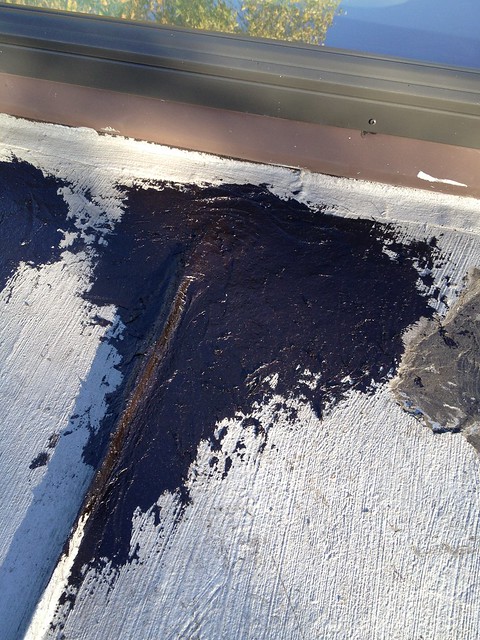
<?xml version="1.0" encoding="utf-8"?>
<feed xmlns="http://www.w3.org/2005/Atom" xmlns:media="http://search.yahoo.com/mrss/">
  <title>Old Town Home Category: 'Roof'</title>
  <updated>2013-07-10T09:42:00.000-04:00</updated>
  <id>http://www.oldtownhome.com/roof/index.atom</id>
  <link rel="alternate" href="http://www.oldtownhome.com/roof/index.atom" />
  <author>
    <name>Alex and Wendy</name>
    <uri>http://www.oldtownhome.com/</uri>
    <email>wendy@oldtownhome.com</email>
  </author>
  <entry>
    <guid>97e683fc-754b-4f8f-a9a0-79651208b6a9</guid>
    <id>https://www.oldtownhome.com/2013/7/10/Raining-in-the-Guest-Bedroom/</id>
    <title>Raining in the Guest Bedroom</title>
    <summary type="html"><![CDATA[<p>The life and responsibilities of a DIYer definitely do not end with working on new home projects. Maintenance and correction of home-related issues are equally if not more important in many instances, although not nearly as glamorous. This weekend was a particularly rude reminder of this simple yet often forgettable fact. But before I get into our weekend work, let me take a step back to tell you a little bit about what we were dealing with.</p><p>The guest bedroom bay window has been a bit of a pain in our sides since we bought the house back in 2003. Whether we're talking about the rotted windows, the uneven surfaces, or the fact the windows don't actually open, we've been dealing with issues related to this sad set of windows since day one. </p><p>Last week we had a run of several days with on again/off again rain and thunderstorms. This bane of a bay window actually offers some of the better views from our home when we're storm watching. About two minutes after posting this Instagram video of a thunderstorm that included lightening, wind, rain, and hail...</p><p>
</p><div class="MediaContainer VideoEmbed"><iframe width="560" height="349" src="http://www.youtube.com/embed/emei9mqBr1U?wmode=transparent&amp;hd=1" frameborder="0" allowfullscreen="true"></iframe></div><p>...I felt a drip of water on the top of my head. No, I wasn't outside, nor was I suddenly transported into our shower. This drop of water, quickly followed by at least four of its closest friends, hit me on the top of the head before I could really even process what it was I was experiencing. </p><p>"Odd," I thought, "it seems like water is coming into our house...oh wait, wait just a second...it IS coming into our house!!"</p> <a href="https://www.oldtownhome.com/2013/7/10/Raining-in-the-Guest-Bedroom/">more</a>]]></summary>
    <published>2013-07-10T09:42:00.000-04:00</published>
    <updated>2013-07-10T09:42:00.000-04:00</updated>
    <link rel="alternate" href="https://www.oldtownhome.com/2013/7/10/Raining-in-the-Guest-Bedroom/" />
    <author>
      <name>Alex</name>
    </author>
    <content type="html"><![CDATA[<p>The life and responsibilities of a DIYer definitely do not end with working on new home projects. Maintenance and correction of home-related issues are equally if not more important in many instances, although not nearly as glamorous. This weekend was a particularly rude reminder of this simple yet often forgettable fact. But before I get into our weekend work, let me take a step back to tell you a little bit about what we were dealing with.</p>
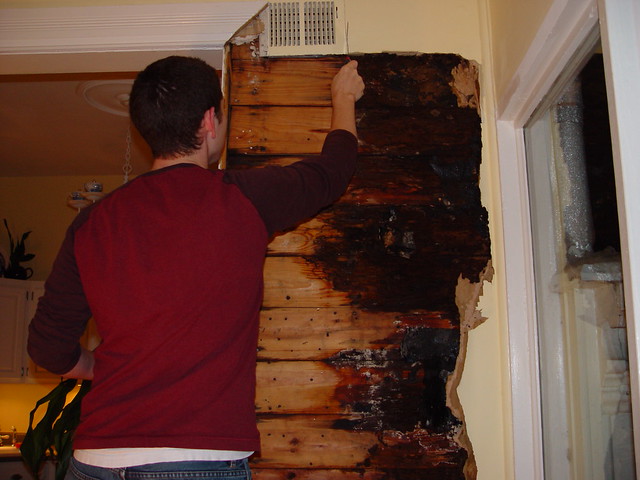
<p>The guest bedroom bay window has been a bit of a pain in our sides since we bought the house back in 2003. Whether we're talking about the rotted windows, the uneven surfaces, or the fact the windows don't actually open, we've been dealing with issues related to this sad set of windows since day one. </p>
<p>Last week we had a run of several days with on again/off again rain and thunderstorms. This bane of a bay window actually offers some of the better views from our home when we're storm watching. About two minutes after posting this Instagram video of a thunderstorm that included lightening, wind, rain, and hail...</p>
<p>
</p>
<div class="MediaContainer VideoEmbed"><iframe width="560" height="349" src="http://www.youtube.com/embed/emei9mqBr1U?wmode=transparent&amp;hd=1" frameborder="0" allowfullscreen="true"></iframe></div>
<p>...I felt a drip of water on the top of my head. No, I wasn't outside, nor was I suddenly transported into our shower. This drop of water, quickly followed by at least four of its closest friends, hit me on the top of the head before I could really even process what it was I was experiencing. </p>
<p>"Odd," I thought, "it seems like water is coming into our house...oh wait, wait just a second...it IS coming into our house!!"</p>
<p>Wendy and I were both watching the torrents of rain outside, yet we quickly sprung into action to deal with the exterior water that had somehow found its way to our interior. I guess it had missed the "No Tresspassing...and this means you, H2O!!" signs I had posted.</p>
<p>We grabbed a bucket and a large cup and strategically set up a collection station beneath the seam above our bay window where the water had been dripping. To say we were high tech in our collection methods would be...well, generous. See for yourself.</p>
<p>
</p>
<div class="MediaContainer VideoEmbed"><iframe width="560" height="349" src="http://www.youtube.com/embed/Gu6wVx9BMas?wmode=transparent&amp;hd=1" frameborder="0" allowfullscreen="true"></iframe></div>
<p>The consistent storms of the week brought more water than relief, and our bucket brigade and collection station stayed in place until we'd be able to inspect the source of the week over the weekend, when both sunny days and more free time were expected. Until I could properly correct the issue, I removed a piece of molding and drilled a relief hole at the top of the window to hopefully allow the water to drip where we wanted it to go, rather than where it wanted to go. </p>
<p>
</p>
<div class="MediaContainer PhotoContainer"><a href="http://farm3.staticflickr.com/2875/9246069068_a757b0d319_z.jpg" rel="PhotoPopup" popupheight="640" popupwidth="480"><img alt="" src="https://farm3.staticflickr.com/2875/9246069068_a757b0d319.jpg" width="375" height="500" style="border-width: 0px; border-style: solid;"></a></div>
<p>Over the next couple of days I thought about the possible source of the leak. Through my consistent over analysis I was able to build a hypothesis. Due to the location of the leak, and the fact there wasn't an obvious errant trickle of water during the rains, I figured the water must be entering through a point on our roof, rather then through a backed up gutter or otherwise compromised element of our structure. </p>
<p>My suspicions were confirmed when I set up the ladder and climbed onto our upper roof. As soon as I found myself atop our home and overlooking the majestic scenery of Old Town Alexandria, I also saw our leak culprit.</p>
<p>
</p>
<div class="MediaContainer PhotoContainer"><a href="http://farm3.staticflickr.com/2888/9245710056_e7d9e7d8f1_z.jpg" rel="PhotoPopup" popupheight="480" popupwidth="640"><img alt="" src="https://farm3.staticflickr.com/2888/9245710056_e7d9e7d8f1.jpg" width="500" height="375" style="border-width: 0px; border-style: solid;"></a></div>
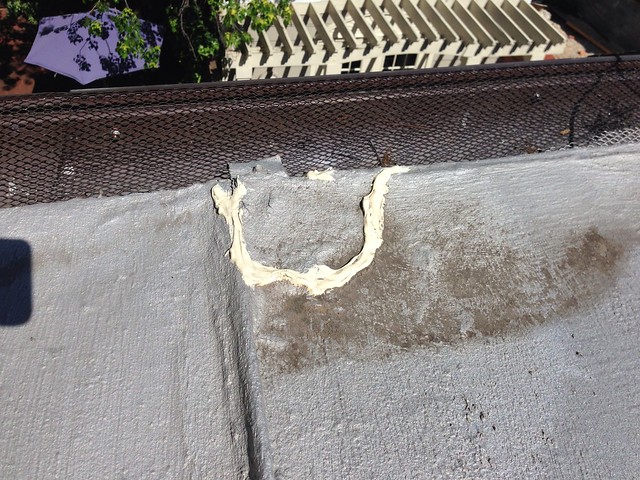
<p>Do you see what I see? It looks like someone caulked our roof for us. I say "someone" because it definitely wasn't me. The last time I was on our roof I was painting the roof patch around our skylight, and this caulk wasn't there. I think a neighbor probably had a roofer working and they decided to take a field trip onto other neighbors' roofs. They probably thought they were doing us a favor by patching up a failed section of our roofing. The problem is that this patch job was not done properly and didn't correct the primary issue, it was only a temporary fix. As soon as the caulk failed, it began letting water into a problem area. </p>
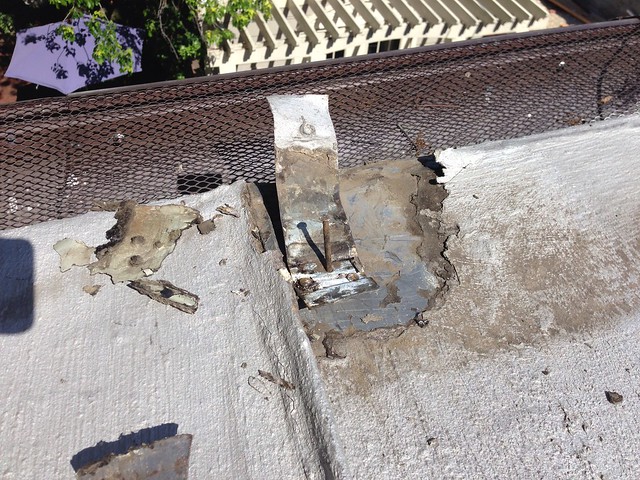
<p>I started scraping the caulk away only to reveal the primary issue that was causing our bay window to resemble a rain shower head. It seems someone, at some point, many years ago, maybe 25 years or more, nailed a piece of tin directly through our roof.</p>
<p>
</p>
<div class="MediaContainer PhotoContainer"><a href="http://farm8.staticflickr.com/7432/9245708912_31ed1c11e9_z.jpg" rel="PhotoPopup" popupheight="480" popupwidth="640"><img alt="" src="https://farm8.staticflickr.com/7432/9245708912_31ed1c11e9.jpg" width="500" height="375" style="border-width: 0px; border-style: solid;"></a></div>
<p><em>There was actually a roofer working two houses over from us who was giving me odd looks because I kept taking photos of the work I was doing. Apparently he doesn't have a blog...</em></p>
<p>Now I can't claim to read minds, but I'm going to go out on a limb and say that the mind of the person who did this had something on his mind other than doing a good job. Most likely, he was probably thinking more about shiny things and how 2 + 2 might equal 9 but he's just not sure. In other words, m-o-r-o-n! </p>
<p>Who nails through a metal roof? Seriously? Seriously?</p>
<p>A poorly applied tar patch, placed over paint and without any fabric to hold it all together ultimately doomed this portion of our roof to leak always and forever...until we came along to fix it. </p>
<p>After scraping away the thick tar and paint I stared at the piece of metal and it taunted and provoked me as it stared back at me from our roof. Disgusted with this little piece of metal's mere existence, I removed it and the three rusted nail friends it was hanging out with. They were uninvited guests in our home, and I was the night club bouncer telling them they'd had enough and it was time to move on. However, their expulsion revealed the true number that had been done on our roof in the way of additional holes. These holes, which were probably made at the same time as the tin strip was applied, were simply allowing water that evaded the caulk barrier to pour right into our home each and every time it rained. Oh, the horror!!!</p>
<p>
</p>
<div class="MediaContainer PhotoContainer"><a href="http://farm3.staticflickr.com/2868/9245707630_9ce7fb7e04_z.jpg" rel="PhotoPopup" popupheight="480" popupwidth="640"><img alt="" src="https://farm3.staticflickr.com/2868/9245707630_9ce7fb7e04.jpg" width="500" height="375" style="border-width: 0px; border-style: solid;"></a></div>
<p>But have no fear. Now that I knew the root cause of our leak, fixing it was pretty straight forward. First, I shot the holes nice and full of a 100% silicone outdoor caulk. The point is to back fill the holes, not to seal them with caulk. This makes a final barrier and keeps moisture or other items from attacking our patch from the underside of the roof through the holes.</p>
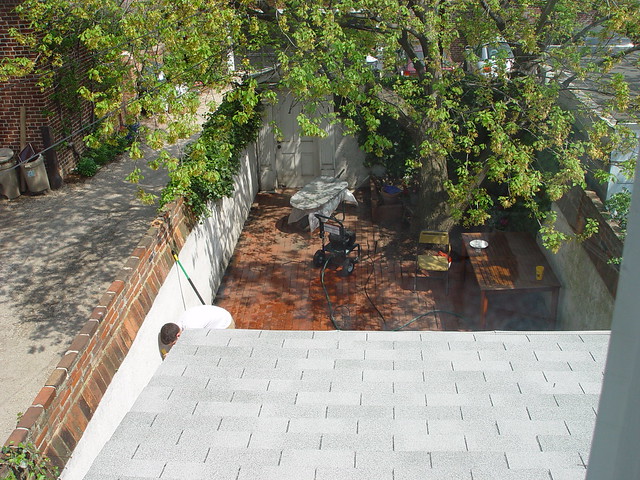
<p>The cure for the caulk required a tad bit of downtime. Rather than getting down from the reflective roof on this glorious 95 degree day, I opted to enjoy the spectacular views of Alexandria our roof has to offer.</p>
<p>
</p>
<div class="MediaContainer PhotoContainer"><a href="http://farm6.staticflickr.com/5515/9242923127_6a7a1ba64e_z.jpg" rel="PhotoPopup" popupheight="480" popupwidth="640"><img alt="" src="https://farm6.staticflickr.com/5515/9242923127_6a7a1ba64e.jpg" width="500" height="375" style="border-width: 0px; border-style: solid;"></a></div>
<p>I also daydreamed about the possibility of building a roof deck. Sure, it would require cooperation from neighbors, a city variance, tons of structural work, and an upheaval of our life I can't begin to fathom, but it would be absolutely awesome, and totally worth it, I'm sure!</p>
<p>Okay, back to reality. </p>
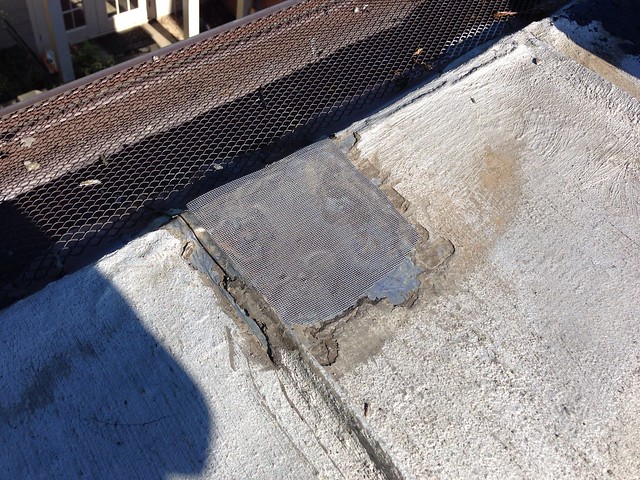
<p>Once allowing adequate cure time, I thoroughly cleaned the area of the roof that will receive the patch, chipping away any loose paint, tar, or debris. The goal is to give myself a good and clean surface to work with, otherwise we'll end up on the exact same situation in a few months. Once clean, I cut myself a piece of fiberglass patch that will sit over the sensitive area. </p>
<p>
</p>
<div class="MediaContainer PhotoContainer"><a href="http://farm8.staticflickr.com/7302/9245702396_7c4192faf9_z.jpg" rel="PhotoPopup" popupheight="480" popupwidth="640"><img alt="" src="https://farm8.staticflickr.com/7302/9245702396_7c4192faf9.jpg" width="500" height="375" style="border-width: 0px; border-style: solid;"></a></div>
<p>The fiberglass will give my patch the structure it needs to avoid cracking or failure when the roof expands and contracts in the varying temperatures of the seasons. I then applied an elastic tar-like roof coating over the newly exposed metal roofing, thus embedding the fiberglass patch into the material.</p>
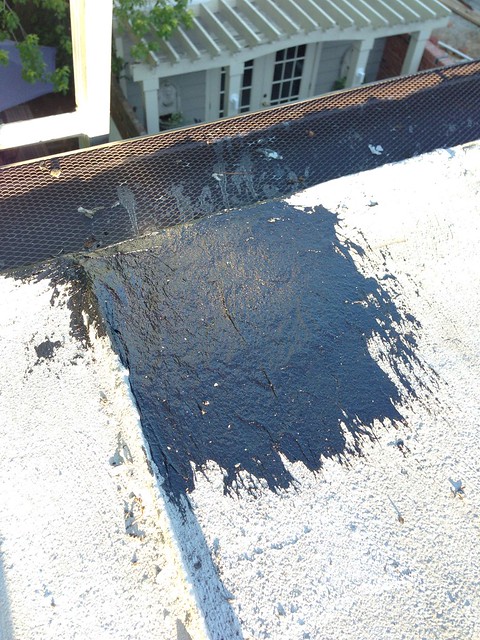
<p>A final coat of roofing cement makes a water tight seal that will keep rain from finding its way under the patch and into our house. If this roofing cement's noxious smell is any indication of its quality and longevity, it should last for a good long time.&nbsp;</p>
<p>
</p>
<div class="MediaContainer PhotoContainer"><a href="http://farm4.staticflickr.com/3691/9245700036_955deae420_z.jpg" rel="PhotoPopup" popupheight="640" popupwidth="480"><img alt="" src="https://farm4.staticflickr.com/3691/9245700036_955deae420.jpg" width="375" height="500" style="border-width: 0px; border-style: solid;"></a><br>
<em>This photo is actually of another patch. I just realized I didn't take a final photo of the first area I was working on, but you get the idea.</em></div>
<p>There are a lot of products on the market that can work in this scenario, but it's important to understand what will and won't work for your roofing surface. Our standing seam zinc roof is somewhat unique and requires specific surface prep or compounds to ensure adhesion. The ideal solution is actually a soldered on patch, but the location of these holes makes affixing a patch extremely difficult. So I opted for this flexible tar-like patch since I could apply it directly to the roof's surface.</p>
<p>The approach I'm using, along with normal maintenance and painting with a reflective coating (after full cure and when I paint the whole roof) will keep this part of our house dry for the life of the roof. </p>
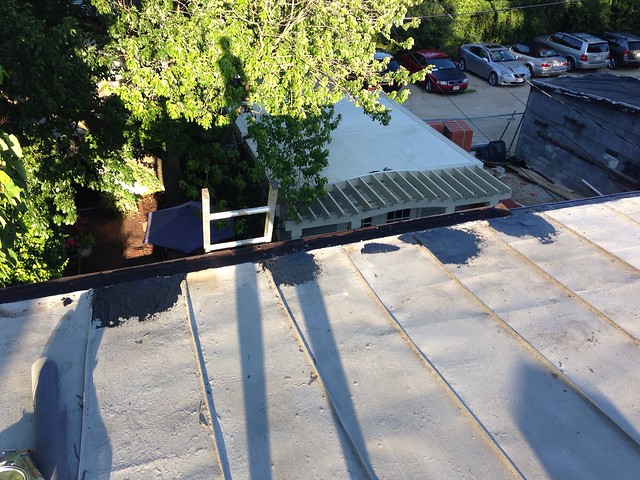
<p>While I was on the roof and correcting the main issue, I also looked at several other suspect areas I knew would ultimately end up with the same fate as our initial problem area. I went ahead and did the same removal, cleaning, and repair on these sections as well. It's my hope that an ounce of prevention is worth a pound of cure, and we won't end up with water streaming down the inside of our walls anytime soon based on my corrections. </p>
<p>
</p>
<div class="MediaContainer PhotoContainer"><a href="http://farm3.staticflickr.com/2851/9242917927_8739165366_z.jpg" rel="PhotoPopup" popupheight="480" popupwidth="640"><img alt="" src="https://farm3.staticflickr.com/2851/9242917927_8739165366.jpg" width="500" height="375" style="border-width: 0px; border-style: solid;"></a></div>
<p>I'll need to let these patches cure for a little while before applying the next coat of roof paint, but our entire roof needs a coat of paint, so I'll probably be talking about that in the next month or so. I'll need to make sure I get to it before fall arrives. There's nothing worse than seeing your hard work covered by a layer of colorful fallen leaves before the paint can actually dry. </p>
<p>Are you dealing with any leak issues in your home? Have you ever had a good Samaritan "fix" a problem with your house, only to realize that they aided in making the problem worse? I'd love to hear your experiences.</p><p><a href="https://www.oldtownhome.com/2013/7/10/Raining-in-the-Guest-Bedroom/">Read Full Post</a></p>]]></content>
    <category term="Header Image" />
    <category term="Leaks" />
    <category term="Projects:Home Improvement" />
    <category term="Roof" />
    <PostImage>http://farm8.staticflickr.com/7286/9223709439_d4068e5c6a.jpg</PostImage>
    <media:thumbnail url="https://farm8.staticflickr.com/7286/9223709439_d4068e5c6a_t.jpg" />
    <ExtensionElements>
      <Item>PostImage</Item>
      <Item>media:thumbnail</Item>
    </ExtensionElements>
  </entry>
  <entry>
    <guid>94e41c34-7c02-43af-b37c-c490797c4808</guid>
    <id>https://www.oldtownhome.com/2012/8/21/When-Incompetent-Contractors-Do-More-Harm-Than-Good/</id>
    <title>When Incompetent Contractors Do More Harm Than Good</title>
    <summary type="html"><![CDATA[<p>Furious, frustrated, fuming...confused! Yep, that about sums up how I'm feeling at the ineptitude of "professionals" after seeing something that I discovered last week while <a href="http://www.oldtownhome.com/2012/8/15/Its-a-Rotten-Job-Mediocrity-Maintenance-for-Our-Bay-Window/index.aspx">painting our bay window</a>. You know what the strangest thing is? It's not even on our house. </p>
<p>Last week, <a href="http://www.oldtownhome.com/2012/8/15/Its-a-Rotten-Job-Mediocrity-Maintenance-for-Our-Bay-Window/index.aspx">while up on our lower back copper roof</a>, I was talking to my neighbor about some painting she recently had done (by a good contractor that I had a chance to chat with). During the conversation with my neighbor she said, "Should I be concerned about the nails coming up through the roof?" Puzzled, I asked her which nails she was worried about, and she mentioned that she had seen some coming up while looking our from her back bedroom window.</p>
<p>Both our upper and lower roofs are one large shared area, so I walked over to her roof to see what she was talking about, and I was simply blown away by what I saw. </p>
<p>
</p>
<div class="MediaContainer PhotoContainer"><a href="http://farm9.staticflickr.com/8442/7788163116_0665b53f5a_z.jpg" rel="PhotoPopup" popupheight="480" popupwidth="640"><img alt="" src="https://farm9.staticflickr.com/8442/7788163116_0665b53f5a.jpg" width="500" height="375" style="border-width: 0px; border-style: solid;"></a></div>
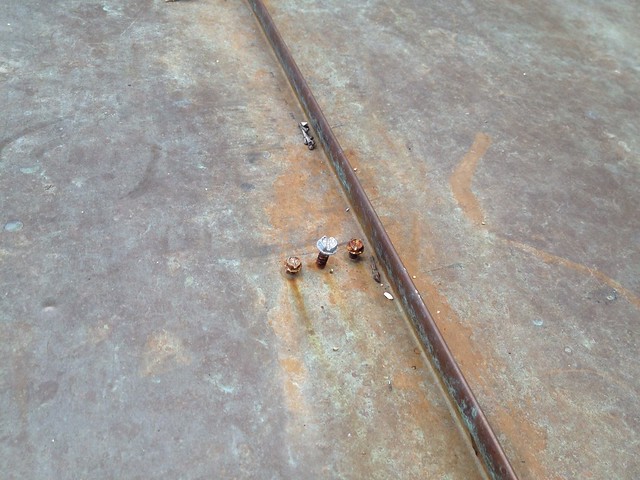
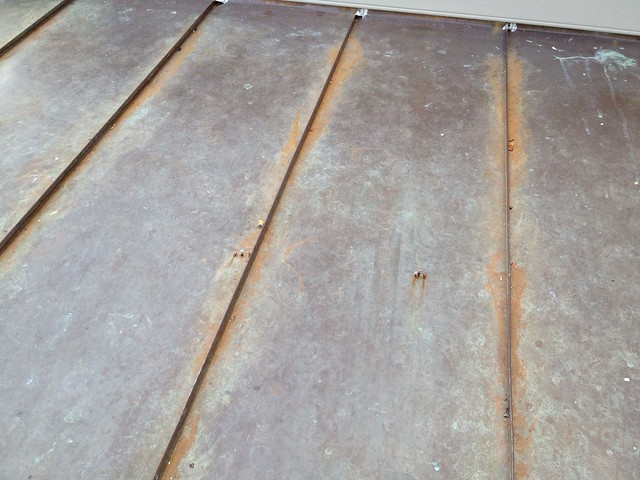
<p>It's a little difficult to discern from the photo, but yes, your eyes do not deceive you. What you're looking at are sheet metal screws put right through the copper standing seam roof material and screwed right into the wood sheathing beneath. I was FLOORED! </p>
<p>
</p>
<div class="MediaContainer PhotoContainer"><a href="http://farm9.staticflickr.com/8432/7788165970_f5f2a229c2_z.jpg" rel="PhotoPopup" popupheight="480" popupwidth="640"><img alt="" src="https://farm9.staticflickr.com/8432/7788165970_f5f2a229c2.jpg" width="500" height="375" style="border-width: 0px; border-style: solid;"></a></div>
<p>After stammering for a second or two, I got my words together and let her know that someone, likely through a complex combination of stupidity, ignorance, and sheer laziness, has more or less sabotaged her (which is actually "our") roof. </p>
<p>I quickly worked through what had likely happened and came up with a logical (well, logically stupid) and probably correct reasoning for the recent appearance of these screws. </p>
<p></p></img></img> <a href="https://www.oldtownhome.com/2012/8/21/When-Incompetent-Contractors-Do-More-Harm-Than-Good/">more</a>]]></summary>
    <published>2012-08-21T09:45:00.000-04:00</published>
    <updated>2012-08-21T09:45:00.000-04:00</updated>
    <link rel="alternate" href="https://www.oldtownhome.com/2012/8/21/When-Incompetent-Contractors-Do-More-Harm-Than-Good/" />
    <author>
      <name>Alex</name>
    </author>
    <content type="html"><![CDATA[<p>Furious, frustrated, fuming...confused! Yep, that about sums up how I'm feeling at the ineptitude of "professionals" after seeing something that I discovered last week while <a href="http://www.oldtownhome.com/2012/8/15/Its-a-Rotten-Job-Mediocrity-Maintenance-for-Our-Bay-Window/index.aspx">painting our bay window</a>. You know what the strangest thing is? It's not even on our house. </p>
<p>Last week, <a href="http://www.oldtownhome.com/2012/8/15/Its-a-Rotten-Job-Mediocrity-Maintenance-for-Our-Bay-Window/index.aspx">while up on our lower back copper roof</a>, I was talking to my neighbor about some painting she recently had done (by a good contractor that I had a chance to chat with). During the conversation with my neighbor she said, "Should I be concerned about the nails coming up through the roof?" Puzzled, I asked her which nails she was worried about, and she mentioned that she had seen some coming up while looking our from her back bedroom window.</p>
<p>Both our upper and lower roofs are one large shared area, so I walked over to her roof to see what she was talking about, and I was simply blown away by what I saw. </p>
<p>
</p>
<div class="MediaContainer PhotoContainer"><a href="http://farm9.staticflickr.com/8442/7788163116_0665b53f5a_z.jpg" rel="PhotoPopup" popupheight="480" popupwidth="640"><img alt="" src="https://farm9.staticflickr.com/8442/7788163116_0665b53f5a.jpg" width="500" height="375" style="border-width: 0px; border-style: solid;"></a></div>
<p>It's a little difficult to discern from the photo, but yes, your eyes do not deceive you. What you're looking at are sheet metal screws put right through the copper standing seam roof material and screwed right into the wood sheathing beneath. I was FLOORED! </p>
<p>
</p>
<div class="MediaContainer PhotoContainer"><a href="http://farm9.staticflickr.com/8432/7788165970_f5f2a229c2_z.jpg" rel="PhotoPopup" popupheight="480" popupwidth="640"><img alt="" src="https://farm9.staticflickr.com/8432/7788165970_f5f2a229c2.jpg" width="500" height="375" style="border-width: 0px; border-style: solid;"></a></div>
<p>After stammering for a second or two, I got my words together and let her know that someone, likely through a complex combination of stupidity, ignorance, and sheer laziness, has more or less sabotaged her (which is actually "our") roof. </p>
<p>I quickly worked through what had likely happened and came up with a logical (well, logically stupid) and probably correct reasoning for the recent appearance of these screws. </p>
<p></p>
<p>This wasn't always a copper roof, it was actually shingles when we moved in. When it was shingles, it was easy to climb up on this single story roof, place a ladder from the shingles to the upper roof ridge, then climb onto the upper roof from there. Here's a view from our bay window that shows the shingles we once had.</p>
<p>
</p>
<div class="MediaContainer PhotoContainer"><a href="http://farm6.staticflickr.com/5066/5644114195_52071dd03c_z.jpg" rel="PhotoPopup" popupheight="480" popupwidth="640"><img alt="" src="https://farm6.staticflickr.com/5066/5644114195_52071dd03c.jpg" width="500" height="375" style="border-width: 0px; border-style: solid;"></a></div>
<p>We thought this all worked great until we noticed a significant amount of water working its way up and under the shingles. The slope of this lower roof is too low for shingles to properly shed water during snowy conditions, so the water was damming and backing up under the shingles and into the ceiling of the sun porch. This was actually part of the problem that ended up in our <a href="http://www.oldtownhome.com/2012/2/27/Our-Newlywed-Kitchen-Nightmare/index.aspx">massive kitchen disaster</a>.</p>
<p>
</p>
<div class="MediaContainer PhotoContainer"><a href="http://farm6.staticflickr.com/5190/5644534604_51d2dd18e0_z.jpg" rel="PhotoPopup" popupheight="480" popupwidth="640"><img alt="" src="https://farm6.staticflickr.com/5190/5644534604_51d2dd18e0.jpg" width="500" height="375" style="border-width: 0px; border-style: solid;"></a></div>
<p>Back in 2007, we coordinated with the owners of the house next door to have a new roof installed. I really wanted to do the job myself, but after <a href="http://www.oldtownhome.com/2012/6/21/Creating-Our-Home-Office-Part-1-Demo-Drywall-and-Broken-Bones/">breaking my collar bone</a>, I was reduced to a sideline role of watching people work on my house and doing something I felt completely confident that I could do. It was not easy, I assure you, especially as I watched the contractors make a mess of the project (I'll fill you in on that another time). </p>
<p>
</p>
<div class="MediaContainer PhotoContainer"><a href="http://farm6.staticflickr.com/5104/5648039391_1941d61072_z.jpg" rel="PhotoPopup" popupheight="480" popupwidth="640"><img alt="" src="https://farm6.staticflickr.com/5104/5648039391_1941d61072.jpg" width="500" height="375" style="border-width: 0px; border-style: solid;"></a></div>
<p>Shortly after having the copper roof installed, and after my wing had completely healed and I was allowed to fly again, I setup the ladder to get up onto the upper roof, as I had always done. What I didn't take into consideration was the new, smooth copper surface. </p>
<p>In physics terms, the coefficient of friction on the copper is far lower than that of asphalt shingles. In English, the copper is WAY more slippery than the shingles. As I ventured onto the upper roof, and when I was nearly at the top of the ladder about 10 feet off of the copper roof and about 20 feet off of the ground below, the ladder started to slide out from under me. </p>
<p>Let me tell you, this is one of the most helpless and horrible feelings in the world. I felt the ladder start to go and I made a split second decision to scamper onto the roof. As the ladder fell I lunged forward to grab the edge of the gutter. &nbsp;Somehow getting my right foot on the bay window roof, and then using the gutter I had installed as something of a pull-up bar (if it had been the old gutter it would have just pulled off of the house), I somehow hooked the falling ladder with my right foot, spun myself around, found my way onto the upper roof, and grabbed the ladder in time to catch it before it fell all the way down. I wish I had it on video, because I still don't know how it all happened. I just know I had a moment where things could have gone very <strong>very</strong> wrong...but luckily didn't. </p>
<p>That heart attack inducing event occurred about five years ago, and neither I, nor Wendy who was inside and heard the calamity, have forgotten that incident or how much worse it could have been. I got lucky, I know this and I don't take it for granted. </p>
<p>After that slip and near fall, I put together a brace of sorts that I assemble each time I need to get into the roof. The brace attaches a platform to a few 2x4s that wrap under the roof's eave. It's a great system, very sturdy, and has secured my venture onto the roof dozens of times since my life-flash-before-your-eyes experience of a few years ago. </p>
<p>
</p>
<div class="MediaContainer PhotoContainer"><a href="http://farm9.staticflickr.com/8428/7788167522_c736632358_z.jpg" rel="PhotoPopup" popupheight="480" popupwidth="640"><img alt="" src="https://farm9.staticflickr.com/8428/7788167522_c736632358.jpg" width="500" height="375" style="border-width: 0px; border-style: solid;"></a></div>
<p>Alright, back to the original point of this post. It seems the person my neighbor hired to service her AC (which is up on the roof) may have had a similar slipping experience as mine. About a year or two ago I noticed that her gutter had been bent with the crease going away from the house. I've always wondered how that happened, since things like that don't often happen on their own. My guess is that her contractor had a similar fall and ended up hanging on the gutter and bent it. After that incident, I'm willing to bet that he decided on a more wreckless and destructive approach to securing his ladder, and rather than building a brace, getting someone to hold it while he climbed up, or just getting a longer ladder and going up from the side of the house, the contractor decided he'd just screw six sheet metal screws through the roofing. </p>
<p>
</p>
<div class="MediaContainer PhotoContainer"><a href="http://farm9.staticflickr.com/8303/7788164606_2f5e7efbd8_z.jpg" rel="PhotoPopup" popupheight="480" popupwidth="640"><img alt="" src="https://farm9.staticflickr.com/8303/7788164606_2f5e7efbd8.jpg" width="500" height="375" style="border-width: 0px; border-style: solid;"></a></div>
<p>Can you think of a worse "solution"? I can't. I told my neighbor that I was simply shocked, and if I had seen the idiot doing this, I would have probably flipped out on them. This roof was several thousand dollars to have installed, and it would last 100 years or more with proper maintenance. Yet this moron puts six screws through it at just a few years after it was installed because he didn't bring the right ladder or didn't have a helper to hold the ladder for him?</p>
<p>For a few reasons, I'm blaming the anonymous AC guy. Other than a roofer (and I highly doubt a roofer would ever do something this stupid), the AC guy is the only person I believe she had up on her roof. Beyond this, the guy used sheet metal screws. Who else would have used sheet metal screws other than an HVAC guy? Makes sense to me. </p>
<p>This right here is a prime example of why I don't like to hire people to work on my house. If it's not their trade, they often don't care, and you're left to put the pieces back together when they leave a mess.</p>
<p>So now I'm doing a bit of research for my neighbor to figure out the best way to repair the issue. I contacted a roofer friend to get some advice, and did a little bit of searching on the Internet. Though she could use a little bit of sealant, it's only going to last so long before it starts leaking, and she won't know it's leaking until water is in the house. The best thing will probably involve soldering two small patches directly to the roof, making a fully water tight patch that will last as long as the roof. A more agressive approach would actually be to unhook and completely replace the affected panels, but that's an expensive approach and one not entirely necessary.</p>
<p>Our neighbor will ultimately hire someone to fix it and ensure water isn't seeping into the house, but if she hadn't said anything to me, who knows how much damage it could have done and how long it would have gone undiagnosed? Though a roofer will correct it, and our neighbor will pay for it, the fact that anyone has to spend time or money on investigating and fixing this issue is basically criminal. </p>
<p>What do you think about this ridiculousness?  Have you ever hired someone to take care of your house in some way, only to have them damage something unrelated? Or do you think I'm totally overreacting? Let me know how you would handle a similar situation. </p><p><a href="https://www.oldtownhome.com/2012/8/21/When-Incompetent-Contractors-Do-More-Harm-Than-Good/">Read Full Post</a></p>]]></content>
    <category term="Contractors" />
    <category term="Header Image" />
    <category term="Roof" />
    <PostImage>http://farm9.staticflickr.com/8293/7831124296_6b15fe8f37.jpg</PostImage>
    <media:thumbnail url="https://farm9.staticflickr.com/8293/7831124296_6b15fe8f37_t.jpg" />
    <ExtensionElements>
      <Item>PostImage</Item>
      <Item>media:thumbnail</Item>
    </ExtensionElements>
  </entry>
  <entry>
    <guid>1fcf9237-c6a8-40c1-9b68-15ad818f574a</guid>
    <id>https://www.oldtownhome.com/2012/1/6/2012-Resolution-List-Progress-Painting-the-Roof-Patch/</id>
    <title>2012 Resolution List Progress: Painting the Roof Patch</title>
    <summary type="html"><![CDATA[<p>In keeping with this week's theme of&nbsp;<a href="http://www.oldtownhome.com/2012/1/2/2012-What-Well-Set-Out-to-Do/index.aspx">New Year Resolutions</a>, I'm happy to report that we can call one of our goals officially done -- applying the coat of roof paint over the newly patched area. Last week&nbsp;we talked about the <a href="http://www.oldtownhome.com/2011/12/28/Dont-Let-a-Leaky-Roof-Rain-On-Your-Parade/index.aspx">work we had done on the roof to stop a very pesky leak</a> that has been coming and going for years. To do this we had to use a roofing cement that remains a bit elastic but requires a somewhat extensive cure time before covering with a final topcoat. In our case, the top coat of choice is a reflective aluminum based roofing paint.</p><p>Years ago when we first had our skylight replaced, Mike Simpson of Lyons Contracting helped me tremendously by pointing out the current shape of our roof and the fact it was in need of a coat of paint. Growing up with shingles on our roof, I was a total stranger to the maintenance items for a standing seam metal roof like we have.</p><p>Mike informed me that we have a great roof that was made with good materials, has no serious visible problems, and is perfect for a very low pitch (like our roof has), but that there are some minor maintenance items that need to be performed on a regular basis, including painting. </p><p>Since our roof is not visible from the street we didn't need to choose a color that matches the house. As a result Mike suggested we use this particular aluminum base roof paint. It does a great job of protecting the roof by creating a somewhat thick and textured surface over the metal roof. When applies properly, it keeps water off of the metal, prevents rust and corrosion, seals up all of the joints, and saves some money by reflecting the hot sun in the summer.</p><div class="ToolItem">
<iframe src="http://rcm.amazon.com/e/cm?t=oltoho-20&amp;o=1&amp;p=8&amp;l=as1&amp;asins=B000VQHR6I&amp;IS1=1&amp;ref=tf_til&amp;fc1=3A3128&amp;lt1=_blank&amp;m=amazon&amp;lc1=61838A&amp;bc1=FAFAF8&amp;bg1=FAFAF8&amp;f=ifr" style="width: 120px; height: 240px;" scrolling="no" marginwidth="0" marginheight="0" frameborder="0"></iframe>
</div><p>In our years in the house I've painted the entire roof a couple of times. It typically takes me one full day working alone and about eight gallons of paint to do it. It makes for a long day, but at about $180-$200 for paint and supplies, it sure beats the $1500-$2000 a roofing company will charge.</p><p>Although I've painted the roof in the last two years, I still had to paint the recent patch job. The patch we applied in November had fully cured and was ready for paint. I figured we wouldn't get a shot at painting until spring when temperatures got back up above 50 degrees, but we received a small window of opportunity over New Year's weekend, so I jumped on the project.</p> <a href="https://www.oldtownhome.com/2012/1/6/2012-Resolution-List-Progress-Painting-the-Roof-Patch/">more</a>]]></summary>
    <published>2012-01-06T10:50:00.000-05:00</published>
    <updated>2012-01-06T10:50:00.000-05:00</updated>
    <link rel="alternate" href="https://www.oldtownhome.com/2012/1/6/2012-Resolution-List-Progress-Painting-the-Roof-Patch/" />
    <author>
      <name>Alex</name>
    </author>
    <content type="html"><![CDATA[<p>In keeping with this week's theme of&nbsp;<a href="http://www.oldtownhome.com/2012/1/2/2012-What-Well-Set-Out-to-Do/index.aspx">New Year Resolutions</a>, I'm happy to report that we can call one of our goals officially done -- applying the coat of roof paint over the newly patched area. Last week&nbsp;we talked about the <a href="http://www.oldtownhome.com/2011/12/28/Dont-Let-a-Leaky-Roof-Rain-On-Your-Parade/index.aspx">work we had done on the roof to stop a very pesky leak</a> that has been coming and going for years. To do this we had to use a roofing cement that remains a bit elastic but requires a somewhat extensive cure time before covering with a final topcoat. In our case, the top coat of choice is a reflective aluminum based roofing paint.</p>
<p>Years ago when we first had our skylight replaced, Mike Simpson of Lyons Contracting helped me tremendously by pointing out the current shape of our roof and the fact it was in need of a coat of paint. Growing up with shingles on our roof, I was a total stranger to the maintenance items for a standing seam metal roof like we have.</p>
<p>Mike informed me that we have a great roof that was made with good materials, has no serious visible problems, and is perfect for a very low pitch (like our roof has), but that there are some minor maintenance items that need to be performed on a regular basis, including painting. </p>
<p>Since our roof is not visible from the street we didn't need to choose a color that matches the house. As a result Mike suggested we use this particular aluminum base roof paint. It does a great job of protecting the roof by creating a somewhat thick and textured surface over the metal roof. When applies properly, it keeps water off of the metal, prevents rust and corrosion, seals up all of the joints, and saves some money by reflecting the hot sun in the summer.</p>
<div class="ToolItem">
<iframe src="http://rcm.amazon.com/e/cm?t=oltoho-20&amp;o=1&amp;p=8&amp;l=as1&amp;asins=B000VQHR6I&amp;IS1=1&amp;ref=tf_til&amp;fc1=3A3128&amp;lt1=_blank&amp;m=amazon&amp;lc1=61838A&amp;bc1=FAFAF8&amp;bg1=FAFAF8&amp;f=ifr" style="width: 120px; height: 240px;" scrolling="no" marginwidth="0" marginheight="0" frameborder="0"></iframe>
</div>
<p>In our years in the house I've painted the entire roof a couple of times. It typically takes me one full day working alone and about eight gallons of paint to do it. It makes for a long day, but at about $180-$200 for paint and supplies, it sure beats the $1500-$2000 a roofing company will charge.</p>
<p>Although I've painted the roof in the last two years, I still had to paint the recent patch job. The patch we applied in November had fully cured and was ready for paint. I figured we wouldn't get a shot at painting until spring when temperatures got back up above 50 degrees, but we received a small window of opportunity over New Year's weekend, so I jumped on the project.</p>
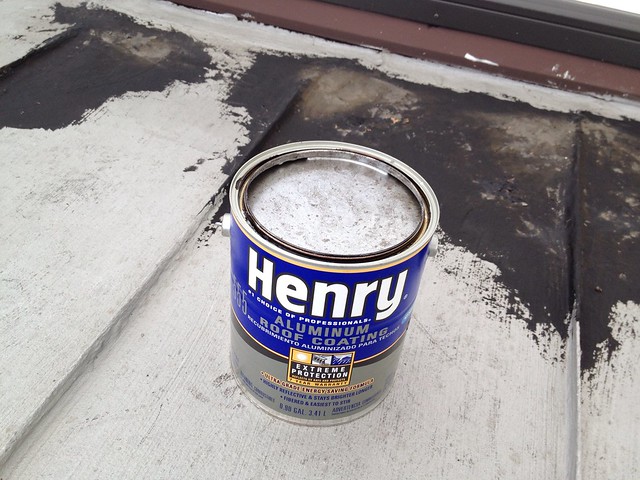
<p>The paint we use can be found on Amazon and it is also carried by one of the Home Depots near us, though not all seem to carry it. It is in their roofing section and comes in five and one gallon containers. Though I prefer the five gallon for our big jobs, the one is all we would need for this small amount of painting.</p>
<p>
</p>
<div class="MediaContainer PhotoContainer"><a href="http://farm8.staticflickr.com/7167/6645580549_5d00185b12_z.jpg" rel="PhotoPopup" popupheight="640" popupwidth="480"><img alt="" src="https://farm8.staticflickr.com/7167/6645580549_5d00185b12.jpg" width="375" height="500" style="border-width: 0px;border-style: solid;"></a></div>
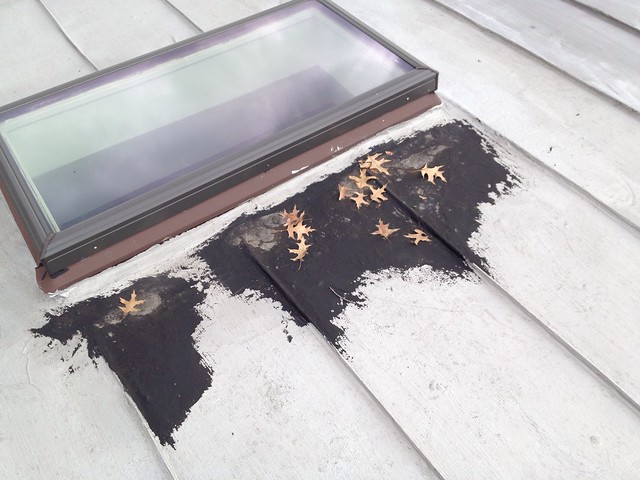
<p>I grabbed a gallon, got home, and headed up on the roof. I was dealing with a small window of time where the temp would be above 50 degrees for the initial dry time and there would be no rain for 24 hours, so I had every intention of making some quick work of the project. However, when I got up on the roof and looked at the patch that I needed to paint, this is what I saw...</p>
<p>
</p>
<div class="MediaContainer PhotoContainer"><a href="http://farm8.staticflickr.com/7163/6645579057_2c6548cba1_z.jpg" rel="PhotoPopup" popupheight="480" popupwidth="640"><img alt="" src="https://farm8.staticflickr.com/7163/6645579057_2c6548cba1.jpg" width="500" height="375" style="border-width: 0px;border-style: solid;"></a></div>
<p>Ugh! Those leaves were suck jerks! This is what I get for doing the project in the fall. The leaves had blown off the nearby tree and embedded themselves in the wet roofing tar, then dried like that. I ended up working for about 30 minutes to get all of the leaf debris out of the sticky mess. Such a pain.</p>
<p>Once I finally had all of the leaves removed from their tar resting places I could finally turn to painting. I vigorously (and I mean like a crazy person vigorously) shook the can and popped it open. It sure looked like it was fully mixed, but this wasn't my first rodeo, so I knew better.</p>
<p>
</p>
<div class="MediaContainer PhotoContainer"><a href="http://farm8.staticflickr.com/7147/6645578195_5fd097f847_z.jpg" rel="PhotoPopup" popupheight="480" popupwidth="640"><img alt="" src="https://farm8.staticflickr.com/7147/6645578195_5fd097f847.jpg" width="500" height="375" style="border-width: 0px;border-style: solid;"></a></div>
<p>Using a mixing padel on the drill I plunged it down through the liquid in the first half of the can and found the thick portion of the product that had settled in the bottom of the can. It's kind of an oily sludge consistency so i had to work carefully to be sure I didnt slop it all over the place. Working the drill very carefully and slowly, I mixed the paint throughly until it was a consistent, thick, and shiny viscosity with a hint of a brown tint that I could effectively paint with.</p>
<p>
</p>
<div class="MediaContainer PhotoContainer"><a href="http://farm8.staticflickr.com/7145/6645575021_95c955eddf_z.jpg" rel="PhotoPopup" popupheight="640" popupwidth="480"><img alt="" src="https://farm8.staticflickr.com/7145/6645575021_95c955eddf.jpg" width="375" height="500" style="border-width: 0px;border-style: solid;"></a></div>
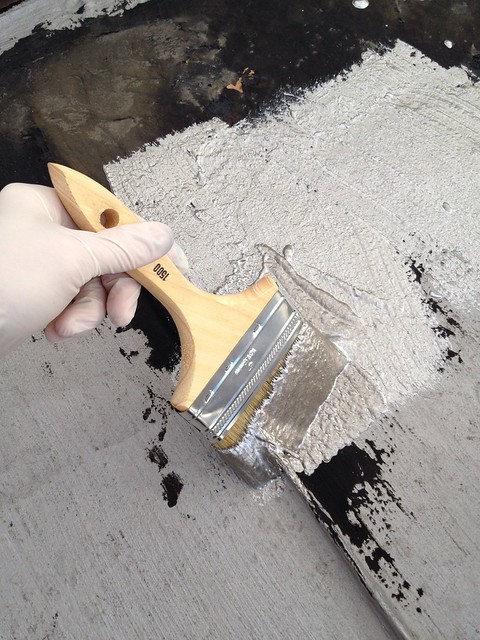
<p>Once mixed the next step is actually quite easy. Just apply liberally using a brush you are going to throw away when you are done.&nbsp;When I say liberally, I mean liberally. You really only need one coat, so no need to miss or have low coverage. Thick, full coverage is the name of the game. Notice that I'm wearing gloves? This paint is tough to get off and gets everywhere. If you get it on yourself or your clothes, you sort of look like the tin man.</p>
<p>
</p>
<div class="MediaContainer PhotoContainer"><a href="http://farm8.staticflickr.com/7158/6645573019_e99c95d49d_z.jpg" rel="PhotoPopup" popupheight="640" popupwidth="480"><img alt="" src="https://farm8.staticflickr.com/7158/6645573019_e99c95d49d.jpg" width="375" height="500" style="border-width: 0px;border-style: solid;"></a></div>
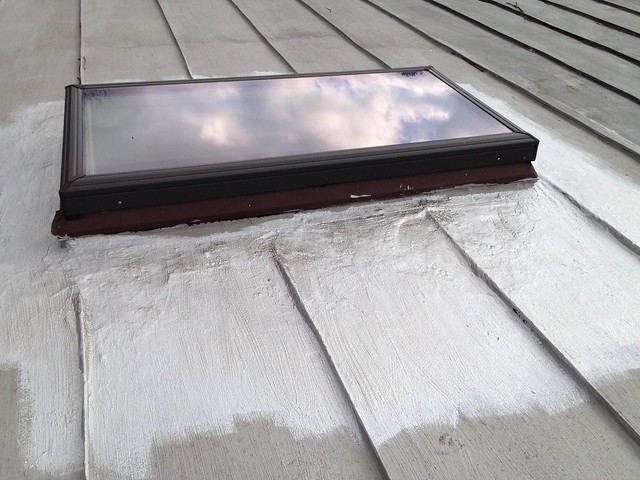
<p>After all was said and done, our new roof patch was cured and fully protected from the elements with a shiny coat of paint.</p>
<p>
</p>
<div class="MediaContainer PhotoContainer"><a href="http://farm8.staticflickr.com/7029/6645571349_a8e98934bd_z.jpg" rel="PhotoPopup" popupheight="480" popupwidth="640"><img alt="" src="https://farm8.staticflickr.com/7029/6645571349_a8e98934bd.jpg" width="500" height="375" style="border-width: 0px;border-style: solid;"></a></div>
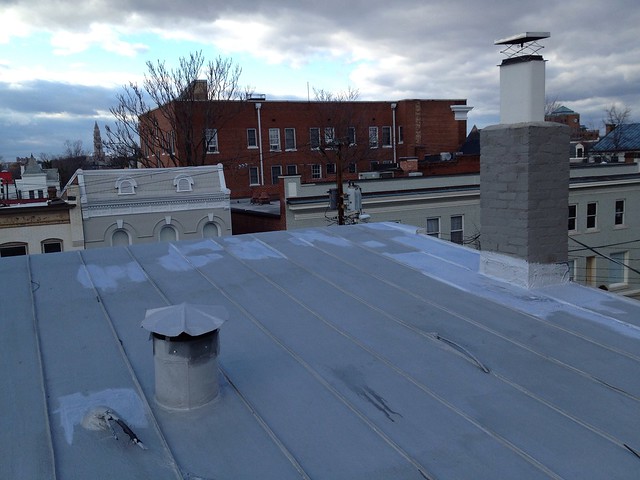
<p>Since I had only used a portion of the paint around the skylight I went around the roof finding any spots that looked like they needed a little touch up or refresh of paint. Look at how clearly you can see the two year old paint versus the new paint. Looks like I'll need to paint the whole roof again the summer of 2013.</p>
<p>
</p>
<div class="MediaContainer PhotoContainer"><a href="http://farm8.staticflickr.com/7174/6645571875_1a649366ae_z.jpg" rel="PhotoPopup" popupheight="480" popupwidth="640"><img alt="" src="https://farm8.staticflickr.com/7174/6645571875_1a649366ae.jpg" width="500" height="375" style="border-width: 0px;border-style: solid;"></a></div>
<p>But until then, I'm hopeful the new patch and paint will keep the water away and out of our attic. Now I can mark this item off of our <a href="http://www.oldtownhome.com/2012/1/2/2012-What-Well-Set-Out-to-Do/index.aspx">2012 New Years Resolutions</a> and move onto the next super exciting project. Hrm, so many to choose from, maybe I'll clean the basement that I was <a href="http://www.oldtownhome.com/2012/1/5/Its-a-Virtual-Intervention-for-Alex-the-Wood-Tool-Hoarder/index.aspx">brutally and publicly shamed about yesterday</a>. </p>
<p>Have you used a roof paint like this? Any experience with painting metal roofs? If so, how long do you typically go between coats? Let us know, we'd love to hear.</p><p><a href="https://www.oldtownhome.com/2012/1/6/2012-Resolution-List-Progress-Painting-the-Roof-Patch/">Read Full Post</a></p>]]></content>
    <category term="Header Image" />
    <category term="Leaks" />
    <category term="New Year Resolutions" />
    <category term="Projects:Home Improvement" />
    <category term="Projects:Paint" />
    <category term="Roof" />
    <PostImage>http://farm8.staticflickr.com/7146/6647505109_aac106e1ee.jpg</PostImage>
    <media:thumbnail url="https://farm8.staticflickr.com/7146/6647505109_aac106e1ee_t.jpg" />
    <ExtensionElements>
      <Item>PostImage</Item>
      <Item>media:thumbnail</Item>
    </ExtensionElements>
  </entry>
  <entry>
    <guid>24e292e9-05e0-4997-9e99-49ff69b3fb79</guid>
    <id>https://www.oldtownhome.com/2011/12/28/Dont-Let-a-Leaky-Roof-Rain-On-Your-Parade/</id>
    <title>Don't Let a Leaky Roof Rain On Your Parade</title>
    <summary type="html"><![CDATA[<p>Wendy and I have had a problem with our house since the day we moved in. Well, actually it's been a problem since the day of the home inspection, we just didn't realize it.</p>
<p>We mentioned this issue in a <a href="http://www.oldtownhome.com/2011/4/25/Lets-Start-at-the-Very-Beginning/index.aspx">post about our home inspection</a> back when we started the blog. During the home inspection the inspector pointed out obligatory issues like "the weather stripping on your back door has failed" or "this window doesn't open all the way because of paint," but we came to later find out he completely ignored the really horrible stuff. One of the ignored items we even pointed out, but it was brushed aside as a non-issue. The problem, deemed a non-issue by Mr. Inspector, was the apparent water spots on the ceiling directly around the base of the skylight. When Wendy pointed it out he said, "Oh, don't worry about that. It's old water damage and looks like it's already been fixed. It just needs a little paint."</p>
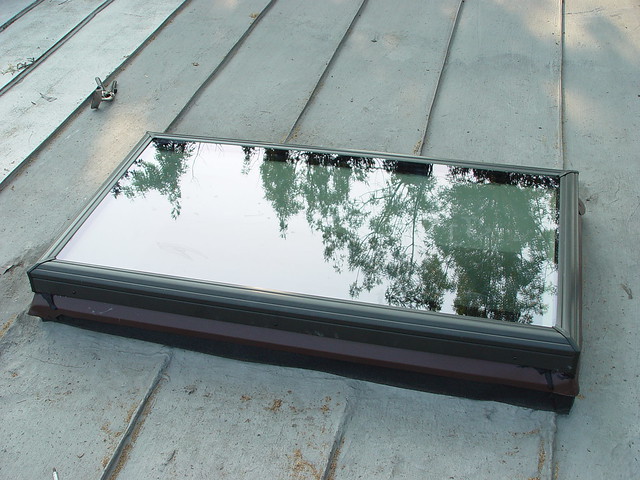
<p>Well wouldn't you know it, not a month into living in our house and those "fixed" leaks and "nothing to worry about" water spots became an active drip zone. We first suspected the nasty old skylight, so we called in a roofer. We hired <a href="http://www.lyonscontracting.com" target="_blank">Lyons Contracting</a>, who turned out to be a great company and great people. In June 2003 they replaced the old skylight with a new one and told us that the old skylight had probably leaked since it was installed. Here's a look at the old&nbsp;skylight. It was in pretty rough shape.</p>
<p>
</p>
<div class="MediaContainer PhotoContainer"><a href="http://farm6.staticflickr.com/5188/5643440599_ae9d81b6e7_z.jpg" rel="PhotoPopup" popupheight="480" popupwidth="640"><img alt="" src="https://farm6.staticflickr.com/5188/5643440599_ae9d81b6e7.jpg" width="500" height="375" style="border-width: 0px; border-style: solid;"></a></div>
<p>The guy doing the job, Mike Simpson, let me hang out on the roof with him and learn/watch what he was doing (an invaluable experience for the DIYer). He pointed out the fact that the old skylight glass and frame was one source of the leak, but there may be others on the roof right around the base of the skylight, and that we would need to watch it. Mike hit the nail on the head with his assessment, and watch it we have.</p>
<p>
</p>
<div class="MediaContainer PhotoContainer"><a href="http://farm6.staticflickr.com/5269/5643638225_e786f459d0_z.jpg" rel="PhotoPopup" popupheight="480" popupwidth="640"><img alt="" src="https://farm6.staticflickr.com/5269/5643638225_e786f459d0.jpg" width="500" height="375" style="border-width: 0px; border-style: solid;"></a></div>
<p>Whoever installed the original skylight 20-30 years ago did a horrible job. The didn't flash it properly, didn't cut the roof joists properly, really didn't do anything with the install quite right. We took care of the skylight itself, but this shoddy original install has left us with a skylight surround that has leaked on and off since we bought the house.</p>
<p></p></img></img> <a href="https://www.oldtownhome.com/2011/12/28/Dont-Let-a-Leaky-Roof-Rain-On-Your-Parade/">more</a>]]></summary>
    <published>2011-12-28T08:31:00.000-05:00</published>
    <updated>2011-12-28T08:31:00.000-05:00</updated>
    <link rel="alternate" href="https://www.oldtownhome.com/2011/12/28/Dont-Let-a-Leaky-Roof-Rain-On-Your-Parade/" />
    <author>
      <name>Alex</name>
    </author>
    <content type="html"><![CDATA[<p>Wendy and I have had a problem with our house since the day we moved in. Well, actually it's been a problem since the day of the home inspection, we just didn't realize it.</p>
<p>We mentioned this issue in a <a href="http://www.oldtownhome.com/2011/4/25/Lets-Start-at-the-Very-Beginning/index.aspx">post about our home inspection</a> back when we started the blog. During the home inspection the inspector pointed out obligatory issues like "the weather stripping on your back door has failed" or "this window doesn't open all the way because of paint," but we came to later find out he completely ignored the really horrible stuff. One of the ignored items we even pointed out, but it was brushed aside as a non-issue. The problem, deemed a non-issue by Mr. Inspector, was the apparent water spots on the ceiling directly around the base of the skylight. When Wendy pointed it out he said, "Oh, don't worry about that. It's old water damage and looks like it's already been fixed. It just needs a little paint."</p>
<p>Well wouldn't you know it, not a month into living in our house and those "fixed" leaks and "nothing to worry about" water spots became an active drip zone. We first suspected the nasty old skylight, so we called in a roofer. We hired <a href="http://www.lyonscontracting.com" target="_blank">Lyons Contracting</a>, who turned out to be a great company and great people. In June 2003 they replaced the old skylight with a new one and told us that the old skylight had probably leaked since it was installed. Here's a look at the old&nbsp;skylight. It was in pretty rough shape.</p>
<p>
</p>
<div class="MediaContainer PhotoContainer"><a href="http://farm6.staticflickr.com/5188/5643440599_ae9d81b6e7_z.jpg" rel="PhotoPopup" popupheight="480" popupwidth="640"><img alt="" src="https://farm6.staticflickr.com/5188/5643440599_ae9d81b6e7.jpg" width="500" height="375" style="border-width: 0px; border-style: solid;"></a></div>
<p>The guy doing the job, Mike Simpson, let me hang out on the roof with him and learn/watch what he was doing (an invaluable experience for the DIYer). He pointed out the fact that the old skylight glass and frame was one source of the leak, but there may be others on the roof right around the base of the skylight, and that we would need to watch it. Mike hit the nail on the head with his assessment, and watch it we have.</p>
<p>
</p>
<div class="MediaContainer PhotoContainer"><a href="http://farm6.staticflickr.com/5269/5643638225_e786f459d0_z.jpg" rel="PhotoPopup" popupheight="480" popupwidth="640"><img alt="" src="https://farm6.staticflickr.com/5269/5643638225_e786f459d0.jpg" width="500" height="375" style="border-width: 0px; border-style: solid;"></a></div>
<p>Whoever installed the original skylight 20-30 years ago did a horrible job. The didn't flash it properly, didn't cut the roof joists properly, really didn't do anything with the install quite right. We took care of the skylight itself, but this shoddy original install has left us with a skylight surround that has leaked on and off since we bought the house.</p>
<p></p>
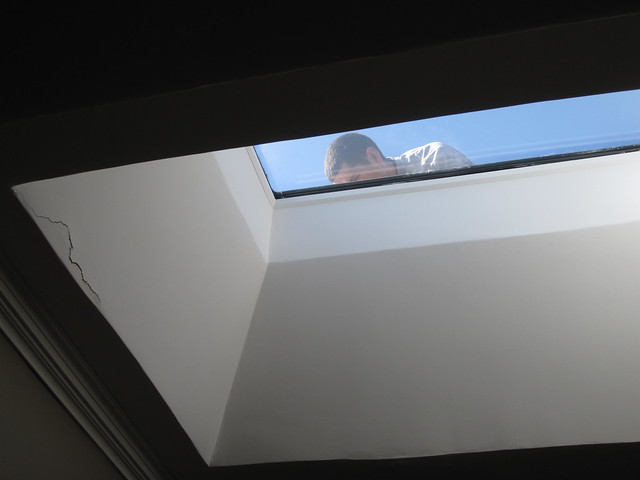
<p>After not experiencing any water infiltration after the new skylight install, we hoped the leak was fixed. We went ahead and spend hours fixing the crack and damage in the ceiling that was caused by the water, as well as replastering and repainting the entire upstairs hallway and ceiling. All was quiet on the western front for some time, but eventually the water issue resurfaced and ruined the work we had completed, leaving us with an unsightly crack (seen on the left side in the photo below).</p>
<p>
</p>
<div class="MediaContainer PhotoContainer"><a href="http://farm7.staticflickr.com/6094/6351492083_564b3a8715_z.jpg" rel="PhotoPopup" popupheight="480" popupwidth="640"><img alt="" src="https://farm7.staticflickr.com/6094/6351492083_564b3a8715.jpg" width="500" height="375" style="border-width: 0px; border-style: solid;"></a></div>
<p>In the summer of 2010 I fixed the issue on the roof that caused the big crack on the side of the skylight. But my fix was no match for this summer's rains that would last for days at a time, and another source of water infiltration soon revealed itself. This time we noticed a small drip coming from a point in the ceiling a few feet over from our nasty crack.</p>
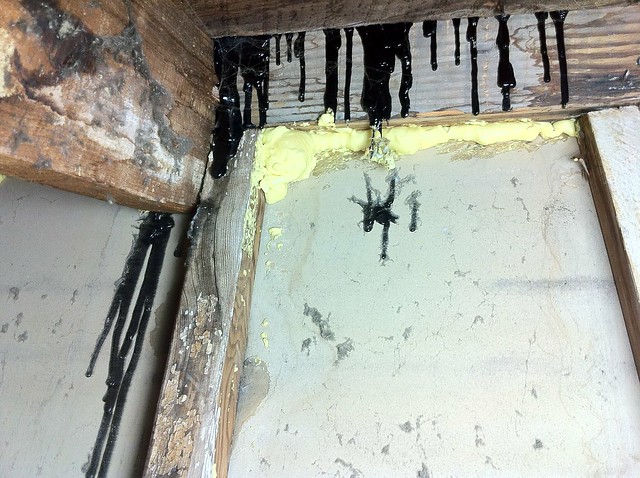
<p>I crawled into the attic and back to the skylight. Sure enough, I could see the water getting into the area right at the base of the front side of the skylight, exactly where Mike the roofer said we would need to watch for it. In the photo below you can see that one of the support pieces of wood is actually wet from water that was coming in during a storm.</p>
<p>
</p>
<div class="MediaContainer PhotoContainer"><a href="http://farm7.staticflickr.com/6079/6127251256_2611a98194_z.jpg" rel="PhotoPopup" popupheight="478" popupwidth="640"><img alt="" src="https://farm7.staticflickr.com/6079/6127251256_2611a98194.jpg" width="500" height="374" style="border-width: 0px; border-style: solid;"></a></div>
<p>Recently we <em>finally</em> made the time to take care of this leak (hopefully once and for all). Below is the list of steps and the tools I used to correct the issue. If you ever have unexpected showers in your home, we hope that it can help you take care of your issue too.&nbsp;</p>
<p>Any day that involves a trip up to the roof involves planning and safety. This is to minimize the trips I need to make up and down the ladder so I can reduce my risk of falling. I took stock of all of the supplies I would need for the chore.</p>
<ol>
    <li>5-in-1 tool</li>
    <li>Small hammer</li>
    <li>Utility knife</li>
    <li>Small spade</li>
    <li>Scissors</li>
    <li>Fiberglass screen</li>
    <li>Wire brush</li>
    <li>Roofing cement</li>
    <li>100% Silicone caulk</li>
    <li>Caulk gun</li>
    <li>Gloves</li>
    <li>Paper towels</li>
    <li>Cleaner</li>
    <li>Paint can opener</li>
</ol>
<p>I packed all of these things up in a good and organized way (a contractor bag often works well), and lugged the whole thing up to the roof.&nbsp;Once up there, I got to work identifying the source of the leak. Here's a photo I took of the area where the water was getting in. Do you see the problem?</p>
<p>
</p>
<div class="MediaContainer PhotoContainer"><a href="http://farm7.staticflickr.com/6104/6327988970_cfbf7093c8_z.jpg" rel="PhotoPopup" popupheight="480" popupwidth="640"><img alt="" src="https://farm7.staticflickr.com/6104/6327988970_cfbf7093c8.jpg" width="500" height="375" style="border-width: 0px; border-style: solid;"></a></div>
<p>Look closely, do you see those tiny cracks in the paint on the ridges of the roof? Yep, these...</p>
<p>
</p>
<div class="MediaContainer PhotoContainer"><a href="http://farm8.staticflickr.com/7007/6585323129_ff17b0b51f_z.jpg" rel="PhotoPopup" popupheight="480" popupwidth="640"><img alt="" src="https://farm8.staticflickr.com/7007/6585323129_ff17b0b51f.jpg" width="500" height="375" style="border-width: 0px; border-style: solid;"></a></div>
<p>Those tiny little cracks are the root cause of our problems. The water runs down the roof and sits on these cracks, slowly seeping under the existing roofing cement and getting behind the insufficient flashing around the skylight. </p>
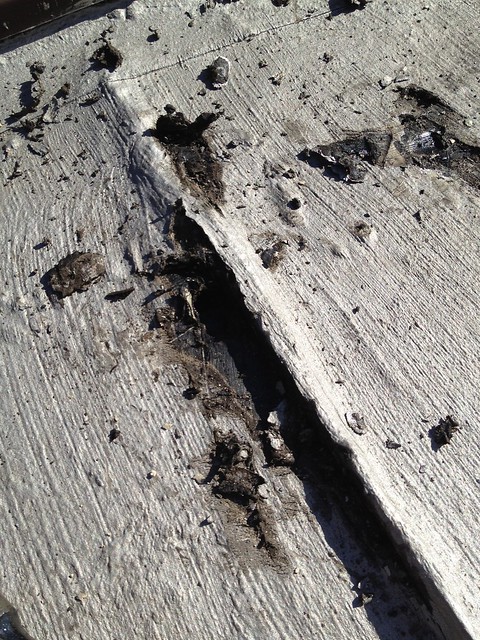
<p>So the first step in fixing the problem is to remove the bad and cracked roofing cement to get to the root of the water infiltration. I did this by using the 5-in-1 tools, hammer, and utility knife to scrape, cut, and pry the old tar away from the roof. </p>
<p>
</p>
<div class="MediaContainer PhotoContainer"><a href="http://farm7.staticflickr.com/6049/6327241625_553a923c45_z.jpg" rel="PhotoPopup" popupheight="640" popupwidth="480"><img alt="" src="https://farm7.staticflickr.com/6049/6327241625_553a923c45.jpg" width="375" height="500" style="border-width: 0px; border-style: solid;"></a></div>
<p>Once I got down to the bare metal roof I was able to see rust (a telltale sign of water issues) and a gap between the flashing and roofing that gave the water an easy path to the inside of the house. </p>
<p>
</p>
<div class="MediaContainer PhotoContainer"><a href="http://farm7.staticflickr.com/6033/6327994464_5d9a7f7023_z.jpg" rel="PhotoPopup" popupheight="640" popupwidth="480"><img alt="" src="https://farm7.staticflickr.com/6033/6327994464_5d9a7f7023.jpg" width="375" height="500" style="border-width: 0px; border-style: solid;"></a></div>
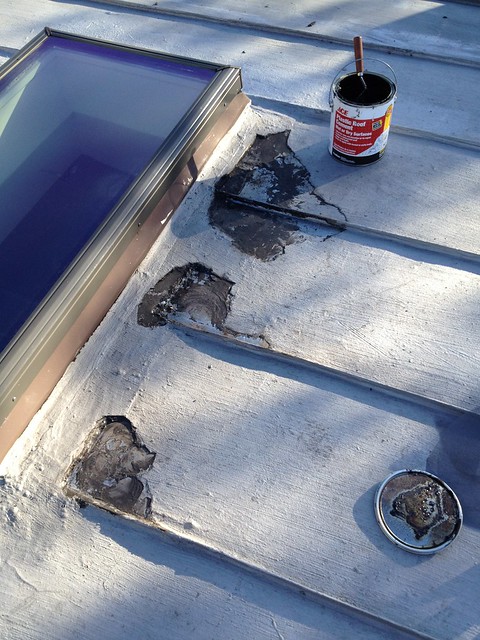
<p>I continued this process in every spot where I had concern for eventual leaks. Might as well fix them all at once rather than waiting for it to ruin our ceiling again in the future. All told I scraped away three different sections. </p>
<p>
</p>
<div class="MediaContainer PhotoContainer"><a href="http://farm7.staticflickr.com/6035/6327249453_6a49408420_z.jpg" rel="PhotoPopup" popupheight="640" popupwidth="480"><img alt="" src="https://farm7.staticflickr.com/6035/6327249453_6a49408420.jpg" width="375" height="500" style="border-width: 0px; border-style: solid;"></a></div>
<p>With the roof exposed I had to prepare the patches. To do this I used my old standby of fiberglass screen. The screen gives the patches something to hold onto while allowing some level of movement and resisting future cracking. I used the scissors to cut roughly sized patches for each area I exposed. It is much easier to cut the patches now, before the sticky cement is all over the place. </p>
<p>
</p>
<div class="MediaContainer PhotoContainer"><a href="http://farm7.staticflickr.com/6094/6327997344_1cedd9cb7b_z.jpg" rel="PhotoPopup" popupheight="640" popupwidth="480"><img alt="" src="https://farm7.staticflickr.com/6094/6327997344_1cedd9cb7b.jpg" width="375" height="500" style="border-width: 0px; border-style: solid;"></a></div>
<p>Next I used the 100% silicone caulk and pushed it into the deep gaps under the flashing. The point of this caulk it to get into any gaps or areas where water could easily get to. It's a last line of defense, and maybe not 100% necessary, but I like to do it.</p>
<p>
</p>
<div class="MediaContainer PhotoContainer"><a href="http://farm7.staticflickr.com/6043/6327997970_4c7d24ee1e_z.jpg" rel="PhotoPopup" popupheight="640" popupwidth="480"><img alt="" src="https://farm7.staticflickr.com/6043/6327997970_4c7d24ee1e.jpg" width="375" height="500" style="border-width: 0px; border-style: solid;"></a></div>
<p>I push everything down into the silicone and then allow it a little bit of time to get a partial cure. It will cure on its own since the back side of the caulk is still getting air.</p>
<p>Once the caulk has setup a bit, it's time to start applying the roofing cement with the small trowel.&nbsp;</p>
<p>
</p>
<div class="MediaContainer PhotoContainer"><a href="http://farm7.staticflickr.com/6222/6327250191_cf73393543_z.jpg" rel="PhotoPopup" popupheight="640" popupwidth="480"><img alt="" src="https://farm7.staticflickr.com/6222/6327250191_cf73393543.jpg" width="375" height="500" style="border-width: 0px; border-style: solid;"></a></div>
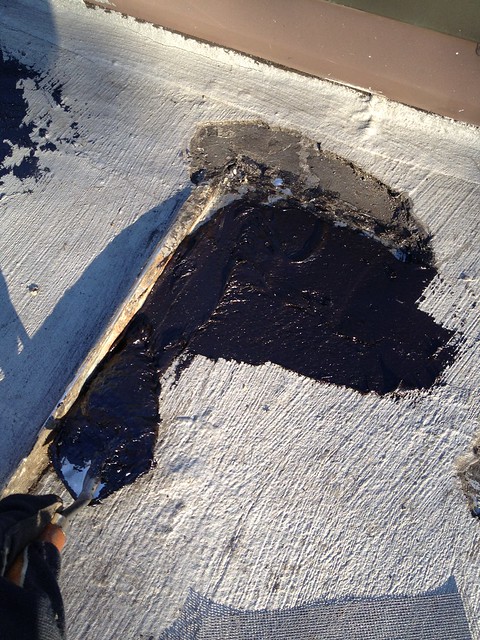
<p>It's a total mess but if you take your time and are patient, you can get the cement where it needs to go without much sloppiness. You just want to make sure you overlap the edges of the area you are applying it to pretty significantly.</p>
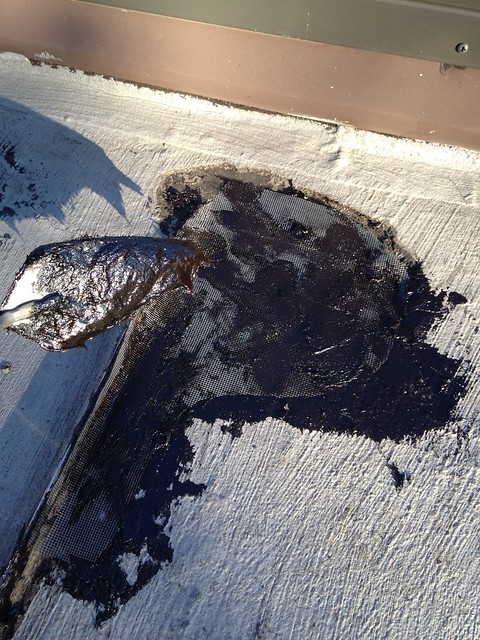
<p>Once the base coat is down, I apply the pre-cut portions of screen into the roofing cement. Using the trowel I just methodically push the screen into the cement as best as I can, leaving no bubbles or bumps.</p>
<p>
</p>
<div class="MediaContainer PhotoContainer"><a href="http://farm7.staticflickr.com/6226/6328000868_357296158f_z.jpg" rel="PhotoPopup" popupheight="640" popupwidth="480"><img alt="" src="https://farm7.staticflickr.com/6226/6328000868_357296158f.jpg" width="375" height="500" style="border-width: 0px; border-style: solid;"></a></div>
<p>The final step is to then cover the base coat and screen with an even more generous coat of roofing cement.This is the final coat so it is best to be as overkill as your are comfortable with. Spread it way out over the edges of the area and don't give the water any chance to get back to the offending portion of the roof.</p>
<p>
</p>
<div class="MediaContainer PhotoContainer"><a href="http://farm7.staticflickr.com/6035/6328001632_99febd3e4c_z.jpg" rel="PhotoPopup" popupheight="640" popupwidth="480"><img alt="" src="https://farm7.staticflickr.com/6035/6328001632_99febd3e4c.jpg" width="375" height="500" style="border-width: 0px; border-style: solid;"></a></div>
<p>At this point I just take a step back and look at the project. I make sure I got everything with as much cement as I need to prevent any future leaks.&nbsp;</p>
<p>
</p>
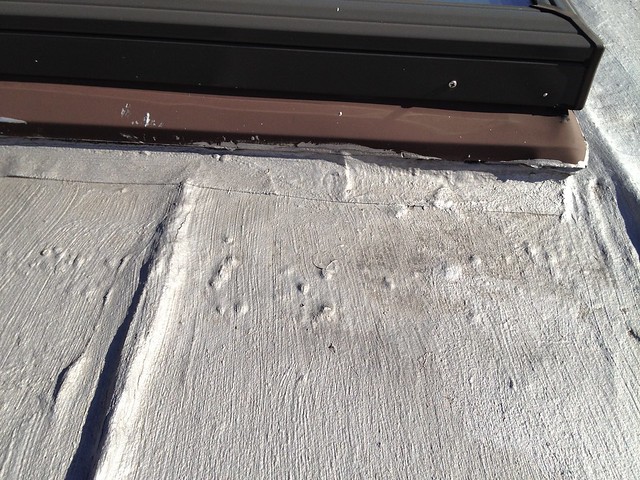
<div class="MediaContainer PhotoContainer"><a href="http://farm7.staticflickr.com/6053/6327252753_59a1184126_z.jpg" rel="PhotoPopup" popupheight="480" popupwidth="640"><img alt="" src="https://farm7.staticflickr.com/6053/6327252753_59a1184126.jpg" width="500" height="375" style="border-width: 0px; border-style: solid;"></a></div>
<p>The roofing cement needs about 30 days of cure time to reach a full cure so that it can be painted, but it is very waterproof in its unpainted state. After about one day it is dry to the touch, but it is actually ready to take on water almost immediately. Talk about instant gratification.</p>
<p>About two weeks after I finished the work on the roof we had a major day and a half long rain storm. This storm just kept going. I was nervous, but what a great test of the patch. I'm glad to report that after so many hours of rain we didn't have a single drop make it into the attic. Mission accomplished!</p>
<p>I still need a nice warm day to get on the roof to paint the finished work, but I'm happy to check the "fix the roof leak" item off of my to do list. Now I just need to fix those unsightly cracks and water damage in the ceiling.</p>
<p>Oh, I almost forgot my final step in the project. It is to always enjoy the very nice view from the top of our house. Whenever I'm up there I tend to think "roof deck." But those are just dreams...ah to dream.</p>
<p>
</p>
<div class="MediaContainer PhotoContainer"><a href="http://farm7.staticflickr.com/6093/6327987632_19b0acc8ed_z.jpg" rel="PhotoPopup" popupheight="480" popupwidth="640"><img alt="" src="https://farm7.staticflickr.com/6093/6327987632_19b0acc8ed.jpg" width="500" height="375" style="border-width: 0px; border-style: solid;"></a></div>
<p>Do you have a similar roof and need to patch a leak? Or do you have a different roof setup that you've had to patch in the past? I know roofing leaks can be intimidating, but with the right tools and materials fixing almost anything on the roof is a job for the DIYer. Just remember that safety is the top priority on any roof/high height projects such as this, and if you don't feel comfortable fixing it yourself, it's always best to call in the professionals. After all, you may be able to watch and learn something that allows you to take on a roofing issue down the road.&nbsp;</p><p><a href="https://www.oldtownhome.com/2011/12/28/Dont-Let-a-Leaky-Roof-Rain-On-Your-Parade/">Read Full Post</a></p>]]></content>
    <category term="Header Image" />
    <category term="How To" />
    <category term="Leaks" />
    <category term="Projects:Home Improvement" />
    <category term="Roof" />
    <PostImage>http://farm8.staticflickr.com/7014/6585410721_2feb71d150.jpg</PostImage>
    <media:thumbnail url="https://farm8.staticflickr.com/7014/6585410721_2feb71d150_t.jpg" />
    <ExtensionElements>
      <Item>PostImage</Item>
      <Item>media:thumbnail</Item>
    </ExtensionElements>
  </entry>
</feed>