<?xml version="1.0" encoding="utf-8"?>
<feed xmlns="http://www.w3.org/2005/Atom" xmlns:media="http://search.yahoo.com/mrss/">
  <title>Old Town Home Category: 'Project From The Past'</title>
  <updated>2011-06-10T09:35:00.000-04:00</updated>
  <id>http://www.oldtownhome.com/project-from-the-past/index.atom</id>
  <link rel="alternate" href="http://www.oldtownhome.com/project-from-the-past/index.atom" />
  <author>
    <name>Alex and Wendy</name>
    <uri>http://www.oldtownhome.com/</uri>
    <email>wendy@oldtownhome.com</email>
  </author>
  <entry>
    <guid>855c06f3-7251-4ec3-bf6d-b00e1fecc424</guid>
    <id>https://www.oldtownhome.com/2011/6/10/How-To-Create-a-Harlequin-Paint-Treatment-Diamonds-are-a-Girls-Best-Friend/</id>
    <title>How To Create a Harlequin Paint Treatment: Diamonds are a Girl's Best Friend</title>
    <summary type="html"><![CDATA[<p>In previous posts we've covered the renovation effort we embarked on to <a href="http://www.oldtownhome.com/entry-hall/index.aspx">drastically overhaul our entryway</a>. Given our home's modest facade and shotgun layout, the entry to our home is the first opportunity&nbsp;we have to <a href="http://www.oldtownhome.com/2011/4/27/You-Only-Have-One-Chance-to-Make-a-Good-First-Impression/index.aspx">make an impression</a> on our guests. And when we purchased our home back in 2003, our home was sending a message of "I'm tired, boring, and have seen better days."</p>
<p>Our entryway presents some unique decorating challenges, given that it's only 37"&nbsp;wide&nbsp;from&nbsp;shoe molding to shoe molding. And as much as I love the look of a credenza to throw your keys on when you arrive home, a warm bench to sit on while you take off your shoes, or an umbrella stand tucked neatly in a corner, unfortunately this wasn't an option for us.</p>
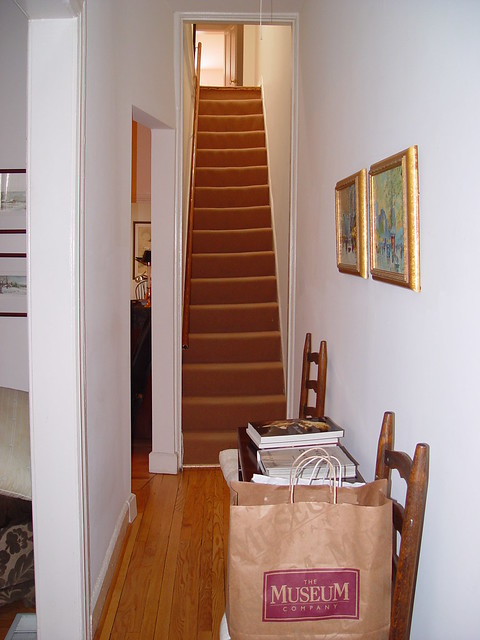
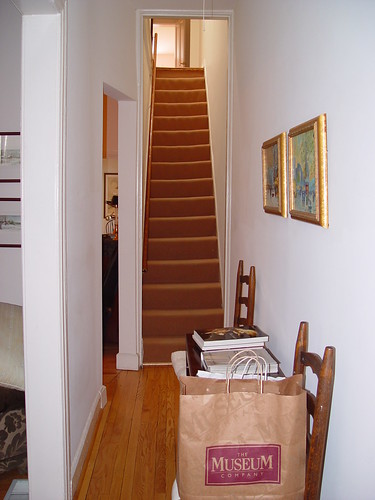
<p>The previous owner, a veritable bachelor, who could have benefitted from a designer's loving hand, attempted to furnish the space himself. As you can see from this photo taken during our <a href="http://www.oldtownhome.com/2011/4/25/Lets-Start-at-the-Very-Beginning/index.aspx">home inspection</a>, you could hardly walk through the hallway without knocking your knees on the awkwardly placed chairs.</p>
<div class="MediaContainer PhotoContainer"><a href="http://farm6.static.flickr.com/5104/5663709410_0aee924f86_z.jpg" rel="PhotoPopup" popupwidth="480" popupheight="640"><img alt="" width="375" height="500" style="border: 0px solid;" src="https://farm6.static.flickr.com/5104/5663709410_0aee924f86.jpg"></a></div>
<p>Given our significant restrictions on furniture and accessories, I knew that the walls themselves were going to be the star in this room. In our minds, we quickly ruled out wallpaper for two reasons: 1) we couldn't afford it, and 2) at the time, it seemed like something only people our parents' age were doing. (Boy how decorating has changed in eight years.) That left us with one clear option -- an interesting paint treatment. </p>
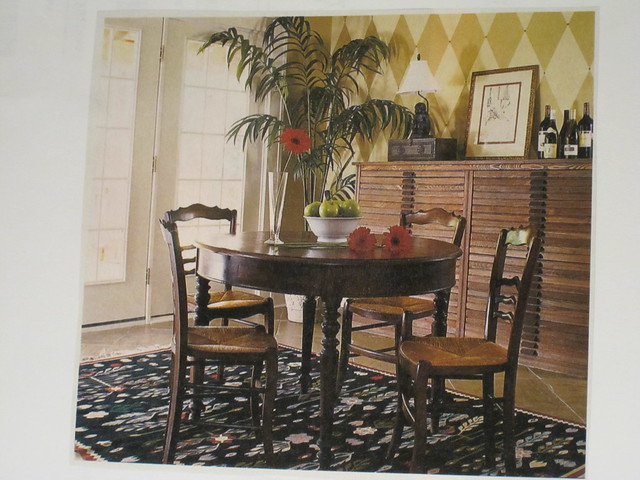
<p>My inspiration came to me when reading a decorating magazine. I spotted&nbsp;a picture of a kitchen's dining nook with an interesting harlequin pattern on the walls. This paint treatment (below) immediately clicked as the answer to my design dilemma for many reasons. In addition to adding bold visual interest without impeding into the space, the paint colors themselves, taken&nbsp;from our living room, dining room, and stairwell,&nbsp;offered a way to tie the downstairs together. This approach meant we already had enough paint for this small space, so the only expense was for a few rolls of painters tape.</p>
<div class="MediaContainer PhotoContainer"><a href="http://farm6.static.flickr.com/5311/5817090230_d67622ba8e_z.jpg" rel="PhotoPopup" popupwidth="640" popupheight="480"><img alt="" width="500" height="375" style="border: 0px solid;" src="https://farm6.static.flickr.com/5311/5817090230_d67622ba8e.jpg"></a></div>
<p>At first, Alex wasn't quite sure of the idea. I think he said something along the lines of "You want to paint what, where?" We needed an artists rendering to help him to understand my vision.</p>
<p>I have an artist's sketch book that has served us for years. Both Alex and I have used this book to jot down ideas, paste inspirational clippings, sketch out plans, and even to calculate room budgets. This helps me to not only think the idea through, but in many cases, it also helps me to get my <span style="text-decoration: line-through;">sometimes skeptical</span> dear husband on board with my crazy ideas. Below is my original concept rendering of the space that I made to help Alex "see" what I saw.</p>
<p></p></img></img> <a href="https://www.oldtownhome.com/2011/6/10/How-To-Create-a-Harlequin-Paint-Treatment-Diamonds-are-a-Girls-Best-Friend/">more</a>]]></summary>
    <published>2011-06-10T09:35:00.000-04:00</published>
    <updated>2011-06-10T09:35:00.000-04:00</updated>
    <link rel="alternate" href="https://www.oldtownhome.com/2011/6/10/How-To-Create-a-Harlequin-Paint-Treatment-Diamonds-are-a-Girls-Best-Friend/" />
    <author>
      <name>Wendy</name>
    </author>
    <content type="html"><![CDATA[<p>In previous posts we've covered the renovation effort we embarked on to <a href="http://www.oldtownhome.com/entry-hall/index.aspx">drastically overhaul our entryway</a>. Given our home's modest facade and shotgun layout, the entry to our home is the first opportunity&nbsp;we have to <a href="http://www.oldtownhome.com/2011/4/27/You-Only-Have-One-Chance-to-Make-a-Good-First-Impression/index.aspx">make an impression</a> on our guests. And when we purchased our home back in 2003, our home was sending a message of "I'm tired, boring, and have seen better days."</p>
<p>Our entryway presents some unique decorating challenges, given that it's only 37"&nbsp;wide&nbsp;from&nbsp;shoe molding to shoe molding. And as much as I love the look of a credenza to throw your keys on when you arrive home, a warm bench to sit on while you take off your shoes, or an umbrella stand tucked neatly in a corner, unfortunately this wasn't an option for us.</p>
<p>The previous owner, a veritable bachelor, who could have benefitted from a designer's loving hand, attempted to furnish the space himself. As you can see from this photo taken during our <a href="http://www.oldtownhome.com/2011/4/25/Lets-Start-at-the-Very-Beginning/index.aspx">home inspection</a>, you could hardly walk through the hallway without knocking your knees on the awkwardly placed chairs.</p>
<div class="MediaContainer PhotoContainer"><a href="http://farm6.static.flickr.com/5104/5663709410_0aee924f86_z.jpg" rel="PhotoPopup" popupwidth="480" popupheight="640"><img alt="" width="375" height="500" style="border: 0px solid;" src="https://farm6.static.flickr.com/5104/5663709410_0aee924f86.jpg"></a></div>
<p>Given our significant restrictions on furniture and accessories, I knew that the walls themselves were going to be the star in this room. In our minds, we quickly ruled out wallpaper for two reasons: 1) we couldn't afford it, and 2) at the time, it seemed like something only people our parents' age were doing. (Boy how decorating has changed in eight years.) That left us with one clear option -- an interesting paint treatment. </p>
<p>My inspiration came to me when reading a decorating magazine. I spotted&nbsp;a picture of a kitchen's dining nook with an interesting harlequin pattern on the walls. This paint treatment (below) immediately clicked as the answer to my design dilemma for many reasons. In addition to adding bold visual interest without impeding into the space, the paint colors themselves, taken&nbsp;from our living room, dining room, and stairwell,&nbsp;offered a way to tie the downstairs together. This approach meant we already had enough paint for this small space, so the only expense was for a few rolls of painters tape.</p>
<div class="MediaContainer PhotoContainer"><a href="http://farm6.static.flickr.com/5311/5817090230_d67622ba8e_z.jpg" rel="PhotoPopup" popupwidth="640" popupheight="480"><img alt="" width="500" height="375" style="border: 0px solid;" src="https://farm6.static.flickr.com/5311/5817090230_d67622ba8e.jpg"></a></div>
<p>At first, Alex wasn't quite sure of the idea. I think he said something along the lines of "You want to paint what, where?" We needed an artists rendering to help him to understand my vision.</p>
<p>I have an artist's sketch book that has served us for years. Both Alex and I have used this book to jot down ideas, paste inspirational clippings, sketch out plans, and even to calculate room budgets. This helps me to not only think the idea through, but in many cases, it also helps me to get my <span style="text-decoration: line-through;">sometimes skeptical</span> dear husband on board with my crazy ideas. Below is my original concept rendering of the space that I made to help Alex "see" what I saw.</p>
<p></p>
<div class="MediaContainer PhotoContainer"><a href="http://farm6.static.flickr.com/5117/5816522315_8668967cf2_z.jpg" rel="PhotoPopup" popupwidth="640" popupheight="480"><img alt="" width="500" height="375" style="border: 0px solid;" src="https://farm6.static.flickr.com/5117/5816522315_8668967cf2.jpg"></a></div>
<p>Once all parties were on board (the second&nbsp;participant&nbsp;was just a little late to the train), we were fully committed&nbsp;to the idea, so we laid out a game plan. The walls had already been prepped and&nbsp;skimmed with a fresh coat of plaster to act as ournew smooth&nbsp;canvas, so we were ready to roll.</p>
<p>We had never painted anything like this, so our approach had to be simple but methodical to eliminate room for error. Once it was time to paint, we had come up with a good plan and our steps were simple and fairly easy to execute.</p>
<ol>
    <li>Paint the base coat color (lighter diamonds).</li>
    <li>Calculate height, width, and intersection point of each diamond.</li>
    <li>Create a template/jig and mark each intersection point.</li>
    <li>Tape the boundaries of every other diamond based on the small intersection points.</li>
    <li>Paint first set of diamonds with two coats of paint (more if required).</li>
    <li>Carefully remove tape and let paint fully dry.</li>
    <li>Using already painted diamond borders as a guide, tape the diamonds that are left to paint.</li>
    <li>Paint second set of diamonds with two coats of paint.</li>
    <li>Carefully remove tape.</li>
    <li>Touch-ups</li>
    <li>Paint dots at the intersection of each diamond to mask the pencil marks.</li>
    <li>Enjoy harlequin pattern and a job well done.</li>
</ol>
<p><strong>1. Paint the base coat color (lighter diamonds).</strong></p>
<p>First, I painted the four walls in the lighter color, Glidden's Toasty Gray, in a flat finish. We paid special attention to ensure full coverage and a good and smooth finish. This base coat will eventually make up all of the lighter color diamonds, so you want to be careful not to mark this area during any of the next steps. If you are following this for your project, make sure you have full coverage. Touch-ups of the light paint once you move past this step can be very difficult.</p>
<p><strong>2. Calculate height, width, and intersection point of each diamond.</strong></p>
<p>This is the most important step in the process, and the one that actually took the most time for us. If you successfully measure and calculate the precise height and width of the diamonds to fit perfectly on your wall, you won't be left trying to fudge or figure out placement while in the painting phase.</p>
<p>Using Alex's mad math skills (while working on this task he reminded me many times that he once got an A in geometry in eighth grade), he worked to determine the exact height and width of the diamonds.&nbsp;</p>
<p>Here's a pretty big admission coming your way: I'm super type A, as anal as they come. And my directive to Alex was that all diamonds had to fit within the wall space offered. I didn't want cut off diamonds at the ceiling or floor level, nor at any of the corners. After a few choice words back and forth, Alex set off to work on&nbsp;calculating&nbsp;my masterpiece.&nbsp;</p>
<p><em>Alex's Technical Notes:</em></p>
<p><em>Wendy and I discussed the ideal height and width of diamonds for the space basing it purely on aesthetics and not actual wall measurements. We determined that a diamond's height should be roughly two times its width. At&nbsp;this point, we were worrying more about what size would look best in the space than the specific end result size.&nbsp;</em></p>
<p><em>Once we figured out the ideal height and width, we then determined the rough number of full diamonds we could fit in the space. We figured out the target number of diamonds across the base of the walls, and the number of diamonds tall the pattern should be. With those numbers in place, I laid out a scale drawing to begin calculations.</em></p>
<p><em>Given the actual width of the wall, and the number of diamonds we wanted to appear, I divided the total width of the wall by the number of diamonds to determine the actual width of each diamond. I repeated the process with the height of the wall and the number of diamonds "tall" the layout would be, this determined the height of each one. After reminding myself how to do a little fraction long division, it really wasn't too hard to determine the ideal width and height of each diamond. But then again, I did get an A in eighth grade geometry. Are you impressed?</em></p>
<p>Thanks, Alex, we're all quite proud of your geometry accomplishments...</p>
<p>This is one of the instances where our&nbsp;skill&nbsp;sets complement each other. I get to be the creative mind behind the project as well as the official painter, whereas Alex's analytical engineering brain can figure out the mechanics behind it all.</p>
<p>As Alex crunched numbers, we realized that we could pretty easily have a nice, neat sizing scheme for the diamonds on the long wall. It was the other three walls, complete with varying sized doorways, that presented a challenge. Our secret though was to slightly alter the size of the diamonds on the other three walls, so that at quick glance they appear to be the same size, but making slight adjustments allowed for the symmetry I was after. Yep, we're sneaky like that.</p>
<p><strong>3.&nbsp;Create a template/jig and mark each intersection point.</strong></p>
<p>We had established the height and width of each diamond on the wall, so we were off to the races. Alex used a 10' long piece of 1"x4" and marked the calculated widths and heights of the diamonds on either side of the wood. This 1"x4" acted as a measuring guide that would allow us to mark the precise intersection points of each diamond on the wall.&nbsp;</p>
<p>A day or so after the two coats of base paint had dried, we began marking the intersection points.&nbsp;We held the wood against the wall with a level to ensure a consistent and plumb measurement, and marked the calculated points. Our goal was to mark every single intersection point of the diamonds on the wall before we painted the first diamond, then we could use those pencil marks as a guide for laying out the painter's tape.&nbsp;</p>
<p><strong>4.&nbsp;Tape the boundaries of every other diamond based on the small intersection points.</strong></p>
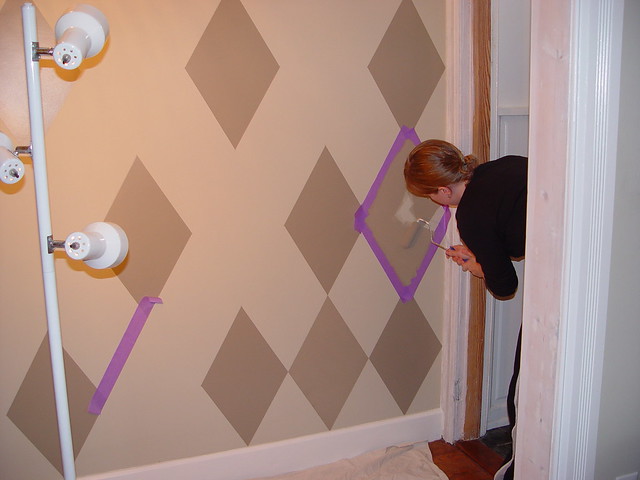
<p>Using the marks from the previous steps, we began taping off the outer borders of the areas that would become the darker diamonds. And, just to be safe, I also placed a small piece of tape in the diamond areas that were supposed to be left as is. The process was tedious and time consuming, I'm not going to lie, but it was far easier since we had the small intersection pencil marks to act as our guide. We were well on our way, and I was well on my way to&nbsp;delirium, as seen from the Vanna White-esque photo below.</p>
<div class="MediaContainer PhotoContainer"><a href="http://farm6.static.flickr.com/5061/5644400432_1ba8d840ac_z.jpg" rel="PhotoPopup" popupwidth="640" popupheight="480"><img alt="" width="500" height="375" style="border: 0px solid;" src="https://farm6.static.flickr.com/5061/5644400432_1ba8d840ac.jpg"></a></div>
<p>Once the taping was complete, we were careful to run our painter's rag covered fingers over the edges of all the tape to ensure the paint wouldn't bleed under the tape. It also helped that we had a very smooth wall from the recent re-plastering that Alex has completed.</p>
<p><strong>5.&nbsp;Paint first set of diamonds with two coats of paint (more if required).</strong></p>
<p>I began rolling on the darker paint, Behr's Brushwood, in a satin finish. This step was smooth sailing, and took little time at all thanks to our diligent prep work.&nbsp;</p>
<div class="MediaContainer PhotoContainer"><a href="http://farm6.static.flickr.com/5063/5643845019_04d4cd5d08_z.jpg" rel="PhotoPopup" popupwidth="480" popupheight="640"><img alt="" width="375" height="500" style="border: 0px solid;" src="https://farm6.static.flickr.com/5063/5643845019_04d4cd5d08.jpg"></a></div>
<p>From the photo above, you can see what I mean by painting only every other diamond on the first go. It's important to note why we taped and painted every other diamond for the first coat. Since the diamonds each intersected with each other, it would have been nearly impossible to adhere the tape in a way that would allow for the intersection of the diamonds and painting in one fell swoop.&nbsp;if we had tried to tape and paint the darker color all at once, we would have had to make a lot of very detailed cuts on the painter's tape to ensure crisp intersected corners. Using this every other approach meant that the tape never ran into another diamond with wet paint.</p>
<p><strong>6.&nbsp;Carefully remove tape and let paint fully dry.</strong></p>
<p>Before the final coat has dried, remove the tape by starting at the end and pulling at a sharp angle away from the diamond. Doing this while the paint is wet will help to prevent you from pulling the paint off with the tape. Remove all of the first set of diamond's paint from the wall and then wait a day or two for the paint to fully dry. The next step will place tape directly on the new paint, and the last thing you want to do it pull the new paint off of the wall.</p>
<p><strong>7. Using already painted diamond borders as a guide, tape the diamonds that are left to paint.</strong></p>
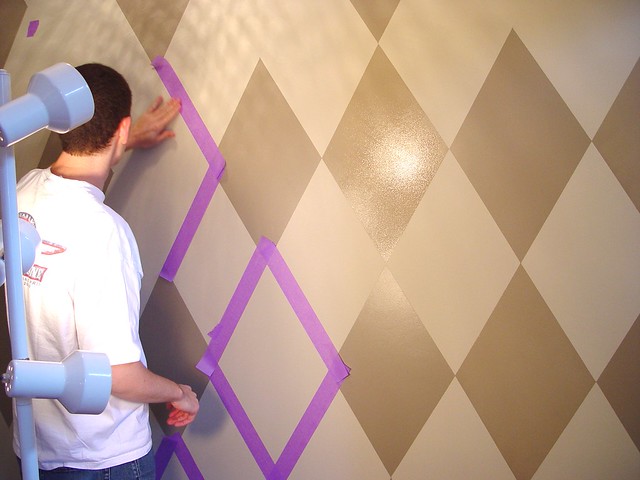
<p>Once the first set of darker diamonds had set up for a day, we began taping the borders of the second set. From the photo below, you can see that Alex was able to use the lines from the first set of diamonds to simply connect one diamond to the next.</p>
<p>
</p>
<div class="MediaContainer PhotoContainer"><a href="http://farm6.static.flickr.com/5230/5835746059_80abb046e6_z.jpg" rel="PhotoPopup" popupheight="480" popupwidth="640"><img alt="" src="https://farm6.static.flickr.com/5230/5835746059_80abb046e6.jpg" width="500" height="375" style="border-width: 0px; border-style: solid;"></a></div>
<p>You can use the painted diamonds as a guide that ensures symmetry between all diamonds on the wall. For this step, having two people work together worked very well.</p>
<p>We were nervous that our tape might pull off the paint on the first set of diamonds, so Alex worked to tape off all of the diamonds, while I followed behind him painting the masked off areas. Once I was done painting a small area, Alex would circle back and carefully remove the paint.</p>
<p><strong>8.&nbsp;Paint second set of diamonds with two coats of paint.</strong></p>
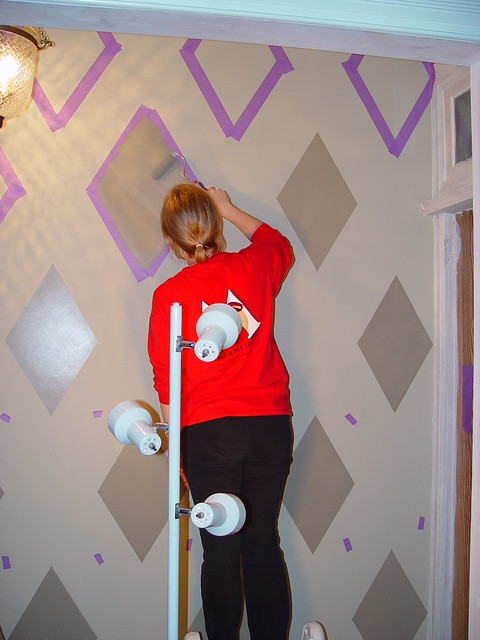
<p>It was so each to use the conveniently placed tape lines to quickly and easily apply the couple coats of paint that was needed. Here I am in the midst of painting the first few second coat diamonds.&nbsp;</p>
<div class="MediaContainer PhotoContainer"><a href="http://farm6.static.flickr.com/5181/5644419484_aa553cd631_z.jpg" rel="PhotoPopup" popupwidth="640" popupheight="480"><img alt="" width="500" height="375" style="border: 0px solid;" src="https://farm6.static.flickr.com/5181/5644419484_aa553cd631.jpg"></a></div>
<p><strong>9. Carefully remove tape.</strong></p>
<p>Careful removal is important here given the somewhat fragile paint from the first set of diamonds. You can see on the photo above that Alex left the tape slightly peeled up at the edges. This allowed him to easily grasp the edge of the tape for removal without scratching the new paint.</p>
<p><strong>10. Touch-ups</strong></p>
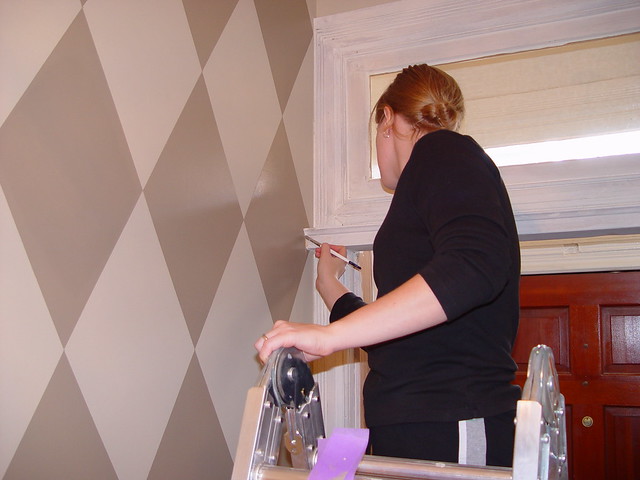
<p>For the harder to reach spots, I used an artist's brush to apply the paint. This let me get right into the corners that were quite hard to reach.</p>
<div class="MediaContainer PhotoContainer"><a href="http://farm6.static.flickr.com/5141/5643855261_24a764c2c6_z.jpg" rel="PhotoPopup" popupwidth="640" popupheight="480"><img alt="" width="500" height="375" style="border: 0px solid;" src="https://farm6.static.flickr.com/5141/5643855261_24a764c2c6.jpg"></a></div>
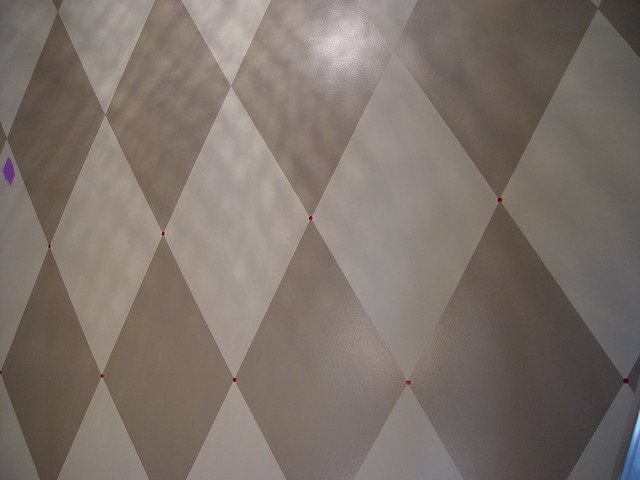
<p><strong>11.&nbsp;Paint dots at the intersection of each diamond to mask the pencil marks.</strong></p>
<p>And this brings us to the final step of the paint treatment: the colored polka dots that overlap the intersection of the diamonds. I still chuckle when I think about the conversation Alex and I had about this, and how differently our minds work. Even though he could figure out all of the math involved in the project, he was totally stumped on how we would paint on the little dots. He was throwing out ideas of custom stencils and other complicated processes, when I looked at him with an "are you stupid glare" and said, "This is a no brainer. We're going to dip a no. 2 pencil eraser in the paint and stamp it on." &nbsp;I mean, duh!&nbsp;</p>
<div class="MediaContainer PhotoContainer"><a href="http://farm6.static.flickr.com/5308/5643856105_9a77144d23_z.jpg" rel="PhotoPopup" popupwidth="640" popupheight="480"><img alt="" width="500" height="375" style="border: 0px solid;" src="https://farm6.static.flickr.com/5308/5643856105_9a77144d23.jpg"></a></div>
<p>Seriously though, it's just another reason why we make a great team. There are so many projects that if working alone, one of us would surely throw in the towel. It's the support from one another and different problem solving methods that help us along the way in our DIY adventures. (Though I may need someone to remind me of this when we start back up on our master bathroom reno.)</p>
<p><strong>12.&nbsp;Enjoy harlequin pattern and a job well done.</strong></p>
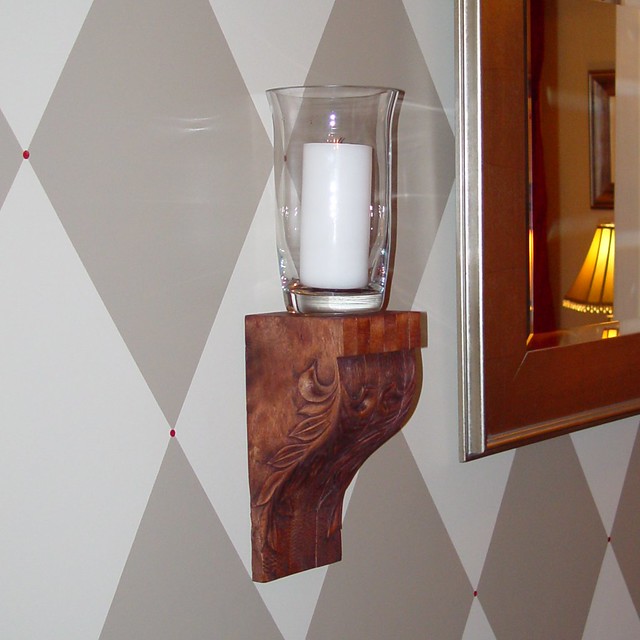
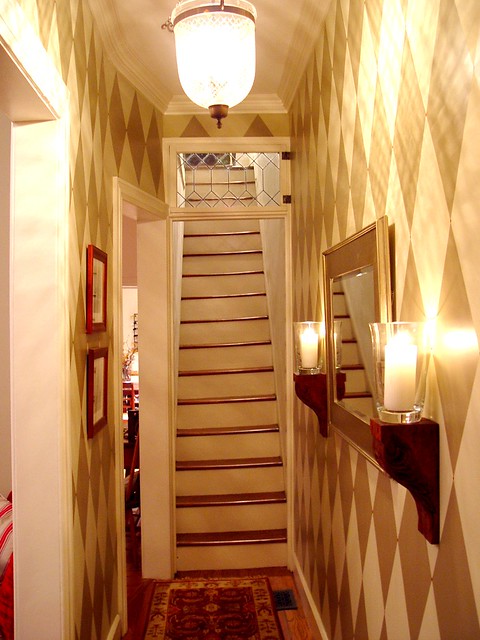
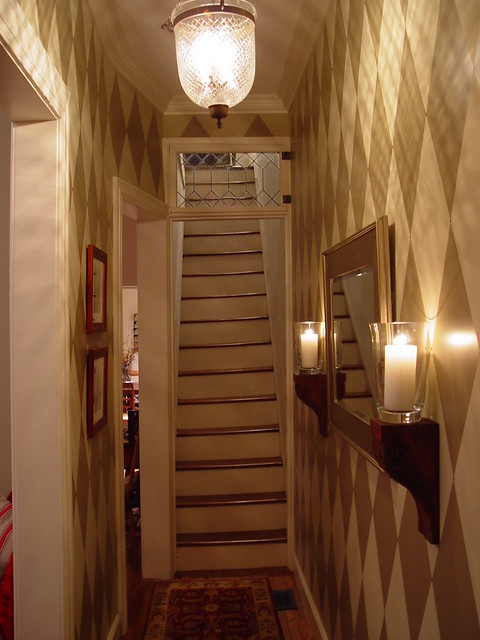
<p>After the paint was complete and my little red dots were dry, we put down a rug won from eBay, hung a mirror and added <a href="http://www.oldtownhome.com/2011/5/23/Corbels-Adding-Interest-Through-Achitectural-Salvage/index.aspx">salvaged wooden corbels as candle holders</a>&nbsp;to round out the look.&nbsp;</p>
<div class="MediaContainer PhotoContainer"><a href="http://farm3.static.flickr.com/2028/5751352736_862da1e385_z.jpg" rel="PhotoPopup" popupwidth="640" popupheight="640"><img alt="" width="500" height="500" style="border: 0px solid;" src="https://farm3.static.flickr.com/2028/5751352736_862da1e385.jpg"></a></div>
<p>Our <a href="http://www.oldtownhome.com/2011/4/29/Our-First-Impression-of-Renovating-This-is-Harder-Than-it-Looks/index.aspx">downstairs hallway</a> has come a long way from the boring and dingy space that it once was. It took months of hard work to get to the point where we were ready to add a snazzy paint treatment, but the effort was well worth it.&nbsp;</p>
<p>
</p>
<div class="MediaContainer PhotoContainer"><a href="http://farm6.static.flickr.com/5104/5833069746_8d526b6892_z.jpg" rel="PhotoPopup" popupheight="640" popupwidth="480"><img alt="" src="https://farm6.static.flickr.com/5104/5833069746_8d526b6892.jpg" width="375" height="500" style="border-width: 0px; border-style: solid;"></a></div>
<p><strong>If I had it to do over again, would I?</strong>&nbsp;Absolutely, but today I might try out a fun&nbsp;Moroccan look or a more modern, graphic pattern. But most importantly, I would never use flat paint again in such a high traffic area. It tends to scuff, and the touch ups we've made don't blend in with the original paint.</p>
<p>Love 'em or hate 'em, these babies make a bold statement when you enter our home. Many people actually mistake them for wallpaper because the lines are so crisp. They're a fun conversation piece and one of the lasting impressions from our home. Years after visiting our house, people often ask us "Are the diamonds still on the wall in your hallway?" They say diamonds are a girl's best friend. I couldn't agree more.</p>
<p>Have you tried any interesting paint treatments in your home? Or done something to make your entryway memorable? We'd love to hear about it.</p><p><a href="https://www.oldtownhome.com/2011/6/10/How-To-Create-a-Harlequin-Paint-Treatment-Diamonds-are-a-Girls-Best-Friend/">Read Full Post</a></p>]]></content>
    <category term="Decorating Tips" />
    <category term="Design" />
    <category term="eBay" />
    <category term="Entry Hall" />
    <category term="Header Image" />
    <category term="How To" />
    <category term="Painting" />
    <category term="Project From The Past" />
    <category term="Projects:Paint" />
    <PostImage>http://farm3.static.flickr.com/2331/5817315698_094b742da4.jpg</PostImage>
    <media:thumbnail url="https://farm3.static.flickr.com/2331/5817315698_094b742da4_t.jpg" />
    <ExtensionElements>
      <Item>PostImage</Item>
      <Item>media:thumbnail</Item>
    </ExtensionElements>
  </entry>
  <entry>
    <guid>b2ccba5d-d7cc-4114-a4d5-bf373d4ea4bd</guid>
    <id>https://www.oldtownhome.com/2011/4/29/Our-First-Impression-of-Renovating-This-is-Harder-Than-it-Looks/</id>
    <title>Our First Impression of Renovating: This is Harder Than it Looks!</title>
    <summary type="html"><![CDATA[<p>We bought our house in January 2003. I started itching to write a blog chronicling our renovation adventures by 2004. Since then, I've bored my co-workers and Facebook friends with details of our follies over the years. It is now 2011 and we finally have our DIY blog up and running. Better late than never, right?</p>
<p>It makes me a little sad that we can't give you real time details of our first projects that we've already completed. Honestly, that is our loss but absolutely your gain, as our projects take FOREVER and now we can recap the interesting bits in a much more efficient manner. Don't worry though, we'll have plenty of other agonizingly long projects to recap. Come to think of it, we're in the middle of two or three as I type this.</p>
<p>The process of blogging about some of our early years' projects is also allowing us to relive some of our fond memories, which is a ton of fun. For instance, last night I said to Wendy, "Can you believe we lived with parchment paper on the stairs and a yellow extension cord running down the stairs for a year?" To which she responded, "I think I hate you." Love is in the air!</p>
<p><a href="/2011/4/27/You-Only-Have-One-Chance-to-Make-a-Good-First-Impression/index.aspx">Yesterday's post</a> covered our enthusiastic and almost giddy rush into the first several days of homeownership. We were excited and ready to take the world by storm renovating houses. We had three full weeks overlap living in our apartment while also working on our empty house. Our plan was to get as much done as we could, move in, fix it up, enjoy it, and move on. Like most first time DIY homeowners with a wreck of a house, we had absolutely no idea what we were getting ourselves into. </p>
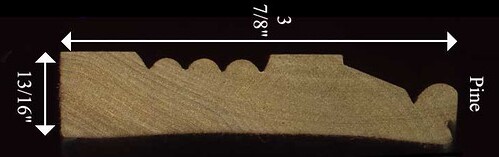
<p>For one, we had made a commitment to strip all of the molding and doors in the house, thinking that would be an easy task. Given the seemingly endless layers of old paint from the last 100+ years, combined with the intricate details of the molding profile, well, it turned out to be a tall task that we are still working on 8+ years later. The picture below shows the profile of the mid-sized molding throughout our house. See the rounded portions and grooves all over the place. Paint just loves to goop and hide there.</p>
<div class="MediaContainer">
<img src="https://farm6.static.flickr.com/5225/5664462534_f66163f1b6.jpg" width="500" height="157" alt="molding"></div>
<p></p></img> <a href="https://www.oldtownhome.com/2011/4/29/Our-First-Impression-of-Renovating-This-is-Harder-Than-it-Looks/">more</a>]]></summary>
    <published>2011-04-29T12:45:00.000-04:00</published>
    <updated>2011-04-29T12:45:00.000-04:00</updated>
    <link rel="alternate" href="https://www.oldtownhome.com/2011/4/29/Our-First-Impression-of-Renovating-This-is-Harder-Than-it-Looks/" />
    <author>
      <name>Alex</name>
    </author>
    <content type="html"><![CDATA[<p>We bought our house in January 2003. I started itching to write a blog chronicling our renovation adventures by 2004. Since then, I've bored my co-workers and Facebook friends with details of our follies over the years. It is now 2011 and we finally have our DIY blog up and running. Better late than never, right?</p>
<p>It makes me a little sad that we can't give you real time details of our first projects that we've already completed. Honestly, that is our loss but absolutely your gain, as our projects take FOREVER and now we can recap the interesting bits in a much more efficient manner. Don't worry though, we'll have plenty of other agonizingly long projects to recap. Come to think of it, we're in the middle of two or three as I type this.</p>
<p>The process of blogging about some of our early years' projects is also allowing us to relive some of our fond memories, which is a ton of fun. For instance, last night I said to Wendy, "Can you believe we lived with parchment paper on the stairs and a yellow extension cord running down the stairs for a year?" To which she responded, "I think I hate you." Love is in the air!</p>
<p><a href="/2011/4/27/You-Only-Have-One-Chance-to-Make-a-Good-First-Impression/index.aspx">Yesterday's post</a> covered our enthusiastic and almost giddy rush into the first several days of homeownership. We were excited and ready to take the world by storm renovating houses. We had three full weeks overlap living in our apartment while also working on our empty house. Our plan was to get as much done as we could, move in, fix it up, enjoy it, and move on. Like most first time DIY homeowners with a wreck of a house, we had absolutely no idea what we were getting ourselves into. </p>
<p>For one, we had made a commitment to strip all of the molding and doors in the house, thinking that would be an easy task. Given the seemingly endless layers of old paint from the last 100+ years, combined with the intricate details of the molding profile, well, it turned out to be a tall task that we are still working on 8+ years later. The picture below shows the profile of the mid-sized molding throughout our house. See the rounded portions and grooves all over the place. Paint just loves to goop and hide there.</p>
<div class="MediaContainer">
<img src="https://farm6.static.flickr.com/5225/5664462534_f66163f1b6.jpg" width="500" height="157" alt="molding"></div>
<p></p>
<p>Due to the paint stripping, the cracked walls, the need to re-plaster, the pull chain light, other projects, life, and the fact that we tackle many projects at once in spite of our understanding that we really shouldn't, the work on the entry hallway and stairs started in January 2003 and didn't wrap up until January 2005. That's a full 2 years for those of you scoring at home. Technically, if you count the fact that the entry vestibule isn't done, and I have a few items I'd still like to change on the hall, this project has actually taken longer to complete than our blog took to launch.</p>
<p>Once we had the carpet off of the stairs, and the stair treads refinished, we eventually shifted our focus back to the task at hand, and it was time for me to start stripping all of the molding I was talking about. And there sure was a lot of it.</p>
<p>Please note the pull string light, caked up paint job on the inoperable transom window, and the huge amount of work ahead. At least the transom glass was original and wavy. (Something I've yet to share: I heart wavy glass.)</p>
<div class="MediaContainer PhotoContainer">
<a href="http://farm6.static.flickr.com/5261/5643626657_a00c8d273b_z.jpg" rel="PhotoPopup"><img src="https://farm6.static.flickr.com/5261/5643626657_a00c8d273b.jpg" width="500" height="375" alt="o_1859"></a>
</div>
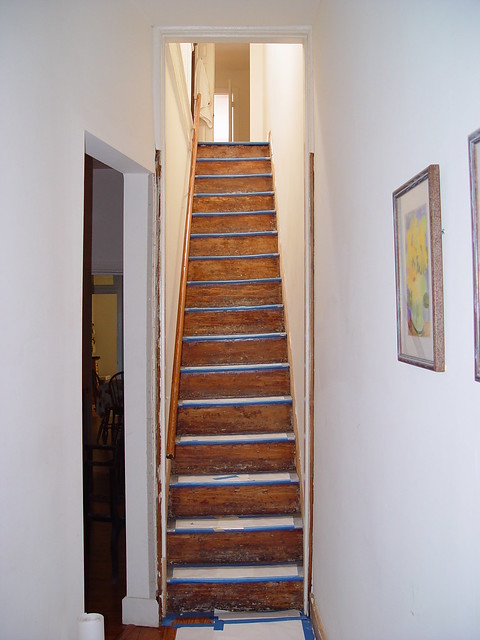
<p>This was our view up the stairs after the baseboards were stripped. You can see the paper on the stairs that I mentioned earlier. Yeah, I think it was actually on there for a full year. Also note the odd lack of molding around the doorway into the dining room. Something about this wide open space, giant doorway, and lack of molding was just plain wrong and boring...so we decided to fix it.</p>
<div class="MediaContainer PhotoContainer">
<a href="http://farm6.static.flickr.com/5224/5643626179_0ed41f6695_z.jpg" rel="PhotoPopup"><img src="https://farm6.static.flickr.com/5224/5643626179_0ed41f6695.jpg" width="375" height="500" alt="o_1858"></a>
</div>
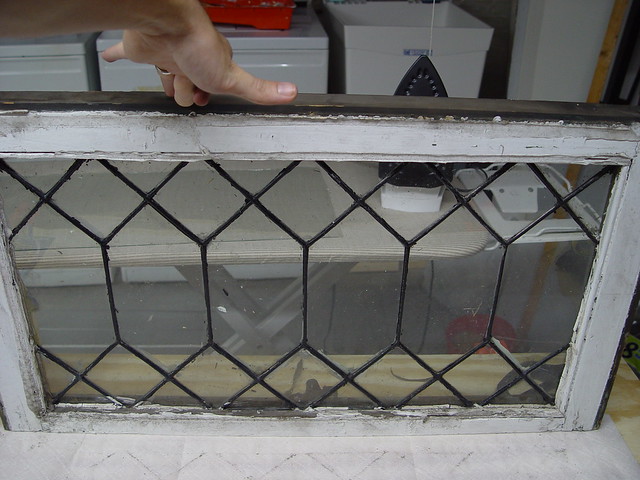
<p>To correct this issue we turned to something that will undoubtedly become a theme on this blog, eBay.com. We found a wonderful leaded wavy glass window for about $30 (+5$ shipping). As you can see from the photo, it was in rough shape. The leading had been painted black at some point, someone had put silicon caulk around the perimeter of the glass for some reason, and the sash was falling apart.</p>
<div class="MediaContainer PhotoContainer">
<a href="http://farm6.static.flickr.com/5069/5643646193_7884cf9d01_z.jpg" rel="PhotoPopup"><img src="https://farm6.static.flickr.com/5069/5643646193_7884cf9d01.jpg" width="500" height="375" alt="o_1954"></a>
</div>
<p>I took it all apart, spent many hours cleaning it up with a razor and steel wool, and the end result was decent and fits nicely with our old house. That is one thing we learned right off the bat, if your work is close to perfect in an old house, it looks out of place. We really don't have a straight line or 90 degree angle in the house, so why start now?</p>
<div class="MediaContainer PhotoContainer">
<a href="http://farm6.static.flickr.com/5308/5643655593_c0d090275f_z.jpg" rel="PhotoPopup"><img src="https://farm6.static.flickr.com/5308/5643655593_c0d090275f.jpg" width="375" height="500" alt="o_1921"></a>
</div>
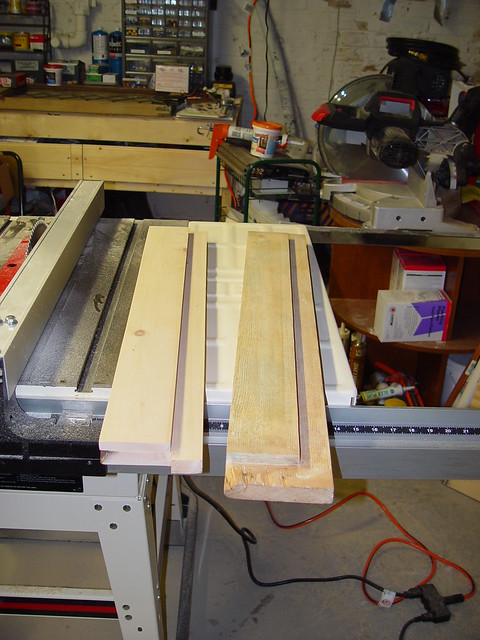
<p>Next up, we made a new piece of jamb to match the thickness and dimension of the old one (I've gotten a lot better at this now).</p>
<div class="MediaContainer PhotoContainer">
<a href="http://farm6.static.flickr.com/5261/5644256294_e7ca3b416f_z.jpg" rel="PhotoPopup"><img src="https://farm6.static.flickr.com/5261/5644256294_e7ca3b416f.jpg" width="375" height="500" alt="o_1987"></a>
</div>
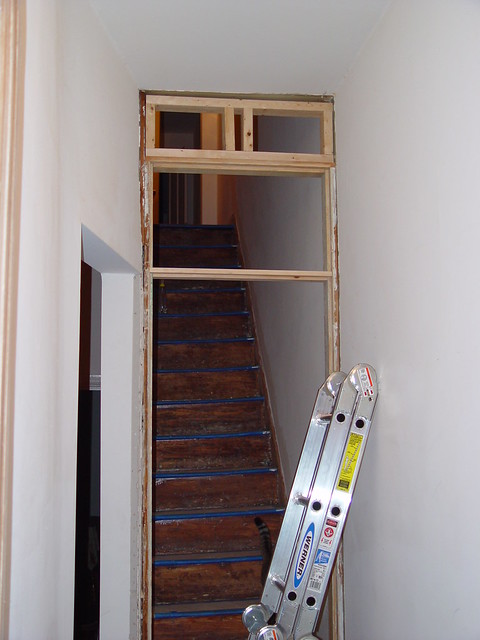
<p>We then framed up a bit of an actual wall, and the opening for the soon to be installed transom window. This is one of those times where doing it "right" looked wrong. When I installed the transom ledge perfectly level, the leaning stairs made it look horrible. I actually had to lower the left side of the ledge to take it out of level and therefore make it look like it had always been there. Isn't that what they call character?</p>
<div class="MediaContainer PhotoContainer">
<a href="http://farm6.static.flickr.com/5184/5643689717_8b30dd9824_z.jpg" rel="PhotoPopup"><img src="https://farm6.static.flickr.com/5184/5643689717_8b30dd9824.jpg" width="375" height="500" alt="o_1989"></a>
</div>
<p>Here is the test fit of the transom in it's place. The main reason I used this photo was to highlight the infamous extension cord that we all grew to love. You can also see that I installed a door jamb in the doorway to the dining room so that we could put in a door casing so it wouldn't look so out of place.</p>
<div class="MediaContainer PhotoContainer">
<a href="http://farm6.static.flickr.com/5188/5643807441_8e959e7fdc_z.jpg" rel="PhotoPopup"><img src="https://farm6.static.flickr.com/5188/5643807441_8e959e7fdc.jpg" width="500" height="375" alt="o_2087"></a>
</div>
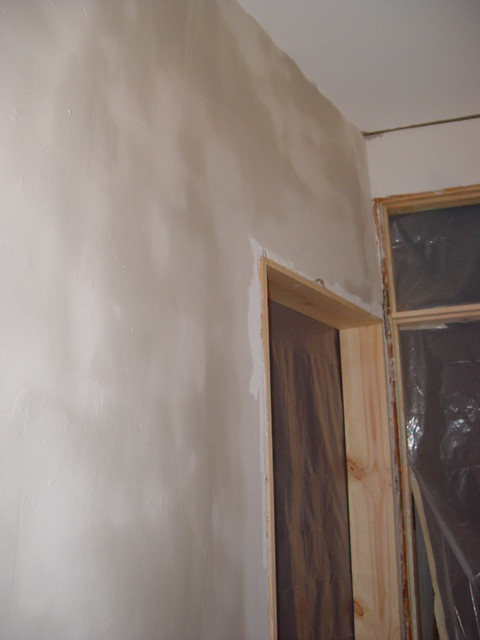
<p>After this, we focused on fixing all of the cracks and "re-plastering" the walls. I'll get much more into the plastering techniques we've adopted over the years in future posts. It has gone through several iterations, but this was our first attempt at it. Let's just say that there has been a lot of mud, dust, sanding, and swearing along the way.</p>
<div class="MediaContainer PhotoContainer">
<a href="http://farm6.static.flickr.com/5263/5644290712_a3aae97dcf_z.jpg" rel="PhotoPopup"><img src="https://farm6.static.flickr.com/5263/5644290712_a3aae97dcf.jpg" width="375" height="500" alt="o_2039"></a>
</div>
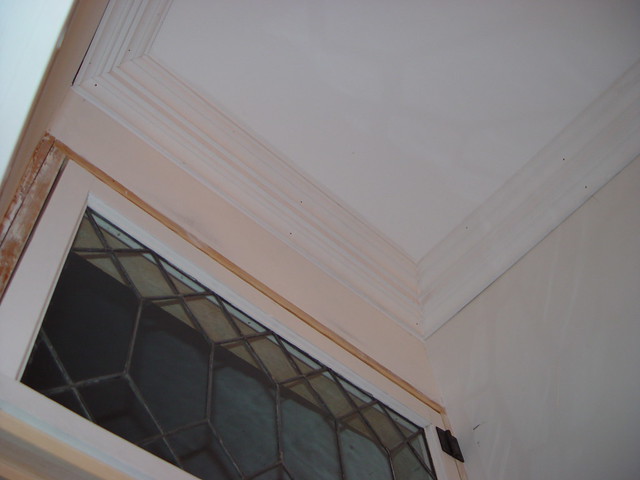
<p>We opted for a somewhat substantial crown molding for the hallway, and a matching but slightly smaller profile for the upstairs hall. The first floor ceilings are 10', so a heftier crown just looked more at home. Also in this photo, you can see the hinges we used for the transom. To this day, the side hinged transom frustrates me. This was back when we were noobs, and we were following the lead of another transom in the house with incorrectly placed hinges. At some point, I'll change this.</p>
<div class="MediaContainer PhotoContainer">
<a href="http://farm6.static.flickr.com/5264/5643820321_9f561a33bc_z.jpg" rel="PhotoPopup"><img src="https://farm6.static.flickr.com/5264/5643820321_9f561a33bc.jpg" width="500" height="375" alt="o_2096"></a>
</div>
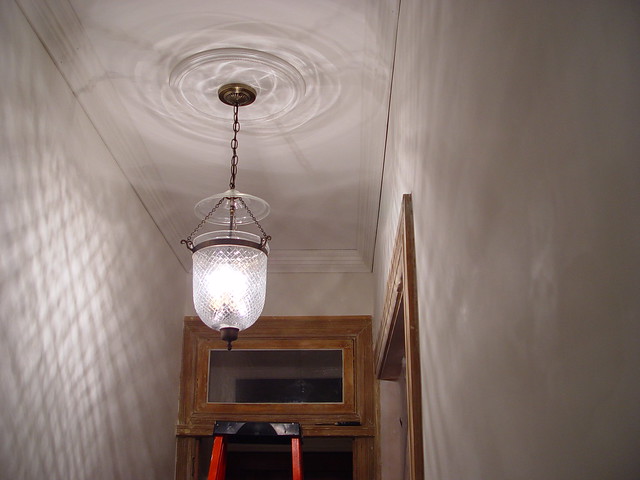
<p>We searched and searched for a light fixture for this hall, and I had it in my head that we HAD to have a glass bell hundi lantern. I wanted an antique one so badly, but they are quite <a href="http://www.eronjohnsonantiques.com/dynapage/PP040808.htm" target="_blank">expensive</a>, and were way out of our price range. This was also well before they were popular in mail order catalogs, so we just kept our eyes open. We spent our first anniversary in St. Michaels, Maryland, and Wendy spotted an etched glass hanging bell candle holder in a store window. It was not a lamp and wasn't electrified, but she looked at me with her knowing glance and said, "Can you make that into a light for us?" I cannibalized the old, hideous, brass lamp from the hall, added a little spray paint and some new wires. The end result, for under $200, is what you see below.</p>
<div class="MediaContainer PhotoContainer">
<a href="http://farm6.static.flickr.com/5185/5643819949_8d0bb8a52e_z.jpg" rel="PhotoPopup"><img src="https://farm6.static.flickr.com/5185/5643819949_8d0bb8a52e.jpg" width="500" height="375" alt="o_2095"></a>
</div>
<p>The light is honestly one of my favorite things in the house, and something we will absolutely be taking with us if we ever move. We also added a small plaster veneer ceiling medallion for good measure.</p>
<p>With the light hung, molding stripped, and the walls crack free and smooth as can be, we turned our attention to painting the hall. With the diamond shaped etched glass hanging lamp casting little diamond shadows on the wall, and the diamond like shapes in the new transom, Wendy thought it appropriate to do a two-tone diamond harlequin pattern. She felt it would give the entry that wow factor right when you walked into the house. Here Wendy is working on completing the pattern. We'll cover exactly how you can achieve something similar in a future post.</p>
<div class="MediaContainer PhotoContainer">
<a href="http://farm6.static.flickr.com/5181/5644419484_aa553cd631_z.jpg" rel="PhotoPopup"><img src="https://farm6.static.flickr.com/5181/5644419484_aa553cd631.jpg" width="500" height="375" alt="o_2157"></a>
</div>
<p>With the light hung, transom installed, new door casing, and walls painted, the hall was taking shape. The photo below gives you a decent side by side before and after. The dates listed are 100% accurate (before photo is of the previous owner's lovely decor) and are part of the reason why my wife has a perfectly reasonable excuse to loathe <del>me</del> long projects. Our end result is my chance at redemption.</p>
<div class="MediaContainer PhotoContainer">
<a href="http://farm6.static.flickr.com/5225/5644520244_53f7f20c91_z.jpg" rel="PhotoPopup"><img src="https://farm6.static.flickr.com/5225/5644520244_53f7f20c91.jpg" width="500" height="354" alt="o_2313"></a>
</div>
<p>We still had a ways to go until the new handrail on the stairs completed the project, but I'll cover that one in my next post. </p>
<p>So there you have it. My long winded detailed summary of a project that we started on day one. It may have taken way longer than expected, but I hope you'll agree that the end results were worth the blood, sweat and tears.</p>
<div class="MediaContainer PhotoContainer">
<a href="http://farm6.static.flickr.com/5265/5644095185_4924668aac_z.jpg" rel="PhotoPopup"><img src="https://farm6.static.flickr.com/5265/5644095185_4924668aac.jpg" width="375" height="500" alt="o_2440"></a>
</div>
<p>Now that I've come clean with our (first) never ending project, why don't you share some of your stories? Who has a partner than easily exceeds their time estimates by 10x, or constantly says it'll be done in 2 more weeks? </p><p><a href="https://www.oldtownhome.com/2011/4/29/Our-First-Impression-of-Renovating-This-is-Harder-Than-it-Looks/">Read Full Post</a></p>]]></content>
    <category term="eBay" />
    <category term="Entry Hall" />
    <category term="Entryway" />
    <category term="Paint Removal" />
    <category term="Project From The Past" />
    <category term="Stairs" />
    <PostImage>http://farm6.static.flickr.com/5265/5644095185_4924668aac.jpg</PostImage>
    <media:thumbnail url="https://farm6.static.flickr.com/5265/5644095185_4924668aac_t.jpg" />
    <ExtensionElements>
      <Item>PostImage</Item>
      <Item>media:thumbnail</Item>
    </ExtensionElements>
  </entry>
  <entry>
    <guid>2684dbaa-35d6-4e3e-89b0-d78a498ec8a8</guid>
    <id>https://www.oldtownhome.com/2011/4/28/You-Only-Have-One-Chance-to-Make-a-Good-First-Impression/</id>
    <title>You Only Have One Chance to Make a Good First Impression</title>
    <summary type="html"><![CDATA[<p style="text-align: left;">And our house was blowing it. Big time.&nbsp;<br>
<br>
Since this is the first week for our blog, we wanted to look back at a project that we tackled during our first week of home ownership that we feel made a significant impact on our home and how people were introduced to it. No better post for our first "Project From the Past" than to fill you all in on the work we started on the first day we owned the house. We were young and innocent (and our budget was essentially $0), so we had to make the biggest impact for the least amount of money.<br>
<br>
Since our house is only 15 feet wide, when a guest walks in through the front door they are immediately greeted by an entry hall and a view straight back through the house and up the staircase.&nbsp;You may recall a photo of our entryway from a post earlier this week containing <a href="http://www.oldtownhome.com/2011/4/25/Lets-Start-at-the-Very-Beginning/index.aspx">photos of our home inspection</a>. Here is a slightly better perspective of the unsightly view our guests were greeted with as soon as the front door opened.&nbsp;&nbsp;</p><div class="MediaContainer">
<a href="http://www.flickr.com/photos/11540307@N05/5663709410/" title="o_1008 by OldTownHome, on Flickr"><img src="https://farm6.static.flickr.com/5104/5663709410_0aee924f86.jpg" width="375" height="500" alt="o_1008" style="border-width: 0px;border-style: solid;"></a>
</div><p style="text-align: left;">Ick. Make that a double ick. From the "too tight of a squeeze" opening into the house, to the nasty pull chain light, all the way down&nbsp;to the filthy carpet on the stairs, our home was a creepy old man sporting a pocket protector and a bad toupee. And something needed to be done about it, pronto.<br>
<br>
No sooner had we finalized the paperwork making it officially ours, we arrived at our new home, ready to make a dent in the ugliness that enveloped the property. We actually settled about two blocks from our house and had parked our car just outside our new front door, full of tools and ready to go.&nbsp;</p><p style="text-align: left;">The toupee, a.k.a. bad rug, was first up on our list. Armed with a hammer and prybar (details on these tools can be found in this <a href="http://www.oldtownhome.com/2011/4/26/Toolbox-Tuesday-Three-Must-Haves-for-Any-Toolbox/index.aspx">blog post</a>), we quickly got to work ripping, pulling, and tearing up the rug and tack strips below. Despite the rough state, we knew we had a diamond in the rough, just waiting to be polished up.&nbsp;</p><div class="MediaContainer"><a href="http://www.flickr.com/photos/11540307@N05/5643387802/"><img width="500" height="375" style="border:0px solid; border-image: initial;" alt="o_1056" src="https://farm6.static.flickr.com/5108/5643387802_c3eb682251.jpg"></a> </div><div class="MediaContainer"><a href="http://www.flickr.com/photos/11540307@N05/5643388660/"><img width="375" height="500" style="border:0px solid; border-image: initial;" alt="o_1060" src="https://farm6.static.flickr.com/5264/5643388660_28cb77cc25.jpg"></a> </div><p>
</p><div class="MediaContainer"><a href="http://www.flickr.com/photos/11540307@N05/5642819291/"><img width="375" height="500" style="border:0px solid; border-image: initial;" alt="o_1062" src="https://farm6.static.flickr.com/5147/5642819291_c0d3efc14f.jpg"></a> </div><div class="MediaContainer"><a href="http://www.flickr.com/photos/11540307@N05/5643397134/"><img width="375" height="500" style="border:0px solid; border-image: initial;" alt="o_1096" src="https://farm6.static.flickr.com/5225/5643397134_76805e0d23.jpg"></a> </div><p>After applying the paste, the next step is to cover the paste with laminated paper (included), that is left on until the paint beneath it dissolves. If you run out of the paper, you can also use a standard roll of wax paper. The laminated paper is then removed with the bulk of the paste and paint adhering to it, and the stripped surface is washed clean. <br>
<br>
</p><div class="MediaContainer"><a href="http://www.flickr.com/photos/11540307@N05/5642837657/"><img width="500" height="375" style="border:0px solid; border-image: initial;" alt="o_1132" src="https://farm6.static.flickr.com/5186/5642837657_c04915e3e9.jpg"></a> </div><div class="MediaContainer"><a href="http://www.flickr.com/photos/11540307@N05/5642837769/"><img width="375" height="500" style="border:0px solid; border-image: initial;" alt="o_1133" src="https://farm6.static.flickr.com/5070/5642837769_288ddd0fff.jpg"></a> </div><p>We'll summarize it all in&nbsp;subsequent posts, as well as additional details on how you can accomplish similar projects in your own home. Do you think our first few hours and days of homeownership were spent wisely? Perhaps there's something you've done to improve the entryway of your home? Please share your tips and projects. We'd love to hear them. </p> <a href="https://www.oldtownhome.com/2011/4/28/You-Only-Have-One-Chance-to-Make-a-Good-First-Impression/">more</a>]]></summary>
    <published>2011-04-28T10:32:00.000-04:00</published>
    <updated>2011-04-28T10:32:00.000-04:00</updated>
    <link rel="alternate" href="https://www.oldtownhome.com/2011/4/28/You-Only-Have-One-Chance-to-Make-a-Good-First-Impression/" />
    <author>
      <name>Wendy &amp; Alex</name>
    </author>
    <content type="html"><![CDATA[<p style="text-align: left;">And our house was blowing it. Big time.&nbsp;<br>
<br>
Since this is the first week for our blog, we wanted to look back at a project that we tackled during our first week of home ownership that we feel made a significant impact on our home and how people were introduced to it. No better post for our first "Project From the Past" than to fill you all in on the work we started on the first day we owned the house. We were young and innocent (and our budget was essentially $0), so we had to make the biggest impact for the least amount of money.<br>
<br>
Since our house is only 15 feet wide, when a guest walks in through the front door they are immediately greeted by an entry hall and a view straight back through the house and up the staircase.&nbsp;You may recall a photo of our entryway from a post earlier this week containing <a href="http://www.oldtownhome.com/2011/4/25/Lets-Start-at-the-Very-Beginning/index.aspx">photos of our home inspection</a>. Here is a slightly better perspective of the unsightly view our guests were greeted with as soon as the front door opened.&nbsp;&nbsp;</p>
<div class="MediaContainer">
<a href="http://www.flickr.com/photos/11540307@N05/5663709410/" title="o_1008 by OldTownHome, on Flickr"><img src="https://farm6.static.flickr.com/5104/5663709410_0aee924f86.jpg" width="375" height="500" alt="o_1008" style="border-width: 0px;border-style: solid;"></a>
</div>
<p style="text-align: left;">Ick. Make that a double ick. From the "too tight of a squeeze" opening into the house, to the nasty pull chain light, all the way down&nbsp;to the filthy carpet on the stairs, our home was a creepy old man sporting a pocket protector and a bad toupee. And something needed to be done about it, pronto.<br>
<br>
No sooner had we finalized the paperwork making it officially ours, we arrived at our new home, ready to make a dent in the ugliness that enveloped the property. We actually settled about two blocks from our house and had parked our car just outside our new front door, full of tools and ready to go.&nbsp;</p>
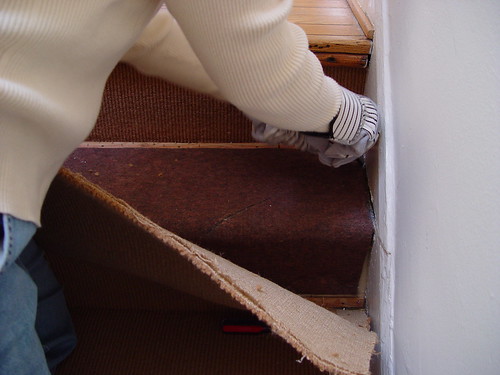
<p style="text-align: left;">The toupee, a.k.a. bad rug, was first up on our list. Armed with a hammer and prybar (details on these tools can be found in this <a href="http://www.oldtownhome.com/2011/4/26/Toolbox-Tuesday-Three-Must-Haves-for-Any-Toolbox/index.aspx">blog post</a>), we quickly got to work ripping, pulling, and tearing up the rug and tack strips below. Despite the rough state, we knew we had a diamond in the rough, just waiting to be polished up.&nbsp;</p>
<div class="MediaContainer"><a href="http://www.flickr.com/photos/11540307@N05/5643387802/"><img width="500" height="375" style="border:0px solid; border-image: initial;" alt="o_1056" src="https://farm6.static.flickr.com/5108/5643387802_c3eb682251.jpg"></a> </div>
<br>
<br>
<div class="MediaContainer"><a href="http://www.flickr.com/photos/11540307@N05/5643388660/"><img width="375" height="500" style="border:0px solid; border-image: initial;" alt="o_1060" src="https://farm6.static.flickr.com/5264/5643388660_28cb77cc25.jpg"></a> </div>
<br>
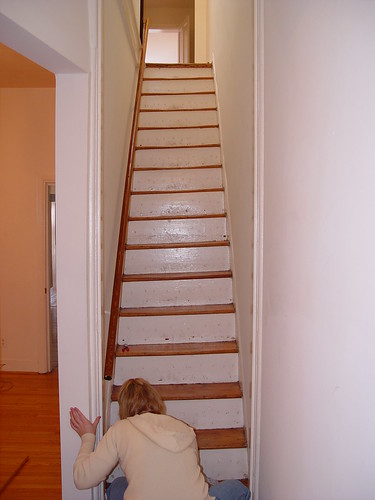
Once the rug and tack strips were removed, the next step was to turn our attention to the scuffed, lumpy paint on the stair risers.&nbsp;
<p>
</p>
<div class="MediaContainer"><a href="http://www.flickr.com/photos/11540307@N05/5642819291/"><img width="375" height="500" style="border:0px solid; border-image: initial;" alt="o_1062" src="https://farm6.static.flickr.com/5147/5642819291_c0d3efc14f.jpg"></a> </div>
<br>
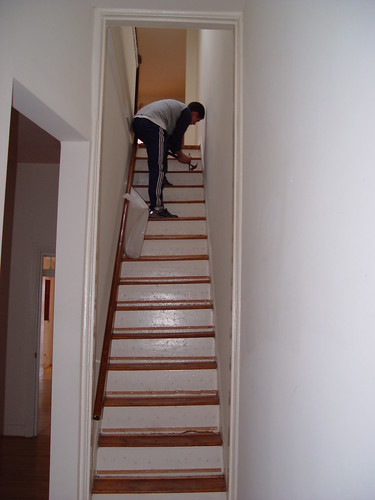
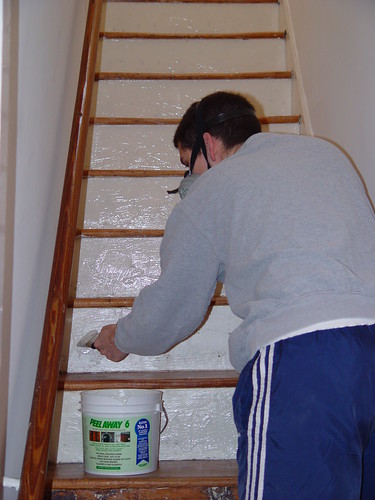
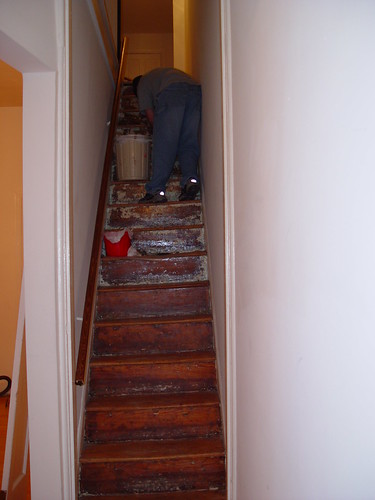
An inexpensive lead test from Home Depot soon revealed what we feared we'd find -- lead paint. Lead abatement is something you don't want to mess around with, and many people call in the professionals. For those that opt to do it themselves, there is a great product on the market for&nbsp;environmentally safe&nbsp;removal of lead-based paint. The product, PEEL AWAY, comes in several "strengths" and, depending on the strength, resembles anything from a thick slime to a cake frosting-like paste that you spread over the surface of what you're stripping.<br>
<br>
<div class="MediaContainer"><a href="http://www.flickr.com/photos/11540307@N05/5643397134/"><img width="375" height="500" style="border:0px solid; border-image: initial;" alt="o_1096" src="https://farm6.static.flickr.com/5225/5643397134_76805e0d23.jpg"></a> </div>
<br>
As you can see, we used Peel Away 6 for this project, because that was what was available at the store and we were Old House newbies. Since then, we've used Peel Away 7, which is a bit stronger but doesn't discolor the wood, as well as Peel Away 1, which is amazing stuff but you have neutralize it after the paint if off, and you must repaint when finished because of how it leaves the wood looking.&nbsp;
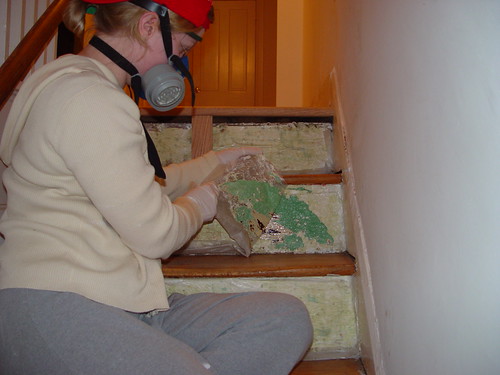
<p>After applying the paste, the next step is to cover the paste with laminated paper (included), that is left on until the paint beneath it dissolves. If you run out of the paper, you can also use a standard roll of wax paper. The laminated paper is then removed with the bulk of the paste and paint adhering to it, and the stripped surface is washed clean. <br>
<br>
</p>
<div class="MediaContainer"><a href="http://www.flickr.com/photos/11540307@N05/5642837657/"><img width="500" height="375" style="border:0px solid; border-image: initial;" alt="o_1132" src="https://farm6.static.flickr.com/5186/5642837657_c04915e3e9.jpg"></a> </div>
<br>
This process prevents lead dust and fumes from becoming airborne, as they would with a heat gun or when sanding, because the paint is kept in a moist state. (For anyone interested, here's <a href="http://www.dumondchemicals.com/html/peelaway2.htm#1">more on the PEEL AWAY system </a>from the manufacturer.) Even so, we were nervous about the prospect of working with lead-based paint, and after Alex&nbsp;had worked in a high lead environment in high school,&nbsp;we weren't willing to take any chances (as seen from the respirators we're sporting in the pictures above). Overkill, maybe. But it made my mom sleep better at night.<br>
<br>
<div class="MediaContainer"><a href="http://www.flickr.com/photos/11540307@N05/5642837769/"><img width="375" height="500" style="border:0px solid; border-image: initial;" alt="o_1133" src="https://farm6.static.flickr.com/5070/5642837769_288ddd0fff.jpg"></a> </div>
<br>
After the paint was safely removed, we allowed the professionals in. (A rare occurrence over the last eight years.) While we had our hardwood floors fixed and refinished, we also had the treads of the stairs redone as well, to bring back the luster of the original heart pine. Our contractor was Richard's Flooring, who we've since had back for a quick repair job. Unfortunately they don't work in the D.C. area anymore, but they are a really great family-owned company. Special thanks to Morrison for his work on this project.<br>
<br>
We were well on our way to a more welcoming entryway, but the work was just beginning to get to a point where our home would start to make a good first impression. <br>
<br>
This was our first week on the job, and we had a lot of items still ahead:
<ul>
    <li>Strip baseboards.</li>
    <li>Priming and painting the newly stripped risers. </li>
    <li>Replaster stairwell walls.</li>
    <li>Coming up with an alternative for the existing handrail. Although semi-functional, our handrail just wasn't working for us. For one, it was installed in such a way that it was imposing in the already narrow space and often caught pant legs on the way down the stairs. Secondly, well, it was ugly. </li>
    <li>Adding visual interest to the stairwell via a salvaged leaded glass window. </li>
    <li>Renovating the downstairs hallway, to include stripping and repainting the orginal molding, replastering the walls and ceiling, adding crown molding, and the completion of a hand-done harlequin paint treatment. </li>
</ul>
<p>We'll summarize it all in&nbsp;subsequent posts, as well as additional details on how you can accomplish similar projects in your own home. Do you think our first few hours and days of homeownership were spent wisely? Perhaps there's something you've done to improve the entryway of your home? Please share your tips and projects. We'd love to hear them. </p><p><a href="https://www.oldtownhome.com/2011/4/28/You-Only-Have-One-Chance-to-Make-a-Good-First-Impression/">Read Full Post</a></p>]]></content>
    <category term="Entry Hall" />
    <category term="Entryway" />
    <category term="Paint Removal" />
    <category term="Project From The Past" />
    <category term="Projects:Home Improvement" />
    <category term="Stairs" />
    <PostImage>http://farm6.static.flickr.com/5104/5663709410_0aee924f86.jpg</PostImage>
    <media:thumbnail url="https://farm6.static.flickr.com/5104/5663709410_0aee924f86_t.jpg" />
    <ExtensionElements>
      <Item>PostImage</Item>
      <Item>media:thumbnail</Item>
    </ExtensionElements>
  </entry>
</feed>